NSK, NTN, Koyo Bearing Numbers: Suffix Codes and Equivalents
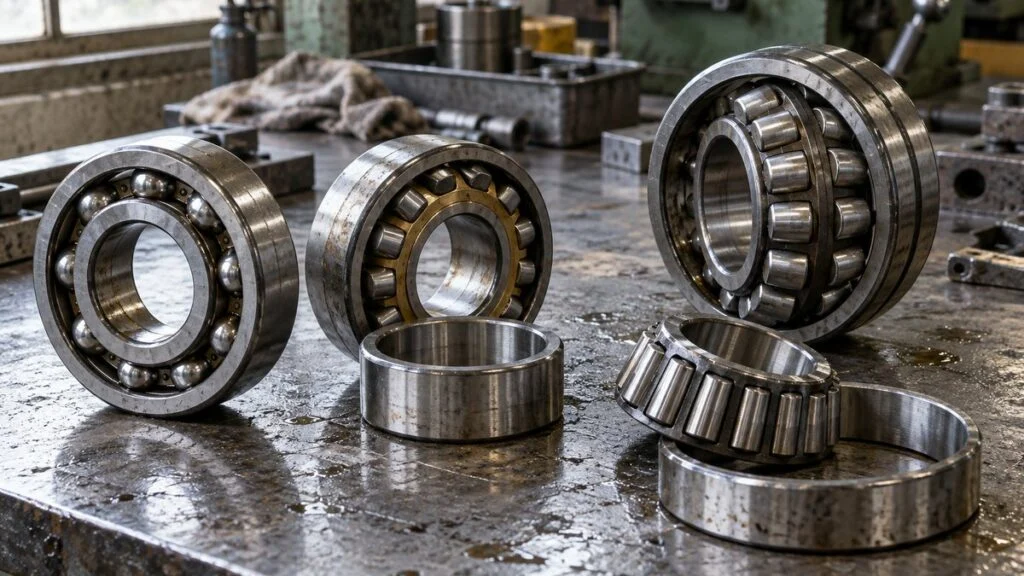
The spare-parts list for a Japanese machine says "NSK 6308ZZC3" for the drive end and "NTN 7210 DB P5" for the spindle. Your local distributor stocks a different brand, and the counter clerk asks which suffixes actually matter. On parts lists from Japanese machine builders, the bearing number is often the only specification you get, so you need to read every letter of it.
The short answer: the basic number (for example, 6308 or 7210) follows an international system and means the same bearing size and type at NSK, NTN, and JTEKT (Koyo). The letters after it do not. Seal, cage, and contact-angle codes are each maker's own, and the same feature can carry three different codes. Clearance and tolerance codes (C3, P5) are largely shared.
This guide shows how the basic number is built, compares the suffix codes from the three makers' English catalogs side by side, and ends with a checklist and an inquiry template you can use before ordering a substitute.
Contents
- Why the Basic Number Is Shared but the Suffixes Are Not
- How to Read the Basic Number
- Suffix Codes Compared: NSK, NTN, and JTEKT (Koyo)
- Tapered Roller Bearings: Metric and Inch Numbers
- Same Number, Different Ratings: Check Before You Substitute
- What to Match When Choosing an Equivalent
- Questions to Send the Japanese Machine Builder
- Where This Guide Does Not Apply
- FAQ
- Sources
Why the Basic Number Is Shared but the Suffixes Are Not
Rolling bearing boundary dimensions (bore, outside diameter, width, and chamfer) are standardized internationally in ISO 15, and Japan adopts them in JIS B 1512. The designation scheme for these standard bearings is set in JIS B 1513, the Japanese standard for bearing numbers, called yobi bango (呼び番号) on Japanese drawings. NSK and JTEKT state in their catalogs that the numbers of their standard bearings follow JIS B 1513, and NTN's catalog describes the same structure of a basic number followed by supplementary codes.
The same catalogs also say each maker adds its own supplementary codes beyond what JIS defines, and that is where brands diverge. The result is a two-part number:
- Basic number: bearing type, dimension series, and bore code (plus contact angle for angular contact bearings). This tells you the envelope size.
- Supplementary codes: seals or shields, cage, internal clearance, tolerance class, matched arrangement, preload, heat stabilization, grease, and special features. These can be prefixes or suffixes, depending on the maker.
Matching the basic number gets you a bearing that fits the shaft and housing. Matching the supplementary codes gets you one that behaves the same way in the machine.
How to Read the Basic Number
Take NSK's own catalog example, 6308ZZC3. Read it from left to right: "6" is the bearing type, "3" is the diameter series, "08" is the bore code, and everything after that is supplementary.
Two catalog examples. The first four characters fix the size; the rest describe the variant.
Examples from the NSK Rolling Bearings catalog (CAT. E1102) and the JTEKT Ball & Roller Bearings catalog (CAT. B2001E).
Bearing Series Codes
The first digits or letters identify the type and the dimension series. The table lists the series you are most likely to see on a Japanese parts list, taken from NSK's series table. NTN and JTEKT use the same codes for these standard bearings.
The series code also tells you which load directions the bearing is designed for.
Series codes from NSK Table 6.5/6.6 and NTN's numbering guide; load characteristics from NTN and JTEKT technical sections. Some width-series digits are omitted in the printed number (for example, 62 is width series 0 + diameter series 2).
Ball bearings touch the raceway at a point, roller bearings along a line. That is why ball types win on speed, quietness, and low torque, while roller types carry more load and deflect less. JTEKT's technical guide ranks radial load capacity at the same bore, from lowest to highest, as deep groove ball, angular contact ball, cylindrical roller, tapered roller, and spherical roller. If the parts list calls for a roller bearing, do not replace it with a ball bearing of the same envelope; it was likely chosen for load.
Bore Codes
The last two digits of the basic number give the bore. From 04 to 96, multiply by 5. Below that, four codes are fixed values, and odd sizes use a slash.
Same rule at NSK, NTN, and JTEKT.
From the bore-number columns in the NSK, JTEKT, and NTN catalogs. Tapered roller bearings in the ISO 355 series and inch-series tapered roller bearings use different schemes (see below).
Suffix Codes Compared: NSK, NTN, and JTEKT (Koyo)
The table below lists only codes that appear in each maker's English catalog or numbering guide. JTEKT sells bearings under the Koyo brand, so Japanese parts lists may show either name. A dash means we did not find a matching code in that maker's English material, not that the feature is unavailable.
Highlighted rows are where the same feature carries different codes.
Sources: NSK Rolling Bearings CAT. E1102, Table 6.6; NTN Numbering System Quick Reference Guide CAT. A-22NTNQREF; JTEKT Ball & Roller Bearings CAT. B2001E, Table 6-2. Temperatures are the maximum working temperatures each maker gives for the code. Not every code exists for every bearing type or size.
Several of these differences cause real ordering mistakes:
- The 30° contact angle. NTN prints no symbol for 30°, and JTEKT usually omits its "A." NSK's catalog writes A. So a bare "7210" from NTN or Koyo is a 30° bearing. Ordering "7210B" from another source gets you 40°, which changes axial stiffness and load sharing.
- Contact vs. non-contact seals. DDU, LLU, and 2RS are contact seals. VV, LLB, and 2RU are non-contact. Contact seals keep out more dirt but add friction and lower the speed limit. If the original was a non-contact seal on a high-speed shaft, a contact-seal substitute may run hotter.
- Normal clearance has no code. 6308ZZ (no clearance code) is CN, normal clearance. Do not "upgrade" to C3 without a reason; C3 is chosen for tight fits or high temperatures, and the reverse substitution can leave a bearing too tight.
- Heat stabilization moves position. At NTN it is a prefix (TS3-6308), while NSK and JTEKT put it after the number, and the temperature steps are not identical.
- Grease codes are brand-specific. Each maker lists its own codes for factory-filled grease (for example, NTN's guide lists 5K as Kyodo Yushi Multemp DRL and 2AS as Shell Alvania 2). Ask for the grease name, not just the code.
For reference, SKF, a brand many distributors outside Japan stock, uses 2Z for shields on both sides, 2RS1 for contact seals on both sides, and 2RZ for non-contact seals, according to SKF's designation-system page. Clearance (C3) and tolerance (P6, P5) codes follow the same pattern.
Tapered Roller Bearings: Metric and Inch Numbers
Tapered roller bearings are where Japanese parts lists vary most. You may see three kinds of numbers:
- Conventional metric series, such as 30205 or 32005. NSK's catalog example HR30207J reads: HR = NSK's high-capacity series (a prefix), 302 = series, 07 = 35 mm bore, J = the small diameter of the outer ring raceway and the contact angle conform to ISO. JTEKT's example 32005JR uses J for the same ISO conformity and R for high load capacity. NTN commonly uses prefixes such as 4T- and ET- (its case-hardened designs), and its catalog uses U for internationally interchangeable tapered roller bearings and R for non-interchangeable ones.
- ISO 355 series numbers, which encode contact angle, diameter, and width series. NTN's catalog notes that the cone (inner ring with rollers) and cup (outer ring) in these series are internationally interchangeable.
- Inch series, written as separate cone and cup numbers, such as LM11949 (cone) and LM11910 (cup). This system comes from the American Bearing Manufacturers Association (ABMA), so it will look familiar to US readers. NTN's guide shows these with its 4T- prefix (4T-LM11949).
For tapered roller bearings, check that the J or U marking (ISO-interchangeable) is present before you mix a cone from one maker with a cup from another. If the number has R (NTN) or no ISO mark, ask the maker or distributor whether the cone and cup can be mixed. Where possible, replace the cone and cup together, since tapered roller bearing clearance is adjusted at assembly.
Same Number, Different Ratings: Check Before You Substitute
Two bearings with the same basic number and equivalent suffixes are dimensionally interchangeable, but their catalog ratings may differ. When we checked the makers' online product pages in October 2026, NSK listed 6203DDU at Cr = 10.5 kN and Koyo listed 6203 2RS at Cr = 12.0 kN, with the same static rating (4.8 kN) and the same grease limiting speed (12,000 min-1). Ratings also change over time: NSK announced on July 1, 2024 that it had revised the basic dynamic load ratings of its deep groove ball, angular contact ball, self-aligning ball, cylindrical roller, and tapered roller bearings, with estimated life of radial roller bearings up to about twice the previous value. NTN has also said it revised basic dynamic load ratings based on endurance test data.
This matters because rated life depends strongly on the dynamic load rating C. The basic rating life L10 (the number of revolutions that 90% of a group of identical bearings will reach before fatigue flaking appears) is calculated under ISO 281 (JIS B 1518) as:
The catalog gives C. You work out P. The exponent depends on bearing type.
From the NTN and JTEKT catalogs (JIS B 1518:2013, which follows ISO 281:2007). For radial bearings, the formula may not apply when P exceeds C0r or C/2, because harmful plastic deformation can occur at the contacts.
A fictional example shows the effect. A ball bearing with C = 20,000 N carries a pure radial load of 2,000 N at 1,500 min-1. C/P = 10, so L10 = 103 = 1,000 million revolutions, or about 11,100 hours. If a substitute with the same number has a dynamic load rating 10% lower (C = 18,000 N), life drops to 93 = 729 million revolutions, about 8,100 hours. When the original design had little margin, re-run the life check with the substitute's catalog values instead of assuming the numbers carry over.
The same applies to static ratings. For bearings that see heavy loads while stopped, at very low speed, or under shock, designers check the static safety factor (basic static load rating C0 divided by the static equivalent load). NTN's catalog gives minimum values of 1 for ball and 1.5 for roller bearings in normal rotation, and 1.5 and 3 under shock loads.
What to Match When Choosing an Equivalent
Use the parts list number, the old bearing's markings, and the machine maker's documents together. Markings on the bearing ring may not show everything: NSK's designation table notes that cage, spacer, and grease codes are not marked on the bearing itself.
Work down the list. Any "no" is a question for the supplier.
NTN's guide, for example, lists numbered special-specification codes (V1, V2, …) with the instruction to contact NTN engineering. Treat any unfamiliar code as special until confirmed.
Two cases need extra care. First, matched sets of angular contact bearings (DB, DF, DT) for spindles: the arrangement, preload, and tolerance class all have to match, and the set is supplied as a set. Second, bearings with an unlisted code on a Japanese machine. Machine builders sometimes order special versions, so a code that appears in none of the tables above may be a customer specification. Ask the machine builder before treating it as a standard part.
Related: JIS Tolerance Chart: JIS B 0405 General Tolerances vs. ASME
Questions to Send the Japanese Machine Builder
When the parts list is unclear, ask the builder rather than guessing. Short, numbered questions get faster answers through a Japanese sales office or agent. A template you can adapt:
Subject: Bearing specification for [machine model / serial no.], parts list item [no.]
We are preparing spare bearings for the machine above. Please confirm the following for item [no.], listed as "[maker and full number, e.g. NTN 7210 DB P5]":
1. Is this a standard catalog bearing, or a special specification for your company?
2. Contact angle, arrangement, and preload of the matched set.
3. Internal clearance class and tolerance class.
4. Cage type (pressed steel, machined brass, or polyamide).
5. Seal type (contact or non-contact) and grease name, if sealed.
6. Whether an equivalent from another maker (e.g. [brand and number]) is acceptable, and any conditions.Thank you for your support.
Item 6 matters most for spindles and other high-precision applications, and it may also affect warranty terms. The builder decides whether an equivalent is acceptable.
Where This Guide Does Not Apply
- Not every code is listed. The comparison covers the codes we confirmed in each maker's English catalog or numbering guide. Each maker has many more, especially for precision, automotive, and special-environment bearings.
- Catalogs change. Ratings, codes, and available variants change between catalog editions. Use the current catalog or the maker's online tool at the time of ordering.
- Maker-to-maker equivalence is not a guarantee. Same codes mean the same category of feature, not identical seal design, cage geometry, or grease. For critical positions, the machine builder or bearing maker decides whether a substitute is acceptable.
- Bearing life in service is a different question. Bearings that fail well before their calculated life usually fail from seizure, wear, cracking, or rust rather than fatigue. NTN's catalog traces these to selection errors, poor mounting, improper lubrication, and inadequate sealing. A perfect equivalent will not fix those causes.
- Inch-series bearings and mounted units (bearing units with housings) follow other numbering systems not covered in detail here.
Related: Japanese Bearing Manufacturers and Component Makers Compared
Once the machine is running, bearings are replaced either on a fixed schedule based on calculated life (time-based maintenance, TBM) or by condition (condition-based maintenance, CBM), and condition monitoring pays off most on equipment that cannot be stopped. For how these maintenance types are organized in Japanese plants, see our guide to hozen (equipment maintenance) types and TPM.
FAQ
Are NSK DDU, NTN LLU, and Koyo 2RS the Same?
They are the same category: contact rubber seals on both sides. Seal design, materials, and friction can still differ by maker, so check the speed limit and temperature range in each catalog. The non-contact counterparts are NSK VV, NTN LLB, and Koyo 2RU.
What Is the Difference Between NSK DDU and VV?
DDU is a contact rubber seal on both sides; VV is a non-contact rubber seal on both sides. Contact seals give better sealing, while non-contact seals have lower friction and suit higher speeds.
What Does C3 Mean on a Bearing Number?
C3 means radial internal clearance greater than normal (CN). It is typically chosen for tight fits or higher operating temperatures. A bearing with no clearance code has normal clearance.
Can I Replace an NTN 7210 With an NSK 7210B?
Not as a direct equivalent. A bare NTN 7210 has a 30° contact angle, while B means 40° at all three makers. The NSK code for 30° is A, so the closer NSK equivalent is 7210A, with the same arrangement, preload, and tolerance class.
Is P5 the Same as ABEC 5?
P5 is ISO tolerance class 5. NTN's numbering guide lists ISO class 5 as equivalent to ABEC 5, class 6 to ABEC 3, class 4 to ABEC 7, and class 2 to ABEC 9. ABEC classes are an ABMA system, so confirm the exact tolerance table if the application is precision-critical.
Sources
- NSK bearing designation table (basic designation, seal, cage, clearance, tolerance, preload, special specification codes) and series codes: NSK, "Rolling Bearings" CAT. No. E1102, Section 6.2 and Tables 6.5–6.6
- NTN numbering and prefix/suffix codes, ABEC equivalence: NTN, "Numbering System Quick Reference Guide" CAT. A-22NTNQREF
- NTN boundary dimensions and bearing number codes (JIS B 1512, ISO 355 tapered roller series, U/R codes): NTN, "Ball and Roller Bearings" CAT. No. 2203/E, Section 5
- JTEKT bearing number configuration and codes, ISO 15 and JIS B 1512/1513: JTEKT, "Ball & Roller Bearings" CAT. No. B2001E, Section 6 and Table 6-2
- Koyo 6203 2RS ratings: Koyo Bearings (JTEKT), product detail "6203 2RS"
- NSK 6203DDU ratings: NSK, product page "6203DDU"
- NSK load rating revision: NSK news release, July 1, 2024
- SKF seal and shield suffixes: SKF, "Deep groove ball bearings: designation system"
- Bearing types, selection, rating life, static safety factor, causes of failure: NTN, general catalog commentary, "Load rating and life" (Japanese) and JTEKT, "Bearing basics: rating life calculation" (Japanese)
- Radial load capacity ranking by bearing type: JTEKT, "Bearing basics: selecting the bearing type" (Japanese)
Original article in JapaneseThis guide is adapted from a MONOSCOPE article written for readers in Japan: 転がり軸受の種類と選び方|玉軸受・ころ軸受の荷重と寿命の考え方
About the editor
 MONOSCOPE EditorFOUNDER & EDITOR
Spent about ten years at a plant equipment maker and a plant engineering company, proposing, designing, and commissioning equipment, then moved into web marketing. Now a web consultant for B2B manufacturers, helping them explain their products and technology. Licensed in Japan as an Energy Manager and a Third-Class Chief Electrical Engineer.
Has run an engineering blog since 2017 (500+ articles) and a Japanese YouTube channel with about 20,000 subscribers. Each English guide is written from the Japanese shop-floor point of view and checked against the cited standards.