Japanese Bearing Manufacturers and Component Makers Compared

A gearbox on a Japanese-built machine runs on NSK bearings. The spindle uses NTN, the conveyor has Koyo, and the axes slide on THK linear guides. Air cylinders are SMC, and half the brackets carry MISUMI part numbers. Then the news says NSK and NTN plan to merge. Your next questions are practical. Who are these companies? How big are they? And will a merger or business sale change part numbers, distributors, or support?
This guide is a who's who of the major Japanese mechanical component makers: bearings, linear motion, pneumatics, precision reducers, springs and seals, chains, and the catalog distributor MISUMI. It covers what each one makes, how big it is (with the fiscal year stated for every figure), how the bearing makers compare with SKF, Schaeffler, and Timken, and which deals could affect your supply. It ends with a checklist, questions for your supplier, and a sample email.
Related: Japanese Mechanical Components: Makers, Distributors, MISUMI
Contents
Who Makes What: The Short Answer
Each component field has its own set of leaders. A company that dominates one field may not appear in the next.
The leading companies change from one field to the next.
Examples only. Each company also sells products in other fields.
In bearings, several large makers compete head-to-head. In precision reducers, a few specialists focused on robot joints hold a strong position. The shape of competition differs by field, which matters when you look for a second source.
If you are matching bearing part numbers across these brands, see NSK, NTN, Koyo Bearing Numbers: Suffix Codes and Equivalents. For SMC and the rest of the factory automation vendors, see Japanese Factory Automation Companies: Who Makes What.
How Big Are They? Revenue Ranking
By consolidated revenue in their latest full fiscal year, JTEKT and MinebeaMitsumi are the only two above JPY 1 trillion. NSK, SMC, NTN, and NHK Spring follow at roughly JPY 800 billion to 900 billion each.
Consolidated revenue for each company's latest full fiscal year.
Sources: each company's English-language results materials (NOK: trade press report of its results). JTEKT, MinebeaMitsumi, THK, and Nabtesco report under IFRS. THK shows continuing operations only. Fiscal years differ, so treat this as a rough comparison.
This ranking does not measure the size of each company's mechanical component business. The top two in particular sell much more than components:
- JTEKT: About 71% of revenue comes from the Automotive segment (steering systems and drivelines). Its Industrial and bearings segment was JPY 347.1 billion for the fiscal year ended March 2026.
- MinebeaMitsumi: Motors, semiconductors, and electronic components make up a large share of sales. Its Precision Technologies segment, which includes ball bearings, was JPY 281.2 billion.
- NTN: The Bearing and Others segment was JPY 348.9 billion, and CVJ/Axle (constant velocity joints for vehicle drive shafts) was JPY 477.5 billion.
- NSK: The Industrial Machinery Business was JPY 377.5 billion and the Automotive Business JPY 403.3 billion, with bearings at the center of both. Measured this way, NSK's bearing-centered businesses are among the largest.
The same caution applies to springs and seals. At NHK Spring, Automotive Seating (JPY 292.5 billion) is a bigger segment than Automotive Suspension Springs (JPY 167.4 billion). At NOK, the Seal business (JPY 367.4 billion) and Electronic Products (JPY 345.1 billion) are almost the same size. The order changes depending on which yardstick you use.
In distribution, MISUMI Group posted net sales of JPY 441.4 billion for the fiscal year ended March 2026, larger than several of the makers in the chart.
Company Profiles
The profiles below cover seven companies that represent their fields. Every figure comes from the company's own English-language results or investor materials for the fiscal year stated. Margins and overseas shares marked "calculated" are our own math from those materials.
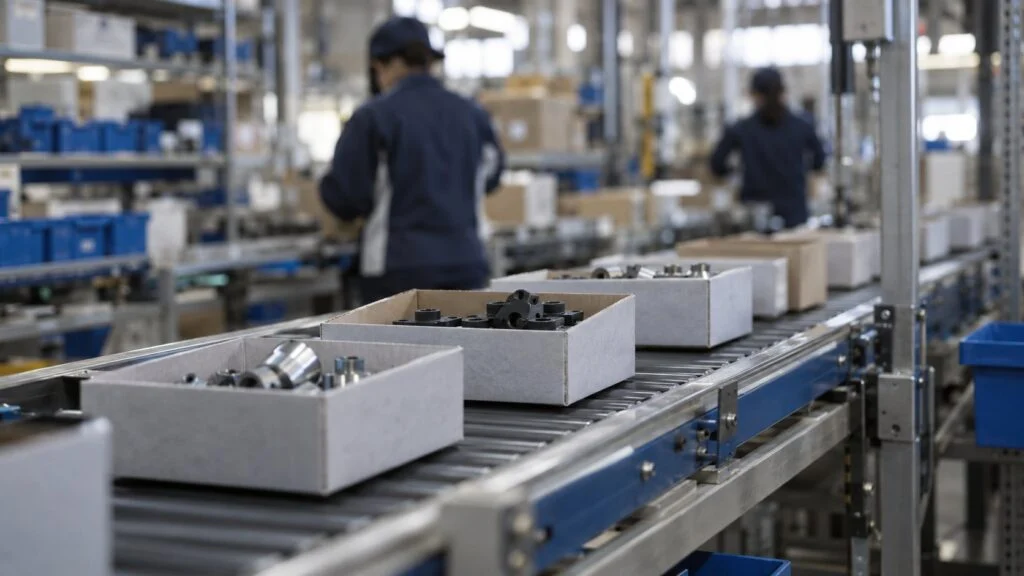
NSK: Industrial and Automotive Bearings
NSK makes bearings for both industrial machinery and vehicles. Sales for the fiscal year ended March 2026 were JPY 911.6 billion, up 14.4%. Much of that growth came from steering: NSK made NSK Steering & Control a consolidated subsidiary on September 1, 2025, which added JPY 100.6 billion of sales. Before that, it had been an equity-method affiliate in which NSK held a minority stake.
Japan accounted for 31.5% of sales, China 21.3%, and the Americas 20.1%, so about 69% of sales came from outside Japan (calculated from regional sales). Operating income was JPY 38.8 billion, a 4.3% margin. NSK's strength is a customer base balanced between industrial machinery and automotive.
NTN: Bearings and Constant Velocity Joints
NTN has two main businesses: bearings and constant velocity joints (CVJs) for vehicle drive shafts. For the fiscal year ended March 2026, net sales were JPY 826.3 billion, with CVJ/Axle at JPY 477.5 billion and Bearing and Others at JPY 348.9 billion.
The Americas accounted for 31.8% of sales, and about 74% came from outside Japan (both calculated from sales to external customers by region). Operating income rose 35.2% to JPY 31.0 billion, helped by restructuring, for a margin of 3.8% (calculated).
MinebeaMitsumi: Ball Bearings Plus Electronics
MinebeaMitsumi treats ball bearings as one of its core products but also makes motors, semiconductors, and electronic components. Net sales for the fiscal year ended March 2026 were JPY 1,664.4 billion, the company's 14th consecutive year of sales growth.
The Precision Technologies segment, which includes ball bearings, grew 10.0% to JPY 281.2 billion on steady demand for data center servers and aircraft. The company has grown through a long series of acquisitions, most recently in ball screws (see the deals section below).
SMC: Pneumatic Components
SMC makes pneumatic components such as air cylinders and solenoid valves. For the fiscal year ended March 2026, net sales were JPY 842.5 billion and the operating margin was 22.6%, far above the bearing makers. SMC forecasts JPY 1 trillion in net sales for the fiscal year ending March 2027. For more on SMC, see the FA companies guide linked above. For a pneumatics topic that often comes up on Japanese drawings, see Pneumatic Valve Speed Controller: Meter-Out vs Meter-In.
THK: Linear Motion Guides
THK is best known for its LM Guide linear motion guides, which guide machine axes in a straight line. Revenue for the fiscal year ended December 2025 was JPY 240.4 billion from continuing operations, up 7.9%.
In February 2026, THK agreed to sell its automotive and transportation business (the shares of TRA Holdings and its subsidiaries) to AP87, a company backed by Advantage Partners funds. THK already reports that business as a discontinued operation, which leaves the company focused on its industrial equipment business.
Nabtesco: Precision Reducers for Robots
Nabtesco makes precision reduction gears used in industrial robot joints, along with railway vehicle equipment and automatic doors. For the fiscal year ended December 2025, net sales were JPY 307.9 billion. Operating income was JPY 21.0 billion, up 59.3%, according to the corrected results Nabtesco issued in September 2026. The original February release had shown JPY 20.7 billion.
The Component Solutions segment, which includes the precision reducers, grew 17.3% to JPY 79.3 billion after robot makers' inventories returned to normal levels. Nabtesco's results move closely with the robot market.
MISUMI Group: Configurable Parts and Distribution
MISUMI sells factory automation parts and die and mold components through catalogs and online. Besides its own MISUMI-brand products, it runs VONA, a distribution business that also sells other makers' products and MRO consumables. Net sales for the fiscal year ended March 2026 rose 9.8% to JPY 441.4 billion:
- VONA business: JPY 192.5 billion
- FA business: JPY 160.5 billion
- Die Components business: JPY 88.4 billion
Acting as both a maker and a distributor gives MISUMI a distinctive position. It has changed how many engineers specify and buy standard parts. For how makers, distributors, and integrators fit together in Japanese factory automation, see Japanese Factory Automation: Makers, Distributors, SIers.
Japanese vs. Global Bearing Makers
The global bearing market also has large players in Europe and the US, and the Japanese makers compete with them in every region.
Revenue in each company's own currency, with recent moves.
Sources: company results releases. Currencies differ, so we do not rank them by yen conversion.
Schaeffler and SKF have moved in opposite directions. Schaeffler merged with Vitesco Technologies on October 1, 2024, extending its range into components for vehicle electrification. SKF is separating its Automotive business to concentrate on industrial customers.
Japan's lineup combines broad bearing makers strong in both automotive and industrial markets (NSK, NTN, JTEKT) with specialists such as MinebeaMitsumi in ball bearings. In some fields, such as pneumatics with SMC, Japanese makers have also built large businesses abroad. For where Japanese companies hold top global share, see Where Japan Holds Top Global Share: Materials and Equipment.
Profitability is where the gap shows. SKF's adjusted operating margin for 2025 was 12.7%, compared with 4.3% at NSK and 3.8% at NTN for the fiscal year ended March 2026 (calculated from results materials). The definitions differ, but the challenge for Japanese makers is to match their overseas rivals on earnings, not just scale. NSK and NTN have named this kind of competition with foreign rivals as a reason for their planned integration.
Mergers, Sales, and Spin-Offs
Recent deals fall into two groups: combining to gain scale, and reshaping the business portfolio. Either one can change a brand, a sales channel, or the support contact for parts already in your plant.
Two trends: combining for scale, and reshaping the portfolio.
Sources: company announcements and results materials. THK's sale was scheduled to close on June 1, 2026. Dates for planned deals may change.
NSK and NTN Plan to Integrate
On May 12, 2026, NSK and NTN signed a memorandum of understanding (MoU) to integrate their businesses through a joint share transfer, creating a joint holding company. Under the announced schedule, the definitive agreement follows within about six months, shareholder meetings vote in June 2027, and the holding company is established and listed in October 2027. Both companies said the schedule depends on regulatory approvals and may change. Reports say both companies will keep operating under the holding company.
For buyers, nothing changes on day one. Over time, though, an integration can bring changes to brands, product line-ups, distributor agreements, and plant footprints. Watch for announcements, and ask your distributor before you design either brand into a new machine.
Other Deals
Tsubakimoto Chain and Daido Kogyo, both chain makers, signed a business integration agreement on May 14, 2025. Daido Kogyo became a wholly owned subsidiary through a share exchange effective January 1, 2026. Tsubakimoto booked a JPY 11.6 billion gain on bargain purchase from the deal in the fiscal year ended March 2026.
MinebeaMitsumi completed its purchase of Tsubaki Nakashima's ball screw business on October 3, 2025, renaming it Minebea Linear Motion. The company puts the global ball screw market at more than JPY 200 billion and aims to expand the business's share.
The makers are taking different views of the automotive business. THK and SKF are moving their automotive businesses out, while NSK brought its steering business in.
What to Look at When You Compare Suppliers
Revenue alone says little about how a maker will behave as your supplier. Three numbers from public results materials give a more useful picture.
Look at these alongside revenue.
Profit Margin
Operating margins in this group range from 22.6% at SMC to 4.3% at NSK and 3.8% at NTN (fiscal year ended March 2026, calculated from results materials). Margin reflects pricing power, and it also shows how much room a maker has to fund new products, application engineering, and service. Look at the margin of the segment that makes your parts, not only the company total. For more ways to read a Japanese supplier's financials, see Japanese Supplier Financial Health: Warning Signs and Checks.
Global Reach
Many of the large makers generate around 70% of their revenue outside Japan. That means they depend on overseas customers, but it does not guarantee local stock or engineers in your country. Regional mix also shows how exposed a maker is to swings in each region's economy and trade policy.
Focus
At JTEKT and MinebeaMitsumi, businesses other than mechanical components are large. Segment sales show how central your product line is to the company. A product line that is a small or shrinking part of a large group deserves a question about long-term supply. With so many recent sales and integrations, also check the latest deal news before you single-source a part.
Checklist: Sourcing Japanese Bearings and Components
Use this list when you take over a Japanese-built machine or set up a second source for its components.
- List each bearing, linear guide, ball screw, reducer, chain, and pneumatic part by maker and full part number, including suffixes.
- Note which parts are Japan-domestic or special-order items and ask for a locally available equivalent.
- Confirm the authorized sales channel in your country for each maker: local subsidiary, authorized distributor, or only through the machine builder.
- Get lead times quoted for delivery to your country, not for Japan.
- Check whether the maker or business unit is part of a pending merger, sale, or spin-off, and who will support the product afterward.
- For a cross-reference to another brand, confirm the full specification (internal clearance, seals, precision class, preload, lubricant), not just the basic number.
- Keep the maker's catalog page or drawing on file for each critical part, in case the part number changes later.
Questions to Ask Your Supplier or Distributor
- Are you an authorized distributor for this maker in our country?
- Is this part a standard global model, or a Japan-only or special-order item?
- What is the lead time for delivery to our site, and what stock do you hold locally?
- Will the planned merger or business sale change this part number, brand, or your distribution agreement?
- If a part is discontinued, what is the replacement, and how much notice will we get?
- Who provides application engineering support locally, for example for bearing life or linear guide preload?
Sample Inquiry Email
Subject: Supply and support for components on [machine name], [PO or project number]
Dear [Name],
We operate [machine name] at our plant in [city, country]. It uses the components listed in the attached file (maker, part number, quantity). For each item, please let us know:
- Whether you can supply it as an authorized distributor in [country]
- Current lead time to our site and any local stock
- Whether it is a global standard model or a Japan-only item, and the local equivalent if needed
- Any planned change to the part number, brand, or distribution channel resulting from recent mergers or business sales
If any item is scheduled for discontinuation, please tell us the replacement part number.
Best regards,
[Your name]
[Company, department]
Limits of This Guide
- Figures cover different fiscal years and accounting standards (IFRS and Japanese GAAP). The ranking shows scale, not an exact order or market share.
- Consolidated revenue includes businesses outside mechanical components. Use segment figures for a closer comparison.
- Each company sells in several fields. The field labels in Figure 1 are simplifications, and many strong mid-sized makers are not covered.
- Planned deals, including the NSK–NTN integration and SKF's automotive separation, may change after publication. Check the companies' latest announcements.
- Local sales channels, stock, and support vary by country. Confirm them with the maker's regional office or authorized distributor.
FAQ
Who are the major Japanese bearing manufacturers?
NSK, NTN, JTEKT (which sells bearings under the Koyo brand), and MinebeaMitsumi. Nippon Thompson (IKO) and THK are major Japanese makers of linear motion products such as linear guides.
What is the largest bearing company in Japan?
It depends on the measure. By total company revenue, JTEKT (JPY 1,925.0 billion) and MinebeaMitsumi (JPY 1,664.4 billion) are the largest, but most of their sales are not bearings. NSK, whose sales center on bearings, had sales of JPY 911.6 billion for the fiscal year ended March 2026.
Are NSK and NTN merging?
They plan to. In May 2026 they signed an MoU to integrate through a joint share transfer that creates a joint holding company, scheduled for October 2027. The plan depends on a definitive agreement, shareholder approval, and regulatory clearances.
NSK vs. NTN: what is the difference?
NSK's sales split mainly between industrial machinery and automotive bearings, plus a steering business it consolidated in 2025. NTN's largest business is constant velocity joints for vehicle drive shafts (JPY 477.5 billion), followed by bearings (JPY 348.9 billion).
Who are the world's largest bearing makers?
SKF (Sweden), Schaeffler (Germany), and Timken (US) are major global players alongside NSK, NTN, and JTEKT. Each reports in a different currency and covers different businesses, so a direct ranking needs care.
Sources
- JTEKT: Consolidated Financial Results for the Fiscal Year Ended March 31, 2026 (IFRS)
- MinebeaMitsumi: Consolidated Financial Results for the Fiscal Year Ended March 31, 2026; results presentation; ball screw business acquisition completed
- NSK: Fiscal 2025 financial results presentation (May 13, 2026); Notice concerning completion of share acquisition (NSK Steering & Control)
- NTN: Consolidated Financial Results for the Fiscal Year Ended March 31, 2026
- NSK and NTN integration: Notice of MoU on business integration (Form 425, May 12, 2026); Jiji Press report
- SMC: Consolidated Financial Results for the Fiscal Year Ended March 31, 2026 (reference translation)
- THK: FY2025 financial results; Notice regarding transfer of shares of consolidated subsidiaries
- Nabtesco: Corrected Summary of Consolidated Financial Statements for FY2025 (September 30, 2026)
- MISUMI Group: Notice of the annual general meeting of shareholders (business report, FY ended March 2026)
- NHK Spring: Financial results presentation, FY ended March 2026
- NOK: European Rubber Journal report on NOK's results
- Tsubakimoto Chain: Consolidated financial results, FY ended March 2026; press release on Daido Kogyo (January 1, 2026)
- SKF: SKF Q4 2025 report release
- Schaeffler: Schaeffler reports solid results for 2025
- Timken: Timken Reports Fourth-Quarter and Full-Year 2025 Results
Original article in JapaneseThis guide is adapted from a MONOSCOPE article written for readers in Japan: 機械要素部品業界の主要企業と勢力図|売上ランキング・各社の強み・再編動向
About the editor
 MONOSCOPE EditorFOUNDER & EDITOR
Spent about ten years at a plant equipment maker and a plant engineering company, proposing, designing, and commissioning equipment, then moved into web marketing. Now a web consultant for B2B manufacturers, helping them explain their products and technology. Licensed in Japan as an Energy Manager and a Third-Class Chief Electrical Engineer.
Has run an engineering blog since 2017 (500+ articles) and a Japanese YouTube channel with about 20,000 subscribers. Each English guide is written from the Japanese shop-floor point of view and checked against the cited standards.