QA vs QC in Japanese Companies: Who to Contact for What

A batch of parts from your Japanese supplier fails your incoming inspection. You send a complaint, and two replies come back: one from the Hinshitsu Hosho-bu (品質保証部, Quality Assurance Department) and one from the Hinshitsu Kanri-ka (品質管理課, Quality Control Section). Both say "quality." Which one owns the problem, and which one should you be talking to?
The short answer: in a Japanese manufacturer, quality control (QC) works inside the plant to stop defects from being made and from moving on to the next process or the customer, while quality assurance (QA) makes and keeps the quality promise to the customer, from design through to after shipment. QC works mainly with the production floor. QA usually acts as the customer's point of contact on quality, runs the quality management system, and handles complaints and supplier quality.
This guide explains what each team does, where it sits in the organization, how it differs from the departments it is often confused with, and who to contact for what. It ends with a quick-reference table, a list of questions to ask your Japanese counterpart, and a sample email.
- QC (hinshitsu kanri) looks mainly at the production process: inspection standards, process data, and keeping defects from being made or passed on.
- QA (hinshitsu hosho) looks at the whole product life: design, purchasing, production, and after shipment. It is usually the customer's quality contact.
- Japanese companies split these teams differently. A QC section may sit inside the QA department, or one "Quality Department" may cover both.
- QA is often independent of manufacturing, and in some companies it has the authority to stop shipments that do not meet standards.
- For schedules and delivery, talk to production control. For process and equipment, talk to production engineering. For commercial terms, talk to sales.
Contents
- What QA and QC Mean in a Japanese Company
- What QA/QC Teams Do: Four Core Jobs
- Where QA Sits: Between the Customer, Other Departments, and Suppliers
- QA/QC vs. Production Control, Production Engineering, and Inspectors
- Plant QC vs. Head-Office QA: Who Picks Up Your Email
- Quick Reference: Who to Contact for What
- Questions to Ask Your Japanese Counterpart
- Where This Picture Does Not Apply
- FAQ
- Sources
What QA and QC Mean in a Japanese Company
Both teams exist to confirm that products meet the quality the customer requires, and to keep them that way. Japanese manufacturers use the English abbreviations too: QA for hinshitsu hosho (品質保証, quality assurance) and QC for hinshitsu kanri (品質管理, quality control). You will see "QA" and "QC" on business cards and in email signatures. Between them, the two teams are involved from product planning until the product is no longer in use in the market.
The ISO 9000 vocabulary that goes with ISO 9001 draws the same line. It treats both as parts of quality management: quality control focuses on fulfilling quality requirements, and quality assurance focuses on providing confidence that they will be fulfilled.
In practice, the two teams cover different ground:
- Quality control works mainly inside the plant. It manages the production process so that defects are not made and are not passed on to the next step or the customer.
- Quality assurance covers the product from design through to after shipment. It promises the customer that the product can be used with confidence, and it builds the system that keeps that promise.
Both protect quality, but they look at a different scope and a different time frame.
Department names and the split of work vary by company. One person often covers both.
Organization charts vary. In some companies the QC section (ka, 課) sits inside the QA department (bu, 部). In others, a single Hinshitsu-bu (品質部, Quality Department) covers both. Manufacturers in every industry have these teams: automotive, electrical equipment, food and pharmaceuticals, machine parts, and more. In fields like electronic components and semiconductors, where tiny defects affect performance, inspection and analysis take up a bigger share of the work.
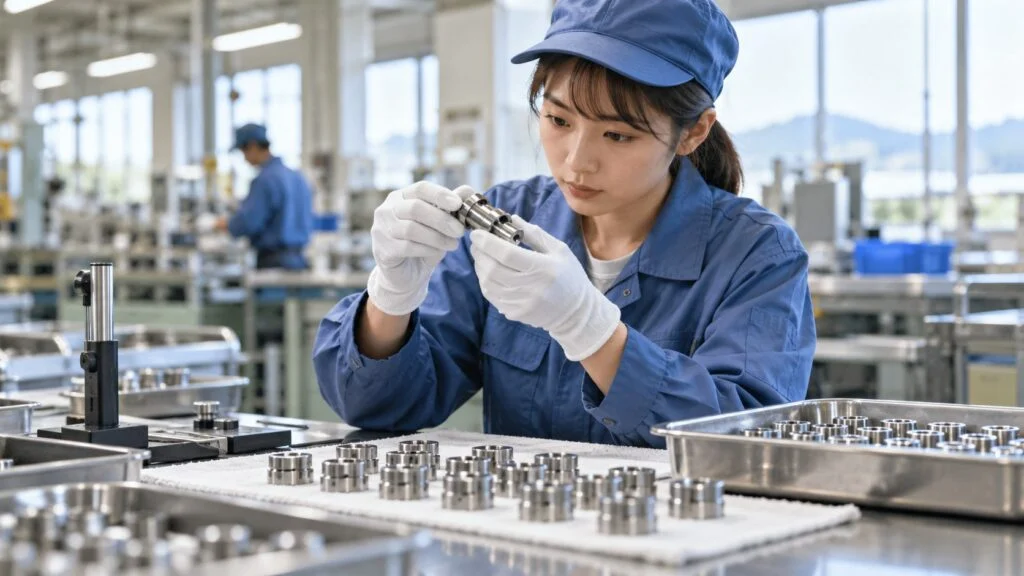
A QA/QC department usually mixes two kinds of staff: inspectors who check parts during production and before shipment, and engineers who set standards and analyze data. Quality work is not limited to large companies. At a small supplier, a small QC team often handles everything from inspection to customer contact, so the person answering your complaint may also be the person who wrote the inspection standard.
What QA/QC Teams Do: Four Core Jobs
The scope changes with company size and product, but most QA/QC teams share four core jobs, plus quality assurance for new products.
The work goes well beyond inspection. It includes building systems and handling defects.
Inspection and Measurement
Inspection confirms that products match the specification and the drawing. Japanese plants typically talk about three stages:
- Receiving inspection (ukeire kensa, 受入検査): checks parts and materials delivered by suppliers
- In-process inspection (koteinai kensa, 工程内検査): checks during production
- Final inspection (saishu kensa, 最終検査): checks before shipment
Calipers, micrometers, coordinate measuring machines (CMMs), and various testing machines are the usual tools. Inspectors do the daily checks. QC staff usually decide the inspection criteria and methods: what to measure, how often, and with which instrument. They write this up as an inspection standard (kensa kikaku, 検査規格). If you disagree with how a characteristic is measured, QC is the team to talk to.
Process Quality Control
Finding and removing defective parts still leaves the waste of making them again. So QC collects data such as dimensions, temperatures, and defect rates, and uses tools like control charts and Pareto charts to make the state of the process visible. When variation starts to grow, QC spots it early and works with production and production engineering to fix it before defects appear.
Running the Quality Management System
Many Japanese manufacturers are certified to ISO 9001, the international standard for quality management systems. The QA department usually acts as the secretariat that checks the system actually works as written. Automotive suppliers may also need an industry-specific standard such as IATF 16949. The main tasks are:
- Maintaining internal rules and procedures
- Managing records
- Planning and running internal audits
- Handling audits by external certification bodies
Requests for certificates, quality manuals, or audit dates usually go through QA.
Related: Quality Assurance Process at Japanese Plants: 8 Steps
Defect and Complaint Handling
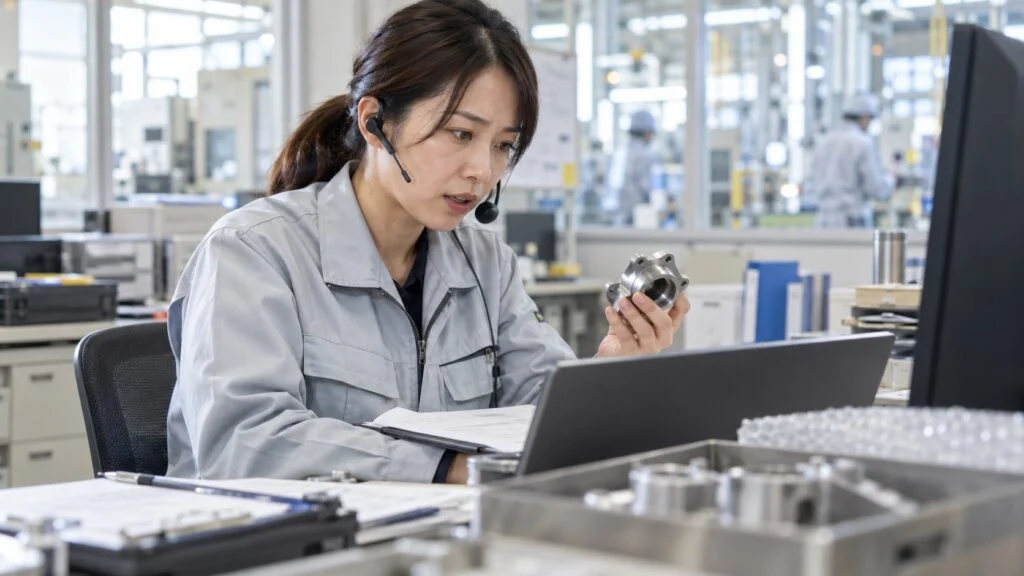
When a defect turns up in the process, or a customer reports a problem, QA/QC investigates and puts countermeasures in place. They examine the actual part, trace back through production records, and find out why the defect happened and, if it was not caught in time, why it escaped to the next process or the customer. Records that show when each product was made, and with which materials and equipment, make this tracing much faster.
The findings and countermeasures go into a report that QA explains to the customer. The standard practice is to extend the fix to similar products and other processes so the same problem does not happen again. Japanese companies call this suihei tenkai (水平展開, horizontal deployment), often shortened to yokoten. When you receive a defect report, ask whether yokoten has been done and to which products.
Quality Assurance for New Products
Before a new product goes into mass production, QA evaluates the design drawings and prototypes to confirm that quality can be maintained in mass production. QA takes part in design reviews (sekkei shinsa, 設計審査) and raises concerns based on past defects. See how Japanese design reviews and DRBFM work.
When production is ready, QA checks process capability and the measurement results from the first production parts, then decides whether the product can move to mass production. How many problems get solved before launch largely determines how many defects and complaints follow.
Where QA Sits: Between the Customer, Other Departments, and Suppliers
In one sentence, QA/QC checks the company's quality from the customer's point of view. Design, production, and purchasing each work toward their own targets, so someone outside those targets has to judge quality. That is why the QA department is often independent of manufacturing, and why some companies give it the authority to stop shipments that do not meet standards. QA works across the whole company rather than for one department.
QA links the customer, internal departments, and suppliers on quality.
The split varies by company. For example, sales may be the commercial contact, and purchasing and QA may guide suppliers jointly.
Each direction has its own work:
- Toward the customer: QA is the quality contact. It confirms quality requirements and reports and explains defects.
- Inside the company: QA joins design reviews and audits processes to catch problems early.
- Toward suppliers: QA runs audits and gives quality guidance. At companies that buy most of their parts, supplier quality decides product quality, and this link matters more every year. Here is how Japanese customers audit their suppliers.
- Toward senior management: QA analyzes defect and complaint data and reports the quality situation. Numbers on which products have which problems, and how often, help the company decide what to fix first.
Depending on who they are dealing with, QA/QC people play three different roles.
What is expected of them changes with the other party.
Most quality problems cannot be solved by one department alone. QA/QC is expected to gather information across departments and bring the right people together to fix them. If your issue needs design, production, and a sub-supplier to act, QA is usually the team that pulls them together.
QA/QC vs. Production Control, Production Engineering, and Inspectors
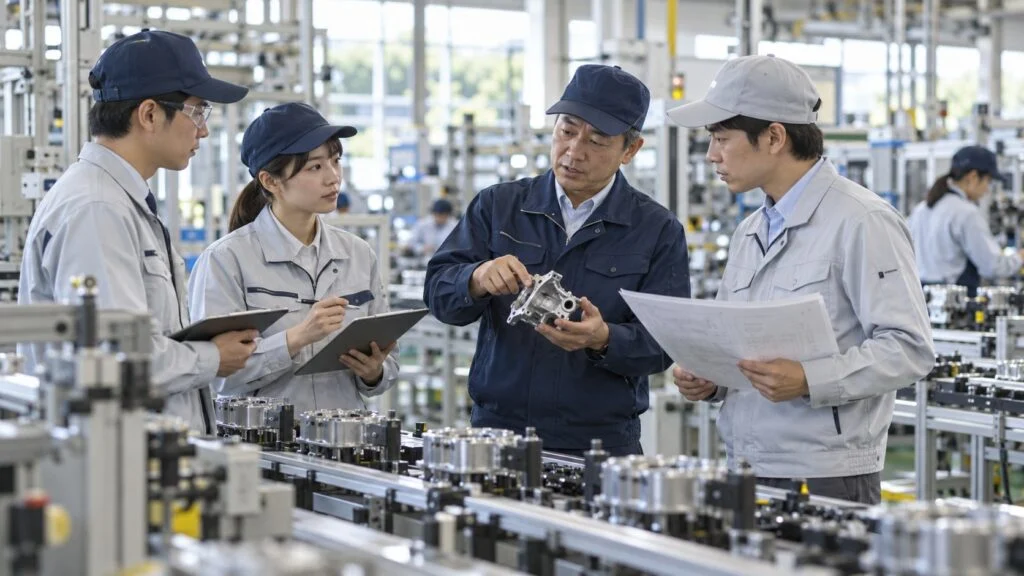
QA/QC works alongside many shop-floor functions, so the boundaries are not always clear from the outside. Three are most often confused with it. All of them deal with the same products and processes, but each puts a different priority first.
They look at the same product, but judge it on different terms.
At smaller companies, QC staff may also do inspection or part of production control.
Production Control (Seisan Kanri)
Production control (seisan kanri, 生産管理) plans production, arranges materials and people, and gets the required quantity made by the due date. It looks mainly at quantity and delivery. QA/QC looks at quality. When a deadline is close but quality is in doubt, QA/QC may have to stop the shipment, so the two sometimes clash. QA/QC can also be at odds with teams focused on cost, and often has to balance strict customer requirements against internal constraints. Good QA/QC people make their case with measurement results and records of past defects rather than gut feeling.
They are not simply opponents. Fewer defects mean less rework, which makes delivery dates easier to keep. Over time, quality and delivery point in the same direction, so regular information sharing between the two teams matters. For you, this means a delivery question goes to production control, but a late shipment held for a quality reason is a QA conversation.
Production Engineering (Seisan Gijutsu)
Production engineering (seisan gijutsu, 生産技術) designs and sets up the processes and equipment that make products efficiently. It shares QA/QC's goal of building a process that delivers stable quality. The difference lies in their roles: production engineering builds the process, and QA/QC checks whether that process really delivers the intended quality. Read more about seisan gijutsu.
Shop-Floor Inspectors
Inspectors (kensa-in, 検査員) measure products against the set inspection standard and make the pass/fail call. Their job is to make accurate, consistent judgments again and again. QC staff set those standards and procedures and analyze the results as data. Some inspectors later move into QC roles.
Put simply, the inspector uses the ruler correctly; QC decides what the ruler should be and keeps reviewing it. In many plants QC also handles calibration of measuring instruments and the training and certification of inspectors. See how calibration records work in Japan.
Plant QC vs. Head-Office QA: Who Picks Up Your Email
The same job title can mean very different days depending on whether the person works at a plant or at head office. Knowing which one you are dealing with helps you set expectations for response time and depth.
A plant QC engineer typically checks the previous day's defect data and inspection records in the morning and raises concerns at the morning meeting with production. The rest of the morning goes to walking the floor to check work and measurement. Afternoons go to root-cause investigations, countermeasure meetings, and writing reports. An urgent customer inquiry or a sudden defect reshuffles the whole plan, so days often do not go as scheduled. A serious defect sets off a race against time: root-cause investigation, checks of products already shipped, and reports to customers, sometimes with overtime or weekend work.
Head-office QA focuses on different work:
- Compiling reports from the plants
- Quality meetings with customers
- Supplier audits and the travel that comes with them
If you need measurement data or a look at the actual part, the plant QC team is closest to it. If you need a formal reply, a company-wide position, or a quality meeting, head-office QA is usually the channel.
Related: Japanese Factory Departments: Who Is Who and Whom to Ask
Quick Reference: Who to Contact for What
This table shows the usual pattern described above. The split varies by company, so confirm it with your counterpart early in the relationship.
| Your situation | Usually handled by | Notes |
|---|---|---|
| Defect found at your receiving inspection, or a field complaint | QA (customer quality contact) | Ask for root cause, escape cause, countermeasures, and yokoten |
| Question about how a characteristic is inspected or measured | QC | QC writes the inspection standard (kensa kikaku) |
| Process data, control charts, defect rates | QC | Plant QC holds the data closest to the process |
| ISO 9001 or IATF 16949 certificates, quality manual, audit scheduling | QA | QA usually acts as the secretariat for the quality system |
| New product readiness for mass production | QA | QA reviews process capability and first production parts |
| Quality of their sub-suppliers | QA and purchasing | Often handled jointly |
| Delivery dates, quantities, production schedule | Production control | If a shipment is held for quality reasons, QA is also involved |
| Process or equipment changes | Production engineering | QA/QC checks whether the changed process still delivers quality |
| Prices, contracts, commercial terms | Sales | Sales is often the overall commercial contact |
Questions to Ask Your Japanese Counterpart
Ask these at the start of a project or when you take over an account. The answers save time the first time something goes wrong.
- Is there a separate QA department and QC section, or one quality department?
- Who is our quality contact for complaints and defect reports: plant or head office?
- Who writes and approves the inspection standard for our parts?
- Which stages of inspection (receiving, in-process, final) apply to our parts, and at what frequency?
- Does QA have the authority to hold a shipment? Who decides when quality and delivery conflict?
- Which quality management standards is the site certified to (for example, ISO 9001 or IATF 16949)?
- When you report a countermeasure, will it include yokoten to similar products and other lines?
- Can you trace each lot back to its production date, materials, and equipment?
- Who handles quality issues at your sub-suppliers?
Sample Email: Confirming Quality Contacts
Short sentences and numbered questions are easier to answer, and to translate internally, than one long paragraph.
Subject: Quality contacts for [part number / project name]

Dear [Name],

To make sure quality issues reach the right person quickly, could you please confirm the following?

1. Our main contact for complaints and defect reports (name, department, email).
2. The person or team that owns the inspection standard for [part number].
3. Whether this contact is at the plant or at head office.
4. Who decides if a shipment should be held for a quality reason.
5. The contact for delivery and schedule questions (production control).

Thank you for your help.

Best regards,
[Your name]
[Company / Department]
Where This Picture Does Not Apply
- Company structure varies. Department names, the QA/QC split, and who is the customer contact differ from company to company. Treat this guide as the common pattern, not a rule.
- Small suppliers merge roles. At smaller companies, one person may handle QA, QC, inspection, and part of production control.
- Shipment authority is not universal. QA is often independent of manufacturing, but not every company gives it the authority to stop shipments.
- Industry adds requirements. Quality requirements are especially strict in the automotive, food, and pharmaceutical industries. Automotive suppliers, for example, may also work to IATF 16949.
FAQ
What is the difference between QA and QC?
QC focuses on the production process: inspection, process data, and stopping defects from being made or passed on. QA covers the whole product life from design to after shipment and is responsible for the quality promise to the customer.
Who should I send a quality complaint to at a Japanese supplier?
Usually the QA department (Hinshitsu Hosho-bu), which typically acts as the customer's quality contact. Confirm the named contact early, because some companies route complaints through a plant QC section or through sales.
Can a Japanese QA department stop a shipment?
In some companies, yes. QA is often independent of manufacturing, and some companies give it the authority to stop products that do not meet standards. Ask your supplier who makes that call.
What does yokoten mean in a defect report?
Yokoten (short for suihei tenkai, horizontal deployment) means extending a countermeasure to similar products and other processes so the same defect does not happen elsewhere. It is a standard part of Japanese defect handling.
Is a QC engineer the same as an inspector?
No. Inspectors measure products and make pass/fail calls against a set standard. QC engineers decide what that standard is, how and how often to measure, and analyze the results.
Sources
- ISO 9000 definitions of quality assurance and quality control: European Union Agency for Railways, terminology collection (quality assurance); Elsmar Cove forum, QA and QC in ISO 9001
Original article in JapaneseThis guide is adapted from a MONOSCOPE article written for readers in Japan: 品質保証・品質管理とは?仕事内容・役割・他職種との違いを実務目線で解説
About the editor
 MONOSCOPE EditorFOUNDER & EDITOR
Spent about ten years at a plant equipment maker and a plant engineering company, proposing, designing, and commissioning equipment, then moved into web marketing. Now a web consultant for B2B manufacturers, helping them explain their products and technology. Licensed in Japan as an Energy Manager and a Third-Class Chief Electrical Engineer.
Has run an engineering blog since 2017 (500+ articles) and a Japanese YouTube channel with about 20,000 subscribers. Each English guide is written from the Japanese shop-floor point of view and checked against the cited standards.