Maintenance Workflow at Japanese Plants: 8 Steps in 3 Phases
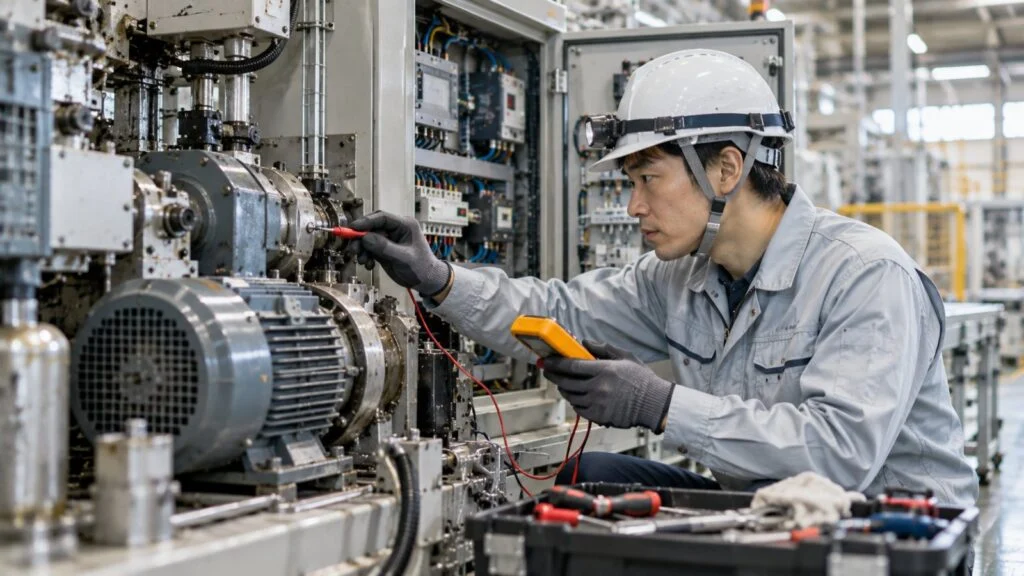
You have just joined the maintenance team at a Japanese-owned plant in Thailand, India, or the US. Head office asks for next year's annual maintenance plan, wants a breakdown report with a "why-why" analysis for last week's stoppage, and reminds you to update the equipment register after the conveyor modification. Each request makes sense on its own, but it helps to see how they fit together.
In Japanese plants, equipment maintenance (setsubi hozen) is planned work: inspections, part replacements, and repairs scheduled so that equipment does not stop. Rushing to an unexpected breakdown is only one part of the job. The team plans which equipment to protect, when, and how; carries out the plan; reviews the results; and feeds them into the next plan. That big loop runs once a year, while a smaller loop of daily inspections and breakdown response runs inside it.
This guide splits the workflow into three phases (planning, execution, and analysis and improvement) and eight steps. For each step, it covers the documents and tools used, who gets involved, and common mistakes. It ends with how the workflow varies by industry and company size, a checklist, and a breakdown report template you can reuse.
Contents
The Maintenance Workflow at a Glance
The work moves through these eight steps:
Know the equipment → Build the maintenance plan → Arrange parts and contractors → Inspect → Carry out planned maintenance → Respond to breakdowns → Find root causes and prevent recurrence → Review records and update the plan
The work falls into three phases: planning, execution, and analysis and improvement.
In practice the steps overlap. A defect found during execution, for example, often goes straight into the next plan.
Once the cycle comes full circle, the next plan begins. A yearly cycle and a day-to-day cycle of inspections and breakdown response run at the same time, and that overlap is what defines maintenance work.
The people you work with change from phase to phase:
- Planning: production control and purchasing
- Execution: production operators and outside contractors
- Analysis and improvement: production engineering and equipment manufacturers
Production engineering (seisan gijutsu) usually handles the installation of new equipment. Maintenance typically takes over once the equipment is commissioned and running. For more on that handover, see Seisan Gijutsu: Japanese Production Engineering Explained.
Phase 1: Planning
In the planning phase, the team takes stock of the plant's equipment and decides which equipment to maintain, and to what extent, with the people and budget available. Much of how well maintenance performs is decided here.
Step 1: Know the Equipment
The first task is to find out what equipment the plant has and what condition it is in. The equipment register (setsubi daicho) records information such as:
- Model and year of installation
- Major components
- Where the drawings and instruction manuals are kept
Next, the team goes through past breakdown records to find the machines and parts that stop most often. It then ranks each machine by criticality, based on how a stop would affect production and safety.
Criticality decides how much time and money each machine gets.
If every machine gets the same treatment, the work piles up and the machines that matter most get neglected. The point of this step is to sort the equipment so the team can focus on what needs protecting.
Common mistake: leaving the register out of date. If modifications are not recorded, the drawings will not match the machine when it breaks down, and finding the cause takes longer.
Step 2: Build the Maintenance Plan
With criticality set, the team chooses a maintenance strategy for each machine and sets inspection and service intervals. It writes inspection standards (tenken kijunsho), which list what to check and the pass/fail criteria, and builds monthly and annual maintenance plans from them.
Major servicing is grouped into periods when production can stop, such as long holidays or scheduled plant shutdowns. That means agreeing on shutdown dates with production control and manufacturing early.
Intervals that are too short drive up cost and labor; intervals that are too long lead to more failures. A practical approach is to start from the equipment manufacturer's recommended intervals and adjust them based on actual results.
In Japan, equipment such as cranes, boilers, and pressure vessels must undergo legally required inspections and periodic self-inspections. The planner makes sure none of these statutory inspection dates are missed. Outside Japan, the local rules apply; check with your safety or compliance team which ones cover your equipment. For more on how Japanese process plants schedule this work, see Teishu (Plant Turnaround) in Japan.
Plans are managed in a maintenance management system (often called a CMMS) or a spreadsheet, with an owner and a date for each task. When work is done, the team records the actuals so it can compare them with the plan.
Step 3: Arrange Parts and Contractors
Once the plan is set, the team arranges replacement parts, tools, and outside contractors. Some parts take several months to arrive, so orders go out early.
When an outside contractor will do the work, the scope, safety measures, and schedule are agreed in advance. Shutdown windows are limited, so any gap in preparation directly delays completion.
Many companies place orders through the purchasing department, but the maintenance staff still collect quotations and confirm the budget. Working closely with purchasing is part of this step.
For critical equipment, the plant keeps spare parts in stock in case of failure. How many of which parts to hold depends on failure frequency, lead time, and price. Too much stock ties up money; too little means you cannot restore the machine when it fails.
Phase 2: Execution
In the execution phase, the team carries out inspections and maintenance according to the plan while also responding to unexpected breakdowns. The hard part is that planned and unplanned work run at the same time.
When breakdowns keep coming, planned inspections and servicing get pushed back, which leads to even more breakdowns. To catch this vicious cycle, many plants track how much of the planned maintenance is actually completed, as a completion rate (jisshi-ritsu).
Step 4: Inspection
There are two kinds of inspection: daily inspections (nichijo tenken) done by operators, and periodic inspections (teiki tenken) done by maintenance staff at set intervals. Following a checklist, they check for noise, vibration, temperature, oil level, and loose parts. Operator-led inspection is a core part of autonomous maintenance; see Jishu Hozen 7 Steps.
Periodic inspections use instruments such as vibration meters, thermometers, and insulation resistance testers, and compare each reading with the last one. Catching small changes in these numbers is the shortest route to fewer unexpected failures.
Common mistake: inspections that become a formality. Once the goal is to fill in the checkboxes, nobody notices abnormalities. Inspectors need to understand why each item is on the list.
The main inspection points fall into four groups. All of them can be checked with the five senses and simple instruments.
Most abnormalities show up first as a change in one of these.
Step 5: Planned Maintenance
Planned maintenance means replacing parts and overhauling equipment on non-production days or during scheduled shutdowns. Before any work starts, the crew always follows the site's procedure to keep the equipment from starting by mistake, such as switching off the power, locking the switch, and attaching a tag (lockout/tagout). Your site's own safety rules decide the exact procedure.
With a lot of work to fit into a short window, the order of tasks and who does what are decided in advance. The job is not complete until the equipment has been test-run and checked.
A common failure is equipment that will not start after servicing. To avoid it, crews photograph the position of removed parts and the wiring, record tightening torques, and use other ways to make reassembly reliable.
When an outside contractor does the work, a maintenance staff member is on site to check quality and safety. When several jobs overlap in the same area, maintenance also coordinates them in advance so they do not interfere with each other or create hazards.
Step 6: Breakdown Response
When equipment stops unexpectedly, maintenance gets the call, goes to the line, checks the situation, and narrows down the cause. The first step is to note any alarm displayed and to ask the operator what happened just before the stop.
Get the line running first, then move on to the permanent fix.
If the abnormality affects safety, the rule is not to rush the restart: keep the equipment stopped until the cause is clear.
Once the cause is known, the team restores the equipment by replacing or adjusting parts. If a root-cause fix is not possible right away, a common decision is to restart with a temporary fix and schedule the permanent fix for a later planned maintenance window.
Common mistake: replacing a part based on the symptom alone and restarting without confirming the cause. The same failure can soon come back and end up causing a longer stop.
The result of each breakdown response goes into a breakdown report (kosho hokokusho) with these items:
- Date and time of occurrence
- Symptom
- Cause
- Action taken
- Downtime
These records become the input for the analysis and improvement phase. At night or on non-working days, decisions have to be made with fewer people on hand, so decide in advance whom to call when you cannot fix it yourself, and how far one person may go working alone.
Phase 3: Analysis and Improvement
In this phase, the team looks back at what happened during execution and builds ways to stop the same failures from recurring. The job does not end with the repair: it ends when the lessons go into the next plan.
Step 7: Find the Root Cause and Prevent Recurrence
To find the cause of a failure, Japanese plants often use why-why analysis (naze-naze bunseki), which asks "why did it fail?" over and over to trace a surface symptom back to its root cause. Examining wear marks and fracture patterns on the failed part also gives important clues.
Listing possible causes under people, machine, material, and method helps reduce what gets overlooked. The key to prevention is not stopping at "operator carelessness" but tracing the problem back to the system that allowed it. For a related approach to reporting near misses, see Hiyari Hatto Near-Miss Reports.
Once the cause is known, typical fixes include:
- Changing the material or shape of a part
- Revising the lubrication method
- Adding inspection items
Prevention includes monitoring the fix for a set period to confirm it works. When a major modification is needed, the team works with the equipment manufacturer and production engineering, and always updates the drawings and equipment register so future staff are not left guessing.
The team measures results by how much the number of failures and the downtime go down. Fixes that work well are rolled out to the same type of equipment elsewhere, a practice Japanese teams call yokotenkai (horizontal deployment).
Step 8: Review Records and Update the Plan
Inspection results, breakdown details, replaced parts, and the time and cost spent are kept as maintenance records. Some plants manage them in paper reports; others enter them into a maintenance management system and analyze them there.
Analyzing the records shows which machines cause the longest downtime and which cost the most. Based on that, the team revises inspection intervals and items and the timing of equipment replacement, and builds them into next year's maintenance plan and budget.
This is also where the team decides whether to keep repairing aging equipment or replace it. Maintenance compares repair costs and failure risk with the cost of replacement and makes a recommendation to management.
More plants are now adopting predictive maintenance, with sensors that monitor vibration and temperature continuously, and smart-factory projects that collect and analyze equipment data. Whether a plant can use its records as data is becoming what sets strong maintenance teams apart.
How the Workflow Varies by Industry and Company
The workflow above is common to most plants, but the emphasis varies by industry and company. The biggest difference is between mass-production assembly and machining plants and process industries such as chemicals and steel.
They differ in how equipment is shut down and how large the impact is when it stops.
Even within one industry, the approach varies with plant size and product.
Mass Production vs. Process Industries
In mass-production assembly and machining plants, as in the auto industry, one stopped machine stops the whole line. How fast the team can recover from a breakdown matters most, and maintenance staff are often stationed right next to the production line.
Process industries such as chemicals, resins, steel, and nonferrous metals run equipment around the clock. Once every few years, the whole plant shuts down for scheduled shutdown maintenance (teiki shuri, or teishu). This shutdown is a major event, and planning and managing the work for it takes up a large part of the job.
In food and pharmaceuticals, hygiene adds maintenance tasks related to cleaning and preventing foreign-matter contamination. The nature of each industry changes what gets inspected and how records are kept.
Large Manufacturers vs. Smaller Companies
At large manufacturers, the maintenance department may be split into mechanical and electrical groups, with planners separate from the technicians who do the work. Plans and records are typically managed in a maintenance management system, and maintenance staff often manage major jobs that partner contractors carry out.
At smaller manufacturers, maintenance teams are small, and each person handles a broad range of work, from planning to repair and improvement. They see the whole workflow quickly, but they also have to build the systems themselves.
Plants that build many different products to order change how equipment is used from product to product. There, maintenance may also cover adjustments for changeovers and upkeep of jigs and fixtures. Adjust the emphasis on each step to suit your own plant.
Japanese Maintenance Terms You Will Hear
Japanese colleagues and documents often use these terms. Translations vary by company, so confirm what your site means by each one.
| Japanese | Common English | Where it appears |
|---|---|---|
| 設備保全 (setsubi hozen) | Equipment maintenance | Department and job names |
| 設備台帳 (setsubi daicho) | Equipment register | Step 1 |
| 点検基準書 (tenken kijunsho) | Inspection standard | Step 2 |
| 日常点検 / 定期点検 (nichijo tenken / teiki tenken) | Daily inspection / periodic inspection | Step 4 |
| 故障報告書 (kosho hokokusho) | Breakdown report | Step 6 |
| なぜなぜ分析 (naze-naze bunseki) | Why-why analysis (similar to 5 Whys) | Step 7 |
| 横展開 (yokotenkai) | Rolling out a fix to similar equipment | Step 7 |
| 定期修理 (teiki shuri, teishu) | Scheduled shutdown maintenance | Process industries |
Checklist: Is Your Maintenance Cycle Complete?
Use this list to review each step of your maintenance cycle.
- Does the equipment register list model, installation year, major components, and where drawings and manuals are kept?
- Have recent modifications been reflected in the register and drawings?
- Does every machine have a criticality rank, and does the plan treat each rank differently?
- Does each machine have a maintenance strategy and inspection and service intervals, with inspection standards that define what to check and the criteria?
- Have shutdown dates been agreed with production control and manufacturing?
- Are all statutory inspections that apply at your site in the plan?
- Have long-lead parts been ordered, and are contractor scope, safety measures, and schedule agreed?
- Do critical machines have spare parts in stock, based on failure frequency, lead time, and price?
- Do you track the completion rate of planned maintenance?
- Is every breakdown recorded in a report, and are root-cause fixes scheduled?
- Is there an after-hours escalation contact and a clear limit on what one person may do alone?
- Are fixes monitored for a set period, and are effective ones rolled out to similar equipment?
- Do maintenance records feed into next year's plan and budget, including repair-or-replace decisions?
Breakdown Report Template
The five items below are the core of a breakdown report, as described above. The example entries are fictional. Your parent company may use its own form with more fields.
| Item | What to write | Example (fictional) |
|---|---|---|
| Date and time | When the stop started | March 4, 2:15 p.m. |
| Symptom | What the operator and maintenance observed, including alarms | Conveyor 3 stopped; motor overload alarm |
| Cause | The confirmed cause, not just the failed part; add the why-why analysis | Bearing seized due to lack of grease; lubrication point not on the inspection sheet |
| Action taken | Temporary fix, and the permanent fix with its planned date | Bearing replaced; lubrication point added to the inspection standard |
| Downtime | From stop to restart | 1 hour 40 minutes |
Limits of This Guide
- The eight-step flow is a general model. In practice the steps overlap, and the emphasis varies by industry and company.
- Criticality ranks, inspection intervals, and report formats vary by company. Follow your site's standards.
- Statutory inspections depend on the country and the equipment. This guide does not list them; check with your safety or compliance team.
- Lockout/tagout and other safety steps are mentioned only as part of the workflow. Follow your site's written procedures.
Summary
- Equipment maintenance runs as a repeating cycle of three phases: planning, execution, and analysis and improvement.
- Planning sets equipment criticality, the maintenance strategy and intervals, and arranges parts and contractors.
- Execution carries out inspections and planned maintenance while handling unexpected breakdowns.
- Analysis and improvement removes the true causes of failures and uses records to revise the next plan.
- The emphasis, and how work is divided, differs between mass production and process industries, and between large and small companies.
FAQ
What Are the Main Steps in a Maintenance Workflow?
A typical workflow has eight steps in three phases. Planning: know the equipment, build the plan, and arrange parts and contractors. Execution: inspection, planned maintenance, and breakdown response. Analysis and improvement: root-cause analysis and prevention, then reviewing records to update the next plan.
How Do Japanese Plants Rank Equipment Criticality?
One example is an A/B/C ranking based on how a stop would affect production and safety. A-rank equipment gets preventive and predictive maintenance; C-rank equipment may be run to failure. The number of ranks and the criteria vary by company.
What Should a Breakdown Report Include?
At minimum: date and time, symptom, cause, action taken, and downtime. Record the confirmed cause, not just the part you replaced, so the report can feed root-cause analysis and the next plan.
How Often Should Equipment Be Inspected?
There is no single interval. A practical starting point is the equipment manufacturer's recommendation, adjusted over time based on actual results. Intervals that are too short increase cost and labor; intervals that are too long lead to more failures.
Sources
- Maintenance-related job descriptions: Ministry of Health, Labour and Welfare, job tag, "Industrial Robot Maintenance" (Japanese)
- Maintenance-related job descriptions: Ministry of Health, Labour and Welfare, job tag, "Textile Equipment Management and Maintenance" (Japanese)
- Inspections required for boilers and other dangerous machinery under Japan's Industrial Safety and Health Act: Cabinet Office, Japan, "Industrial Safety and Health Law"
- Crane inspections and periodic self-inspection: Japan Crane Association, "Inspection and Examination"
Original article in JapaneseThis guide is adapted from a MONOSCOPE article written for readers in Japan: 設備保全の仕事の流れ|保全計画から改善までの各工程を実務目線で解説
About the editor
 MONOSCOPE EditorFOUNDER & EDITOR
Spent about ten years at a plant equipment maker and a plant engineering company, proposing, designing, and commissioning equipment, then moved into web marketing. Now a web consultant for B2B manufacturers, helping them explain their products and technology. Licensed in Japan as an Energy Manager and a Third-Class Chief Electrical Engineer.
Has run an engineering blog since 2017 (500+ articles) and a Japanese YouTube channel with about 20,000 subscribers. Each English guide is written from the Japanese shop-floor point of view and checked against the cited standards.