SMED Step by Step: Internal vs. External Setup (Dandori)
If you work at a Japanese-owned plant, or supply one, you will hear the word dandori (段取り, setup) sooner or later. A Japanese manager may ask you to cut dandori gae (段取り替え, changeover) time, or sort a task list into uchi-dandori and soto-dandori. These are the Japanese terms behind what English-speaking plants call SMED: internal setup, done with the machine stopped, and external setup, done while it runs.
The method came from Japanese shop floors. Shigeo Shingo described how a press changeover at Toyota Motor Co. (Toyota Jidosha Kogyo) went from four hours to about 90 minutes in a little over six months. When he was then asked to get it down to three minutes, the idea that made it possible was simple: do everything you can while the machine is still running.
This guide walks through the Japanese terms, where the time is measured from and to, six steps based on Japanese guidance, four ways to shorten internal setup, the safety checks that are never cut, and how to use the time you save. One fictional press die change runs through the whole article as a worked example.
Contents
- Dandori Terms You Will Hear on a Japanese Shop Floor
- What Counts as Changeover Time
- Six Steps to Reduce Changeover Time
- Steps 1–3: Measure, Sort, and Move Work Outside
- Step 4: Four Ways to Shorten Internal Setup
- Steps 5–6: Streamline External Setup and Make It Standard
- Safety Steps That Are Never Cut
- What to Do With the Time You Save
- Common Mistakes in Setup Reduction
- Checklist: Questions to Settle With the Japanese Side
- Where This Guide Does Not Apply
- FAQ
- Sources
Dandori Terms You Will Hear on a Japanese Shop Floor
| Japanese | Romaji | English | Meaning on the floor |
|---|---|---|---|
| 段取り替え | dandori gae | changeover / setup change | Switching a machine or line from one product to the next, including preparation and trial runs |
| 内段取り | uchi-dandori | internal setup | Work done with the machine or line stopped |
| 外段取り | soto-dandori | external setup | Work done while the machine or line keeps running |
| シングル段取り | single dandori | SMED (single-minute exchange of die) | Internal setup finished in under 10 minutes |
| 試し打ち | tameshi-uchi | trial stroke / tryout | Test hits on a press after the die is set, followed by measuring and readjusting |
| 初品確認 | shohin kakunin | first-piece check | Checking and recording the first good part of the new product |
| ムダ | muda | waste | Work that adds nothing, such as searching for tools |
What Counts as Changeover Time
Japan's production management vocabulary standard, JIS Z 8141, defines changeover as the preparation of materials, machines, jigs and tools, drawings, and so on, plus trial processing, that occurs when switching products or process content. Changeover is not just swapping a die or a cutting tool. Preparation and trial runs are part of it.
That sets the measurement window: from the last good part of the previous product to the first good part of the next one. JMAC (Japan Management Association Consultants) describes setup and adjustment loss the same way, as the time lost until a fully good part comes off the machine.
If you stop the clock when the new die is bolted in, the adjustment and trial runs that follow drop out of the record. That later stretch is often where the biggest savings are, so agree on the window before anyone starts timing.
In overall equipment effectiveness (OEE), the time a machine sits stopped for changeover counts as a downtime loss that lowers availability.
Related: OEE and the 7 Big Losses vs. Six Big Losses in TPM
Internal vs. External Setup
A note to JIS Z 8141 splits setup work into two types. Internal setup (uchi-dandori) is done with the machine or line stopped; external setup (soto-dandori) is done without stopping it.
The same task can fall on either side. Fetching the next die after the press has stopped is internal setup. Moving it to the press while the previous job is still running is external setup. The category depends on whether the machine is stopped, not on what the task is.
.msfig{margin:28px 0;padding:22px 20px;border:1px solid #e0e5ed;border-radius:12px;background:#f7f9fc}.msfig__ttl{font-size:13px;font-weight:700;color:#1a2133;margin:0 0 4px}.msfig__lead{font-size:12px;line-height:1.7;color:#737d8f;margin:0 0 16px}.msfig__note{font-size:11px;line-height:1.7;color:#737d8f;margin:14px 0 0}.msfig__band{display:flex;flex-direction:column;align-items:center}.msfig__box{width:100%;max-width:520px;padding:12px 16px;border:1px solid #d6dfea;border-radius:10px;background:#fff;text-align:center}.msfig__box b{display:block;font-size:13px;color:#1a2133}.msfig__box span{display:block;font-size:11px;line-height:1.6;color:#737d8f;margin-top:3px}.msfig__box--main{border-color:#1f5ed6;background:#eef3fd}.msfig__arrow{display:flex;flex-direction:column;align-items:center;margin:8px 0;font-size:10px;color:#1f5ed6;font-weight:600}.msfig__arrow::before{content:"";width:0;height:0;border-left:6px solid transparent;border-right:6px solid transparent;border-top:8px solid #1f5ed6;margin-bottom:3px}.msfig__row{display:grid;grid-template-columns:repeat(3,1fr);gap:10px;width:100%;max-width:520px}.msfig__row .msfig__box{max-width:none}.msfig__steps{display:grid;grid-template-columns:repeat(3,1fr);gap:10px}.msfig__step{position:relative;padding:12px 14px;border:1px solid #d6dfea;border-radius:10px;background:#fff}.msfig__num{display:inline-block;font-size:10px;font-weight:700;letter-spacing:.06em;color:#1f5ed6;margin-bottom:4px}.msfig__step b{display:block;font-size:13px;color:#1a2133}.msfig__step span{display:block;font-size:11px;line-height:1.65;color:#737d8f;margin-top:4px}.msfig__phase{grid-column:1/-1;font-size:11px;font-weight:700;color:#49546b;padding:6px 0 0;border-top:1px dashed #d6dfea}.msfig__phase:first-child{border-top:none;padding-top:0}@media(max-width:600px){.msfig__steps,.msfig__row{grid-template-columns:1fr}} .msfig__epc{display:grid;grid-template-columns:repeat(3,1fr);gap:10px}.msfig__epc>div{padding:12px 14px;border:1px solid #d6dfea;border-radius:10px;background:#fff}.msfig__epc b{display:block;font-size:13px;color:#1a2133}.msfig__epc em{display:block;font-style:normal;font-size:10px;font-weight:700;letter-spacing:.06em;color:#1f5ed6;margin-bottom:4px}.msfig__epc span{display:block;font-size:11px;line-height:1.65;color:#737d8f;margin-top:4px}.msfig__ttl--icon{display:flex;align-items:center;gap:7px}.msfig__ttl--icon svg{flex:none}.msfig__scope{margin-top:10px;padding:10px 14px;border:1px dashed #1f5ed6;border-radius:10px;background:#eef3fd;font-size:11px;line-height:1.7;color:#1a2133;text-align:center}.msfig__cards{display:grid;grid-template-columns:repeat(2,1fr);gap:10px}.msfig__cards>div{padding:12px 14px;border:1px solid #d6dfea;border-radius:10px;background:#fff}.msfig__cards b{display:block;font-size:13px;color:#1a2133;margin-bottom:4px}.msfig__cards span{display:block;font-size:11px;line-height:1.65;color:#737d8f}@media(max-width:600px){.msfig__epc,.msfig__cards{grid-template-columns:1fr}} .msfig__quals{display:grid;grid-template-columns:repeat(3,1fr);gap:10px}.msfig__qual{background:#fff;border:1px solid #e0e5ed;border-radius:10px;padding:12px;display:flex;flex-direction:column;gap:6px}.msfig__qual .qh{display:flex;align-items:center;gap:8px}.msfig__qual .qh b{font-size:13px;color:#1a2133;line-height:1.4}.msfig__qual .tag{align-self:flex-start;font-size:10px;font-weight:700;padding:2px 8px;border-radius:999px}.msfig__qual .tag.is-op{background:#eef3fd;color:#1f5ed6}.msfig__qual .tag.is-ds{background:#e9f6f1;color:#1d7a5a}.msfig__qual .tag.is-cn{background:#fdf1e7;color:#b0561a}.msfig__qual span.d{font-size:11px;line-height:1.7;color:#49546b}@media(max-width:600px){.msfig__quals{grid-template-columns:1fr}} .msfig__tbl{display:grid;grid-template-columns:1.5fr 56px 1fr 1.5fr;gap:1px;background:#e0e5ed;border:1px solid #e0e5ed;border-radius:10px;overflow:hidden}.msfig__tbl>div{background:#fff;padding:9px 11px;font-size:11px;line-height:1.65;color:#49546b}.msfig__tbl .hd{background:#eef3fd;font-size:12px;font-weight:700;color:#1a2133;text-align:center}.msfig__tbl .nm{font-weight:600;color:#1a2133}.msfig__tbl .tm{text-align:right;font-weight:700;color:#1a2133;white-space:nowrap}.msfig__tbl .sum{background:#f7f9fc;font-weight:700;color:#1a2133}.msfig__tbl .tg{display:inline-block;font-size:10px;font-weight:700;padding:1px 8px;border-radius:999px;background:#eef3fd;color:#1f5ed6;white-space:nowrap}.msfig__tbl .tg.is-out{background:#e9f6f1;color:#1d7a5a}.msfig__tbl .tg.is-keep{background:#fdf1e7;color:#b0561a}@media(max-width:600px){.msfig__tbl{grid-template-columns:1fr 56px}.msfig__tbl .hd.c3,.msfig__tbl .hd.c4{display:none}.msfig__tbl .c3,.msfig__tbl .c4{grid-column:1/-1}} .msfig__sbar{display:flex;flex-direction:column;gap:10px}.msfig__sbar .r{display:grid;grid-template-columns:150px 1fr;gap:10px;align-items:center}.msfig__sbar .l{font-size:12px;font-weight:700;color:#1a2133;line-height:1.4}.msfig__sbar .l small{display:block;font-size:10px;font-weight:400;color:#737d8f}.msfig__sbar .t{display:flex;height:30px;border:1px solid #d6dfea;border-radius:6px;overflow:hidden;background:#fff}.msfig__sbar .v{display:flex;align-items:center;justify-content:center;background:#1f5ed6;color:#fff;font-size:11px;font-weight:700;white-space:nowrap;overflow:hidden}.msfig__sbar .v.is-out{background:#b9c3d3;color:#1a2133}.msfig__sbar .v.is-cut{background:repeating-linear-gradient(45deg,#fff,#fff 5px,#eef1f6 5px,#eef1f6 10px);color:#737d8f;font-weight:400}@media(max-width:600px){.msfig__sbar .r{grid-template-columns:1fr;gap:3px}.msfig__sbar .v{font-size:10px}}The split depends on whether the machine is stopped or running.
Definitions follow JIS Z 8141:2022 (term 5107, note).
What "Single-Minute" Means in SMED
The same JIS note calls internal setup of under 10 minutes single dandori. In English this is SMED, single-minute exchange of die, where "die" is the press tool.
"Single-minute" does not mean one minute. It means a single-digit number of minutes, so anything under 10. A changeover that takes four minutes still counts as SMED.
Shigeo Shingo, a consultant with the Japan Management Association, built the method into a system. He published it in Japanese in 1983, and Productivity Press released the English edition, A Revolution in Manufacturing: The SMED System, in 1985.
An article by Hideo Ishida of JMAC in the April 2023 issue of the Japanese trade magazine Kojo Kanri (Factory Management), drawing on another of Shingo's books, traces the idea through three stages:
- 1950, Toyo Kogyo: while analyzing the running time of an 800-ton press, Shingo saw a long stoppage caused by a missing die bolt and realized that setup work has two different natures, internal and external.
- 1957, Mitsubishi Heavy Industries' Hiroshima shipyard: a spare table let the next job be set up outside a large planer while it kept cutting.
- Toyota, 1,000-ton press: a four-hour changeover was cut to about 90 minutes in a little over six months. Asked to reach three minutes, Shingo landed on moving internal setup to external setup.
These figures come from Shingo's own recollections, not from records Toyota has published, and sources date the Toyota episode to either 1969 or 1970.
Shorter changeovers reduce the need to build large batches of the same product. That makes setup reduction a prerequisite for the Toyota Production System, which aims to make only what is needed, when it is needed, in the amount needed. For how improvement work like this runs day to day in Japanese companies, see Kaizen in Japanese Companies: How Improvement Actually Runs.
Treat 10 minutes as a benchmark, not a pass/fail line. What you can reach depends on the size of the equipment and the product, so start by asking how much of your current time you can cut.
Six Steps to Reduce Changeover Time
The order matters. The Japan Industrial Engineering Association (JIIE) gives it as: move as much internal setup as possible to external setup, shorten the internal setup that remains, and shorten external setup as well.
Guides from J-Net21 (run by Japan's SME support agency) and Osaka Sangyo Sozokan (Sansokan), a public business support center in Osaka, also start with the current state and follow the same order. The six steps below are our summary of those sources.
Measure and sort, move work outside, shorten what is left, then make it standard.
Based on guidance from the Japan Industrial Engineering Association, J-Net21, and Osaka Sansokan (all in Japanese).
There is a reason for this order. Moving work to external setup usually means changing where things are kept and when they are prepared, so it costs little and pays off quickly. Shortening internal setup can mean modifying jigs or changing clamps. Move everything you can outside first, and you only spend money on the work that truly has to happen with the machine stopped.
Steps 1–3: Measure, Sort, and Move Work Outside
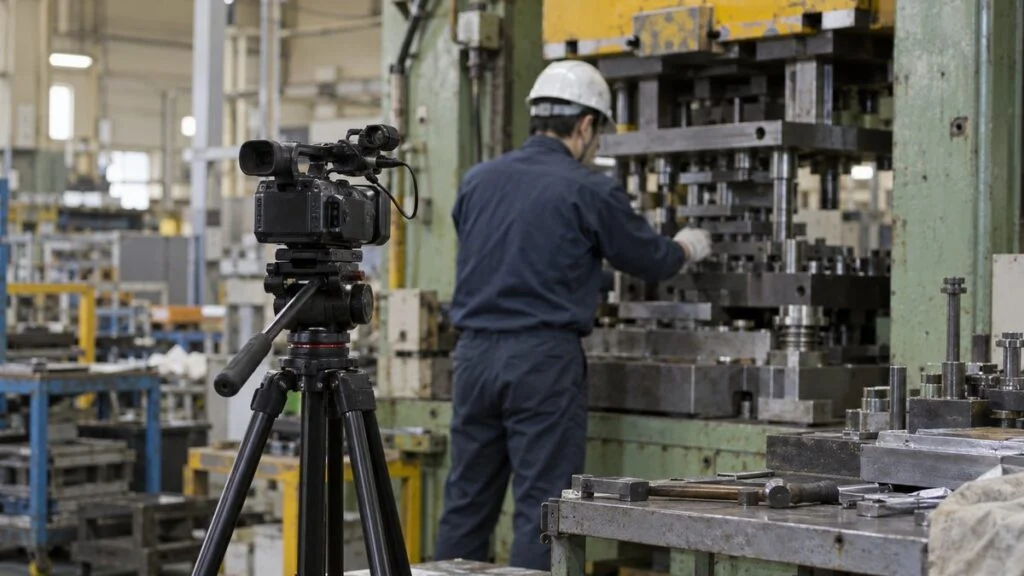
The first three steps make the changeover visible and move out anything that does not need a stopped machine. Skip the measuring and you end up fixing tasks that were never eating the time.
Video the Changeover and Break It Into Elements
Pick equipment where changeover time multiplied by the number of changeovers is large. If it is a bottleneck that keeps downstream processes waiting, the gain spreads across the whole plant.
Record one changeover without a break, from the last part of the old product to the first good part of the new one. Keep the operator in frame when they walk away, not just their hands. Time spent searching, fetching, or asking someone never shows up in hands-only footage.
Before you film, tell the team that the goal is to study the work, not to rate the person. Watch the video together and split it into elements such as fetch, remove, locate, clamp, adjust, and measure, writing down the time for each.
Don't judge from one recording. Changeover time varies with the product pair and the operator, so film several changeovers under different conditions and compare them. That also shows where the variation comes from.
Sort Every Element: Internal, External, or Waste
Put each element into one of three groups: internal setup, external setup, or waste (muda). J-Net21 uses the same three-way split.
One question does the sorting: "Could this be done while the machine is running?" What matters is whether it could be done with the machine running, not whether it is done that way today.
The table below breaks down a fictional press die change. Today all 60 minutes happen with the press stopped, but the question shows that 18 of those minutes could move to running time.
The current 60 minutes split into work elements, sorted into what can move outside and what stays.
Fictional numbers for illustration. Die height (shut height) is the distance from the top of the bolster to the bottom of the slide with the slide at bottom dead center; it is adjusted to match the die.
At this stage, also decide what you will not cut. Safety tasks such as setting safety blocks and locking out the start controls, plus the first-piece check, stay off the reduction list however long they take. Write that down from the start.
Move Work That Doesn't Need a Stop to Running Time
Once the sorting is done, actually move the external tasks to running time. They go to one of two windows: before the machine stops, or after it restarts.
Before the stop, prepare everything the next product needs. Bring the die, jigs, material, tools, drawings, and gauges to the machine, and check the die for chips or dirt at that point. J-Net21 also gives the example of preheating a die before it goes into the machine.
After restart, clean the removed die, return it to the rack, and put the tools away. If a task can wait until the next product is running, it should not happen while the machine is stopped.
To make this happen every time, you need a system that doesn't depend on one person being well organized. Common methods:
- Kit the jigs, tools, and bolts for each part number in one box or cart
- Use a pre-changeover checklist and confirm everything is in place before the stop
- Read the next changeover time off the production schedule and assign who starts preparing, and when
The third point is easy to miss. If no one is assigned to prepare at a set time, the person who stopped the machine ends up fetching things, and the work slides back into internal setup.
Moving work outside takes 60 minutes to 42; shortening the remaining internal setup takes it to 15.
Fictional numbers based on Figure 3. Dark segments show the time the press is stopped.
In the example, moving the 8 minutes of fetching, 4 minutes of searching, and 6 minutes of cleanup outside cuts downtime from 60 to 42 minutes. Those 18 minutes don't disappear. They become labor done while the press runs, and reducing those hours is the job of Step 5.
Step 4: Four Ways to Shorten Internal Setup
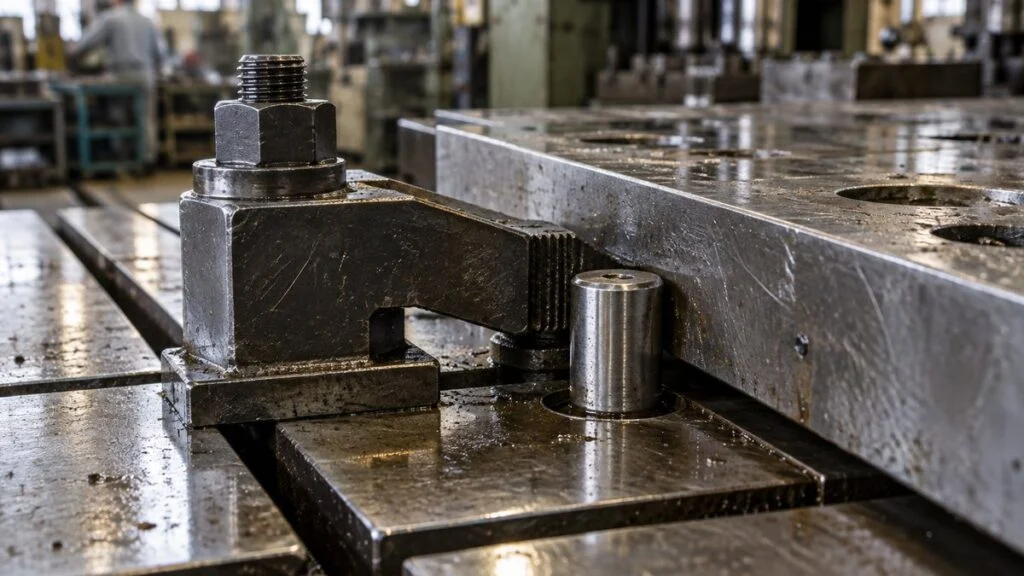
Once everything that can move outside has moved, only work that truly needs a stopped machine is left, and now you shorten the work itself. Look at it from four angles: clamping, locating, parallel work, and adjustment.
Each has a part you can shorten and a check you must not change.
Simplify Clamping
Most of the time spent clamping a die or jig goes into spinning bolts through many turns, not the final tightening. Keep the clamping force the same and cut the number of turns and tool changes.
An easy start is to standardize bolt sizes and head types so one tool does the job. A well-known next step is a slotted (U-) washer or a keyhole slot, which lets you release a die by loosening a bolt instead of removing it. Osaka Sansokan also suggests replacing threaded fasteners with cams or other clamping methods.
Clamping, though, is a direct safety issue. Japan's Ministry of Health, Labour and Welfare (MHLW) lists a fatal accident in which an upper die fell after a die change, with inconsistent tightening of the clamping bolts among the causes. Before you change a clamping method, check the press and die makers' specifications, and keep the step that confirms the die is clamped.
Standardize Locating
Nudging a die back and forth to find its position disappears once you have a reference. The basic fix is locating pins or stop blocks, so that pushing the die against the stop puts it in position.
Also standardize the dimensions that vary from product to product. If die heights and the thickness of the clamping edges are made uniform, using spacers if needed, you don't have to change machine settings with every die. The idea is to standardize only the features involved in mounting, not to make every die identical.
For machining and assembly equipment, a common approach is to build fixtures on a shared base plate in advance and swap the whole base. The cassette approach Osaka Sansokan describes follows the same idea: pre-assemble the parts that change into one unit.
Work in Parallel
On large equipment, one person clamps the front, walks around to clamp the back, then walks back again, and the walking adds up. With two people working front and back at the same time, the walking disappears and downtime drops sharply. If you can't staff two people full time, the person doing external setup can step in for the few minutes the machine is stopped.
In Japan, if the job is a die change on a power press, the helper also needs the legally required special training described below. J-Net21 lists team changeovers among the improvements that cost nothing.
Parallel work only works with agreed roles and sequence. Write down who does what, in what order, and how the team signals before the machine starts. Japan's Ordinance on Industrial Safety and Health (Article 104) requires employers to set signals and name a signal person when starting a machine could endanger workers.
Eliminate Adjustment
Adjustment and trial runs after mounting tend to take a large share of changeover time. In the example, adjustment and trial strokes together take 16 minutes, close to 40% of the 42 minutes that remain as downtime.
Adjustment drags on because people set things by feel every time. Replace nudging a setting little by little while watching a scale with setting it against a block of fixed thickness, and record the settings for each part number so the next changeover can call them up. The goal is to turn "adjust until it's right" into "set to a known value."
The aim is not to drop trial runs but to pass on the first one. The first-piece check itself stays, because it protects quality.
In the example, combining all four methods cuts removal, locating, clamping, adjustment, and trial strokes from 38 minutes to 11. Add the 4 minutes for safety steps and the first-piece check, and downtime is 15 minutes. That is close to single-minute setup, but going further usually means modifying the equipment, so weigh it against the cost.
Steps 5–6: Streamline External Setup and Make It Standard
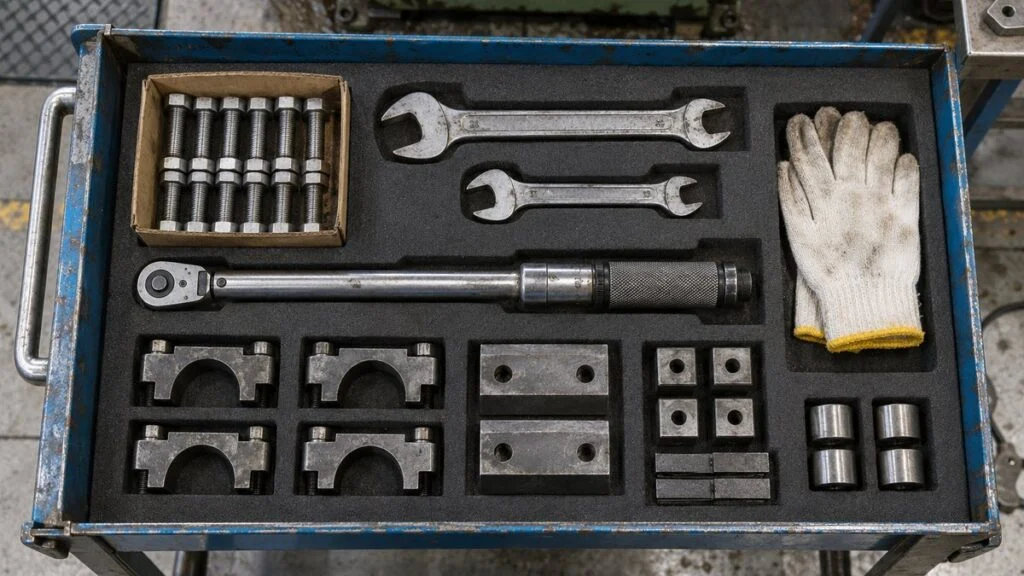
After downtime shrinks, two jobs remain: cutting the labor hours spent on external setup, and keeping the shorter time from creeping back.
Shorten External Setup Itself
External setup doesn't stop the machine, but if preparation takes too long it won't be ready for the next changeover. Store dies and jigs near the machine in order of how often they are used, and set fixed transport routes and carts.
Location labels and return rules follow the same thinking as 5S. Osaka Sansokan lists thorough 5S, written procedures, and training as ways to shorten external setup.
Related: Why 5S Doesn’t Stick: Causes, Fixes, and the Japanese Terms
Die and jig maintenance matters just as much. If you find a problem only after mounting a die, you have to take it off and start again, and the time you saved is gone in one go. Inspect each die right after use and return it to the rack ready for the next run, and count that as part of external setup.
Standardize the Procedure and Target Time
If the improved procedure isn't written down, it drifts back when the operator changes. Put the sequence of elements, tools, safety checkpoints, and target time on one page. For how Japanese plants train people on a written procedure, see TWI Job Instruction and OJT in Japanese Plants.
Then train and keep records. If only a few people can do the changeover, use a skill map to show who can do changeovers on each machine, and train more people on a planned schedule.
Related: Skill Matrix Template: Rikiryo-hyo Japanese Customers Audit
Write down the time, the reason for any delay, and the next action on the same sheet.
As records build up, you see the spread, not just the average. If the target is 15 minutes and one product pair keeps taking 30, that is your next target. Once one machine works, roll the procedure out to machines of the same type.
Safety Steps That Are Never Cut
During changeover, hands and bodies go where they never go in normal operation, such as between die halves or under the slide. That is why Japanese law sets rules for setup work itself. For power presses, Japan's Ordinance on Industrial Safety and Health includes these requirements:
- Article 131-2: when part of the body enters the danger zone while mounting, removing, or adjusting a die on a power press, the employer must have workers use safety blocks or take similar measures against the slide dropping unexpectedly
- Article 131-3: when moving the slide to adjust a die, use the inching function if the press has one, and hand-turn it if not
- Article 107: when adjustment work on a machine poses a hazard, stop the machine and lock the start device or attach a sign, to keep anyone else from starting it
- Article 36, item 2: mounting, removing, and adjusting power press dies requires special training (tokubetsu kyoiku)
- Article 134: the press operations chief (sagyo shunin-sha) directly supervises die mounting, removal, and adjustment
An operations chief is required at workplaces with five or more power presses (Order for Enforcement of the Industrial Safety and Health Act, Article 6, item 7; Ordinance, Article 133). The rules focus on presses, but the principles carry over to other equipment: stop it, secure it so it can't move, and have trained people do the work.
Outside Japan, follow your own country's rules. In the US, for example, OSHA's mechanical power press standard (29 CFR 1910.217) requires employers to provide and enforce the use of safety blocks whenever dies are adjusted or repaired in the press, and lockout/tagout falls under 29 CFR 1910.147. Your safety team decides what applies to your equipment.
Reduction targets how the work is done, never the checks below.
Typical examples that combine legal requirements in Japan with practical precautions. Set your actual procedure from the equipment manual and your own risk assessment.
MHLW's case database also describes a worker killed when an injection molding die, handled without a crane, tipped over onto him. The causes included having no written work procedure, and the recommended fix was a procedure that covers handling heavy loads.
Set the target time with these checks included. Never let a situation arise where skipping a safety step is the only way to hit the target. That responsibility sits with the people driving the improvement.
Related: Lockout/Tagout in Japan: Japanese Law vs. OSHA 1910.147
What to Do With the Time You Save
Once changeovers are shorter, you have two choices for the time. The fictional example continues here.
Say one machine makes four products, and each needs 2,000 pieces a month. Today each product runs twice a month in batches of 1,000, so there are eight changeovers a month and 480 minutes of downtime. Now the changeover drops from 60 minutes to 15.
With changeover down from 60 to 15 minutes, keeping the number of changeovers or keeping total downtime gives different results.
Fictional numbers for illustration. Safety stock is not included.
Which option fits depends on the machine. If it lacks capacity for the orders and holds up downstream processes, Option 1, putting the freed time into production, is the right call.
If capacity is fine but inventory and work in process pile up, choose Option 2. More changeovers and smaller batches shorten the wait between making a part and using it. Rush orders also become easier to slot in, which helps cut overtime.
What you want to avoid is filling the freed time with more parts than anyone needs. Machine utilization looks better, but the plant only gains inventory with no confirmed sale date, and nothing improves overall.
Common Mistakes in Setup Reduction
Even with the steps in hand, projects stall or slide back. Five mistakes come up often:
- Just telling operators to hurry. Moving hands faster saves little and raises the risk of missed checks and injuries. Target what the work contains: searching, carrying, turning bolts, adjusting.
- Measuring too narrow a window. If you only time up to the end of the die swap, adjustment and trial runs fall out. Go back to the definition: measure until the first good part.
- Starting with capital spending. Automatic clamps and die-change equipment work, but bought before you move work to external setup, they leave the searching and waiting untouched.
- No owner for external setup. If it's unclear who prepares what and when, preparation falls behind on busy days and the team goes back to fetching after the stop.
- Stopping measurement once times drop. Without records, you won't notice the procedure slowly slipping. Keep comparing actual times to the target as part of the improvement.
Checklist: Questions to Settle With the Japanese Side
If a Japanese parent company, customer, or consultant is driving a dandori project at your plant, settling these points up front avoids arguments about the numbers later. Setup reduction is a joint effort: production engineering (seisan gijutsu) designs the process and fixtures, manufacturing runs the daily changeovers, and production control sets batch sizes and sequence, so involve all three.
- Measurement window: Does the clock run from the last good part to the first good part, as in JIS Z 8141? Or does your side stop at "die mounted"?
- What is excluded from reduction: Which safety steps and quality checks (lockout, safety blocks, first-piece check) are fixed and included in the target time?
- Target: Is the target "single dandori" (under 10 minutes) or a percentage cut from today's baseline? Which machines and product pairs does it cover?
- Owner of external setup: Who prepares the next die, material, and tools, and how far ahead of the scheduled changeover?
- Changes to clamping or locating: Who approves changes to dies, jigs, or clamps, and do the press and die makers need to sign off?
- Training and qualification: Which local legal requirements and company qualifications apply to die setters? Do helpers in parallel work need the same training?
- Records: Which format do they want for changeover records (time, conditions, findings), and who reviews them?
- Use of saved time: Will freed time go to more output (Option 1) or smaller batches (Option 2)? Who in production control decides?
A short message you can adapt:
Before we start the changeover (dandori) reduction on Press 3, could you confirm three points? (1) We plan to measure from the last good part of the previous product to the first good part of the next. (2) Safety blocks, lockout, and the first-piece check will stay in the procedure and are included in the target time. (3) Any change to die clamping will be checked against the press and die makers' specifications before we try it. Please let us know if your standard differs.
Where This Guide Does Not Apply
- The 60-minute breakdown and the 15-minute result are a fictional example. Real savings depend on the equipment, product mix, and staffing.
- The legal requirements listed are Japan's rules for power presses. Plants in the US, India, or Southeast Asia must follow their own national rules and company standards.
- Definitions and target times vary by company and industry, so confirm them with the team you work with.
FAQ
What does "single-minute" mean in SMED?
It means a single-digit number of minutes, so a changeover of under 10 minutes. JIS Z 8141 calls internal setup of under 10 minutes single dandori. It does not mean one minute.
What is the difference between internal and external setup?
Internal setup (uchi-dandori) is work done with the machine or line stopped. External setup (soto-dandori) is work done while it keeps running. The same task, such as bringing the next die, can be either one, depending on when it is done.
What does "dandori" mean in Japanese manufacturing?
Dandori means setup or preparation. Dandori gae is a changeover between products, and JIS includes preparation of materials, tools, and drawings plus trial processing in it, not just swapping the die.
Should changeover time include trial runs and inspection?
Yes. Measure from the last good part of the previous product to the first good part of the next. Stopping the clock when the die is mounted leaves out adjustment and trial runs, which are often where the biggest savings are.
Sources
- Definitions of changeover, internal/external setup, and single-minute setup: Japanese Standards Association, JIS Z 8141:2022 Glossary of terms used in production management (term 5107; text checked on a JIS viewing page) (Japanese)
- Internal/external setup and the order of improvement: Japan Industrial Engineering Association, IE terms: Setup (Japanese)
- Setup and adjustment loss: JMAC TPM Online, "The 16 major losses" (Japanese)
- Shingo's books: Shigeo Shingo, Shinguru Dandori e no Gententeki Shiko, Japan Management Association, 1983; Shigeo Shingo, A Revolution in Manufacturing: The SMED System, Productivity Press, 1985 (checked on National Diet Library Search)
- History of SMED (Toyo Kogyo, Mitsubishi Heavy Industries, Toyota): Nikkan Kogyo Shimbun, Newswitch, May 4, 2023 (from Kojo Kanri, April 2023), citing Shigeo Shingo, Toyota Seisan Hoshiki no IE-teki Kosatsu (1980). Example of a source dating it to 1969: Aperza News (Japanese)
- Shingo's career: JMAC, Quality Management Institute newsletter Vol. 10 (Japanese)
- Basic steps for setup improvement: J-Net21 (Organization for Small & Medium Enterprises and Regional Innovation, Japan) (Japanese)
- Six steps and practical measures: Osaka Sansokan, "Reducing changeover time for high-mix, low-volume production" (Japanese)
- Ordinance on Industrial Safety and Health, Articles 36, 104, 107, 131-2, 131-3, 133, 134: e-Gov Laws (Japanese)
- Operations chief requirement (Article 6, item 7): e-Gov Laws, Order for Enforcement of the Industrial Safety and Health Act (Japanese)
- Accident cases: MHLW Workplace Safety Site, upper die falls from a hydraulic press; worker crushed by an injection molding die during maintenance (Japanese)
- US press safety blocks: OSHA 29 CFR 1910.217, Mechanical power presses
Original article in JapaneseThis guide is adapted from a MONOSCOPE article written for readers in Japan: 段取り替え時間の短縮手順|内段取り・外段取りの分け方とSMEDの進め方
About the editor
 MONOSCOPE EditorFOUNDER & EDITOR
Spent about ten years at a plant equipment maker and a plant engineering company, proposing, designing, and commissioning equipment, then moved into web marketing. Now a web consultant for B2B manufacturers, helping them explain their products and technology. Licensed in Japan as an Energy Manager and a Third-Class Chief Electrical Engineer.
Has run an engineering blog since 2017 (500+ articles) and a Japanese YouTube channel with about 20,000 subscribers. Each English guide is written from the Japanese shop-floor point of view and checked against the cited standards.