Why 5S Doesn’t Stick: Causes, Fixes, and the Japanese Terms
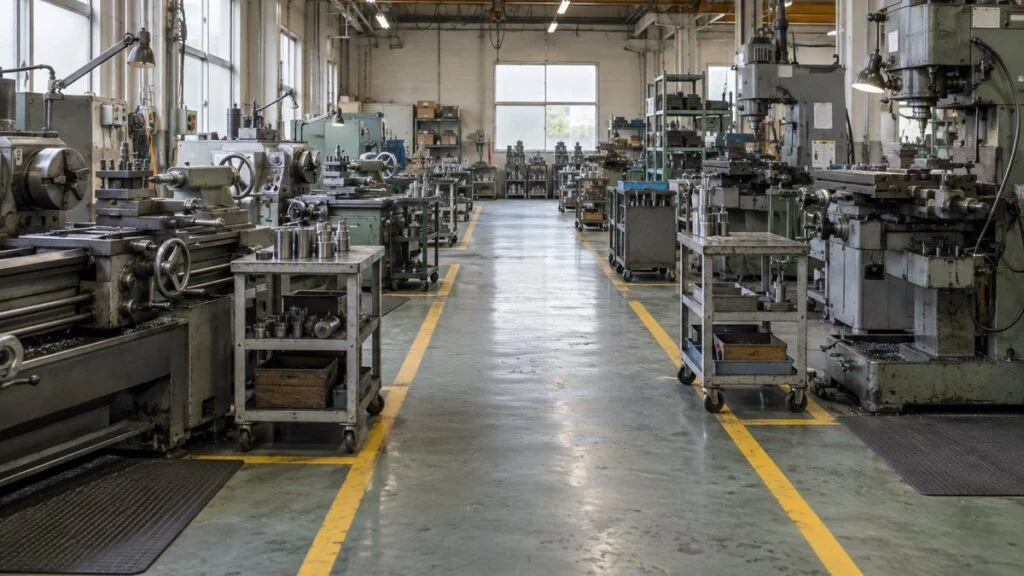
The day before a visit from the Japanese parent company, the line looks spotless. Tools hang on their shadow boards, the aisles are clear, and every rack is labeled. A week later, cartons are back in the aisle and the torque wrench is sitting on a machine guard again. If you work at a Japanese-owned plant in the US, India, or Southeast Asia, you have probably seen this cycle, and you may have been asked to fix it.
5S is the practice of keeping a workplace sorted, organized, and clean, and of keeping it that way. When it does not stick, the cause usually lies in one of four places: how the purpose was explained, how the rules were written, whether audit findings actually get closed, and whether managers give the floor the time and decisions it needs. A lack of discipline is rarely the whole story.
This guide starts with what the five Japanese words actually mean, because the usual English labels hide the part that matters most. It then covers the symptoms of 5S that has not stuck, how to find the cause, fixes for each cause, a routine that keeps 5S going, how to measure whether it has stuck, and a six-step restart from one model area.
Contents
- The Five Japanese Words Behind 5S
- Signs That 5S Has Not Stuck
- Four Places to Look for the Cause
- Fixes for Each Cause
- A Routine That Keeps 5S Going
- How to Tell Whether 5S Has Stuck
- Restarting 5S: Six Steps from One Model Area
- If Your 5S Program Comes from a Japanese Parent Company
- Limits of This Guide
- Key Takeaways
- FAQ
- Sources
The Five Japanese Words Behind 5S
The five S's are the romanized initials of five Japanese words: 整理 (seiri), 整頓 (seiton), 清掃 (seiso), 清潔 (seiketsu), and 躾 (shitsuke). In English they are usually taught as Sort, Set in Order, Shine, Standardize, and Sustain. Japan's standard for production management terms, JIS Z 8141:2022 (term 5603), defines 5S as the five practices that form the basis of workplace management, and gives a short definition for each.
Two plants can both say they "do 5S" and mean very different things.
(Sort)
(Set in Order)
(Shine)
(Standardize)
(Sustain)
Definitions summarized from the notes to JIS Z 8141:2022, term 5603. The English labels in parentheses are the common Western ones, not part of JIS. The "for show" and "has stuck" columns are our own summary.
Two of the five are often misread. Seiketsu literally means "clean" or "hygienic," and the JIS definition describes a condition: the first three S's are repeated, so the workplace stays clean. The English label "Standardize" can suggest writing procedures, but the JIS definition is about the result: a clean state that holds. Shitsuke is the everyday Japanese word for upbringing or training manners, so it is easy to read as "discipline." The JIS definition is narrower: always follow what has been decided, and make it a habit. Neither word is about scolding people or polishing the floor for a visit. Both describe an ongoing state.
Put that way, "5S does not stick" has a precise meaning. The plant has done seiri, seiton, and seiso at least once, but seiketsu and shitsuke are not running. In Japanese practice, 5S is treated as the groundwork for kaizen and quality control, so when it slips, gains from standard work and waste reduction tend to slip with it.
Signs That 5S Has Not Stuck
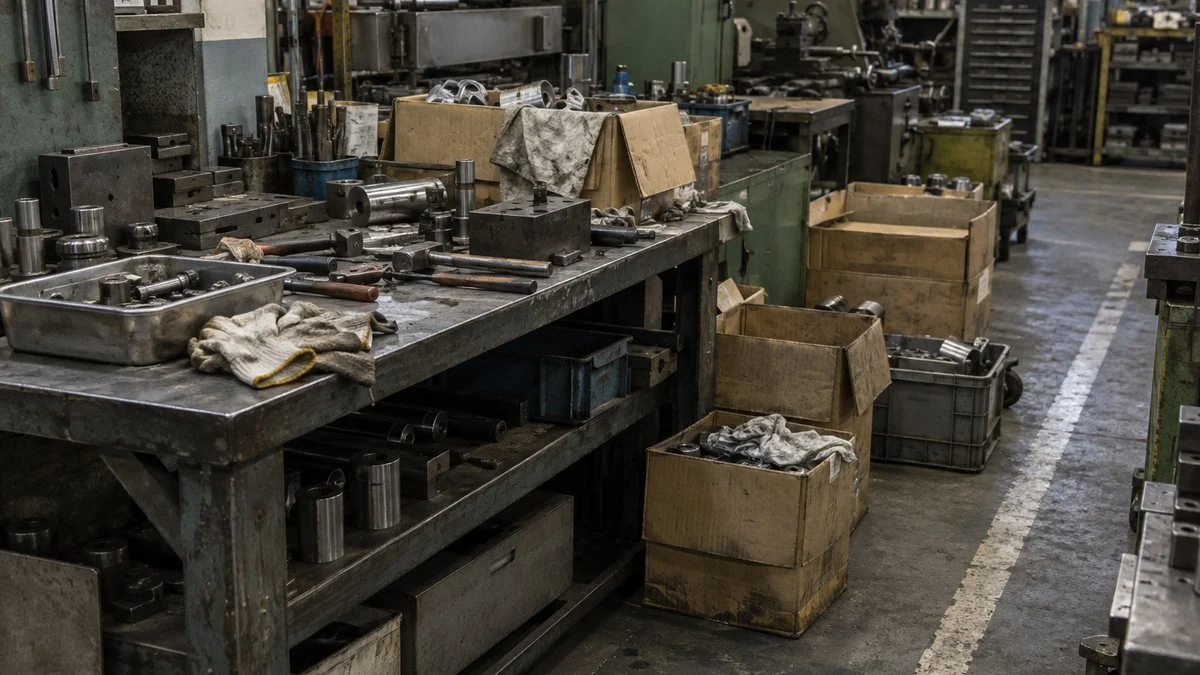
The real problem is not that the floor gets messy. It is that the clean state appears only on special days, such as the day before an audit or a customer visit. The table below lists common symptoms, a question to ask on the floor, the likely cause, and a first step. One symptom can have more than one cause, so it is normal for several rows to apply.
For each symptom: the question to ask first, the likely cause, and a first step.
The likely causes are a starting point. Several causes often overlap in one symptom.
Four Places to Look for the Cause
Four checkpoints help you narrow down why 5S is not holding: purpose, rules, follow-up on findings, and manager support. This is not a complete list of causes. It is a way to decide where to start in your own area. Most plants find that two or more apply at once.
Any checkpoint where the answer is "no" is a candidate to fix first.
Purpose Not Tied to Real Problems
If 5S starts only because "it's basic" or "the customer audit requires it," the floor sees nothing but extra work. Japan's Organization for Small & Medium Enterprises and Regional Innovation (SMRJ) describes 5S as a way to improve quality, cost, and delivery (QCD), and says management should first explain why the company is doing it, so that the purpose and targets are shared company-wide.
Testing this is simple. Ask an operator, "What gets easier for you when we do 5S?" If the answer stops at "it looks clean" or "we don't get yelled at," the purpose has not reached the actual work.
Rules That Cannot Be Followed
J-Net21, SMRJ's business support site, sorts the reasons 5S rules are not followed into two groups. One is operator negligence. The other is that the work environment has changed and the old rules no longer fit. Its examples include a process change that makes the set location hard to reach, rules that are vague, and too many items to fit back in the same place.
In those cases, people cannot follow the rule even if they want to. When labels and actual items do not match, suspect this group first.
Findings That Never Get Closed
The same J-Net21 guidance runs 5S through a plan-do-check-act (PDCA) cycle and says that checking and correcting the rules after they start, not writing them, is what makes 5S real. Many plants put plenty of energy into writing rules and the big first cleanup, and then the checking fades.
If you run regular 5S patrols (audits) and 5S still does not hold, look at what happens after each finding. If findings are not listed, have no due date, or nobody confirms they were fixed, you have inspection without correction.
Not Enough Support from Managers
If cleanup time is not in the schedule, it gets skipped on busy days. Adding shelves, moving a storage area, or scrapping a fixture nobody has used in years are decisions operators cannot make alone. Time, space, and decisions are three things only managers can provide.
J-Net21 also says that 5S does not run smoothly on slogans and verbal explanations alone, that shitsuke is what makes it last, and that the plant manager or company president should lead it company-wide. Check whether "we leave it to the floor" really means "nobody decides."
Fixes for Each Cause
Each fix maps to one of the four checkpoints. You do not need to do everything at once. Start with the checkpoints that got a "no" in Figure 3.
Restate the Purpose as "Searching, Tripping, Mistakes"
Translate the purpose into problems operators feel every day. Three work well: searching, tripping, and mistakes. Stop wasting time searching for tools, keep people from tripping in the aisles, and stop picking the wrong one of two similar parts. Framed that way, 5S becomes a way to make their own jobs easier.
Safety is part of the reason, too. Japan's Ministry of Health, Labour and Welfare (MHLW) describes 4S (the first four S's) as an activity for a safe, healthy workplace that also raises productivity, and stresses that cleaning helps prevent falls and other accidents. Training material from the Shiga Labour Bureau puts it in concrete terms: seiri secures space in aisles and work areas where people can work safely, and seiso removes water and oil from floors so people do not slip and fall. In Japan's final figures for 2025, manufacturing had 26,371 workers killed or injured with four or more days off work. Falls accounted for 5,732 of them, about one in five, second only to caught-in or caught-between accidents (5,992).
Related: Kiken Yochi (KY) Training: Japan’s Hazard Prediction Method
Rewrite Rules So People Can Follow Them

Seiri usually breaks down at the line between "needed" and "not needed." J-Net21 describes the red tag method, where you set the criterion first: anything used in the next month's production plan is needed, and everything else gets a red tag. For items whose future use is unclear, set a waiting period, for example one month for materials and three months for machines. If the item is used within that period, the tag comes off.
Decide four things up front: the criterion, the deadline, the person who decides, and where held items go. Move "might need it someday" items to a holding area with a deadline, and have the decision-maker choose to scrap or keep them when it expires. Without a decision-maker, the holding area just becomes a new storeroom.
For seiton, judge storage by how easy it is to put things back, not by how neat it looks. Japanese plants commonly use santei (三定, the "three fixes": fixed location, fixed item, fixed quantity) and shadow boards that show the outline of each tool. J-Net21 also lists signboards that mark storage locations and shadow boards, and says seiton takes ingenuity and trial and error.
Rules hold up better if you list the exceptions before you write them: work-in-process that piles up at month-end, shared tools used by several teams, and handovers between shifts. Set an overflow location and a maximum quantity, and less material ends up parked in the aisle.
When a rule still is not followed, ask why and fix the rule. J-Net21 says managers should find out why items are not put back and work out the fix together with operators rather than handing down orders. Asking about specific situations shows you what to change.
Instead of "Why don't you put it back?", ask about a specific situation.
The answers are hypothetical examples. Decide what to review based on the answers you actually get.
This is much the same approach you would use when a work standard is not followed: separate problems with the person from problems with the system before you act.
Related: Standardized Work Instructions: Sagyo Hyojunsho Template
Track Findings to Closure
Do not write a patrol finding as "items in the aisle." Write where, what, and against which rule: "Three empty pallets inside the marked aisle on Line 2." Then the person fixing it and the person checking it picture the same thing. Pairing the fact with the requirement is the same idea as writing a nonconformity in an ISO 9001 internal audit.
Give each finding an owner, a due date, and a person who verifies closure, and post the list where everyone can see it. Keep two kinds of findings separate: those fixed on the spot by putting something back, and those that need a storage change or an equipment repair. The second kind cannot be closed by the floor alone, so pass them to managers for a decision.
Give the Floor Time, Space, and Decisions
Walking the floor and saying hello is not enough. Managers own three jobs: putting cleanup and cleaning time into the plan, adjusting storage space and quantities, and deciding on issues the floor cannot decide, then giving an answer. For more on what a Japanese plant manager (kojo-cho) is expected to own, see our separate guide.
Just as you audit the floor, give managers their own checklist so 5S does not fall entirely on the coordinator. For example:
- Did we put cleanup and cleaning time into this month's production plan?
- Did we decide on every pending request to scrap or relocate items?
- Did we answer every improvement request from the floor, with a yes or no and the reason?
- Did we review the findings list and find out why open items are still open?
When requests get no answer, the floor stops making them. Safety reporting works the same way: once reports stop getting a response, people stop sending them, as we explain in our guide to hiyari hatto (near-miss) reports.
A Routine That Keeps 5S Going
Once the fixes are in place, set up a routine that keeps them running. Define five things: when, who, what to check, what to do when there is a problem, and who confirms it is done. The table below is one example. Adapt it to your headcount and shift pattern.
Four timings (daily, weekly, monthly, and at every change), each with its own owner and checks.
Frequencies and job titles are examples. A small plant can combine the weekly and monthly checks.
Make Daily Cleanup Part of the Job
"Clean up when you have a free moment" means the area stays messy on the busiest days. Set aside a fixed slot at the end of the shift or before shift change for cleanup and cleaning. Five or ten minutes is fine, as long as it is built into the production plan or standard time.
How much time you need depends on the size of the area and what you handle. A practical approach is to measure it for about a week and then set a length people can keep up. If the plan relies on overtime, it will not last.
Use Patrols to Track Fixes, Not to Score
Scoring areas with a 5S audit checklist is common, but chasing the score alone teaches people to clean up for audit day. Pay more attention to whether last time's findings were fixed and whether the same findings keep coming back.
When patrols turn into fault-finding, the floor starts hiding problems. The people doing the patrol should ask on the spot why something happened, and if the cause is storage space or quantity, take it back to managers for a decision.
Turn Cleaning into Inspection
J-Net21 notes that seiso also serves to monitor and check the condition of the work area, equipment, and work. When you wipe down a floor or a machine, you notice oil seepage, loose bolts, or a change in how chips build up. Cleaning is the most direct, everyday chance to check how equipment is doing.
Add two or three "points to look at" to the cleaning procedure, and cleaning becomes inspection. Operators taking on daily cleaning, lubrication, and inspection is the core idea of jishu hozen (autonomous maintenance). Catching small problems early also helps cut equipment losses such as minor stoppages (choko-tei) and improves overall equipment effectiveness (OEE).
Related: OEE and the 7 Big Losses vs. Six Big Losses in TPM
Decide in Advance When Rules Get Revised
Rules fit the work as it was when they were written. When products are added, the layout changes, or people turn over, it is natural for them to stop fitting. Decide ahead of time what triggers a review: a process or product change, the same finding twice in a row, or a new person getting confused. The "At every change" row in Figure 5 is there for this.
How to Tell Whether 5S Has Stuck
Judge whether 5S has stuck from records, not from how the floor looks. You do not need to compare against national statistics or other companies. Keep measuring your own area the same way and watch the trend.
Do not set one target for everyone. Keep the measurement method the same and watch the trend.
You do not need a stopwatch. A tally mark each time someone searches is enough to show the trend. Repeat findings and overdue corrections can be counted straight from the findings list.
The other test is what happens when things get busy. If the area holds up in a month when orders jump or a week when you are short-staffed, the rules fit the workflow. If it slides back every peak, either the time allowance or the storage quantities are unrealistic.
Restarting 5S: Six Steps from One Model Area

When you restart 5S after it has stalled, do not begin with a plant-wide cleanup. Narrow the scope to one area. A column from the business consultation office at Sansokan (大阪産業創造館), a small-business support center in Osaka, recommends starting small, for example with storage for frequently used items, and building up small successes.
The bottom line of each step shows when you are ready to move on.
If step 04 shows the rules are hard to use, go back to 03. If the area does not hold in 05, go back to 04. The steps are not meant to run in a straight line.
To show how the steps fit together, here is one hypothetical example: shared measuring instruments and tools used by several teams in a machining area. (This is an illustration, not a real case.)
Steps 1–3: Define the Problem, Baseline, and Cause
First, state the problem in one sentence: "People often have to search for the shared micrometers and hex keys." Next, photograph the storage area and keep a tally of searches for one week. Without that baseline, you cannot show the effect later.
Then ask operators why, using the questions in Figure 4. Suppose the answers are "The rack is far away, so I leave it next to my machine" and "When I tried to put it back, something else was in the spot." That points to the rules, not to operator attitude, as the likely cause.
Step 4: Trial Temporary Rules Before You Lock Them In
Draft a plan. For example, give each machine its own set number of the most-used tools, and keep only the truly shared items on one shadow board. Do not build polished signs or custom racks at this stage.
Use painter's tape and handwritten labels for about two weeks, and fix spots that are hard to return to or items you are short of. If you lock the rules in without a trial period, you will be back to "labels don't match the items" within a few months.
Steps 5–6: Run the Routine and Decide Whether to Expand
Once the rules settle, build them into the routine: operators check before the end of each shift, and the team leader checks once a week. Keep the search tally going and compare it with the baseline.
If the area holds up through a busy week, post the before-and-after photos and records, and let managers decide whether to expand. Do not roll out plant-wide before the first area is running on its own. If the effort depends on one coordinator running around, it stops the day that person is transferred.
When you expand, do not copy the model area's rules. Repeat the steps from Step 1, because a different area has different problems and needs different rules it can actually follow.
If Your 5S Program Comes from a Japanese Parent Company
At Japanese-owned plants abroad, 5S often arrives with a checklist, an audit schedule, or rules modeled on a plant in Japan. The same logic applies: rules that fit one plant's processes may not fit yours. Use the questions below with your Japanese managers or the parent-company team, and use the checklist to review your own area.
Questions to Ask the Japanese Side
- What problem do you most want 5S to solve here: searching, safety in the aisles, mix-ups, or audit results?
- Which rules came from the plant in Japan, and which can we change to fit our process and layout?
- Who has authority to scrap red-tagged items, add storage, or change a layout, and how fast can we get a decision?
- Can end-of-shift cleanup time be included in the production plan and standard time?
- In audits, will you look at whether findings were closed and stay closed, or mainly at the score?
- When an audit finding needs money or a layout change, who answers, and by when?
Checklist: Is Your 5S Built to Last?
- Operators can explain what 5S makes easier for them in their own words
- Red-tag criteria, holding deadline, decision-maker, and holding area are all set
- Locations that tend to overflow have a maximum quantity and an overflow location
- Labels and storage are reviewed on the same day as any process or product change
- Every finding has an owner, a due date, and a person who verifies closure
- Findings that need money or layout changes go to managers, and the floor gets an answer
- Cleanup time is in the production plan, not left to overtime
- Cleaning procedures include two or three points to look at on the equipment
- You track searches, repeat findings, and overdue corrections, and the numbers hold up in busy periods
Limits of This Guide
The four checkpoints, the routine table, and the six steps are a way to organize the problem, not a standard. Frequencies, job titles, and red-tag periods vary by company, industry, and plant size. Treat the numbers here as examples. Where 5S overlaps with safety, such as aisle markings or cleaning around machinery, follow your plant's safety rules, the people responsible for them, and local regulations.
Key Takeaways
- Do not blame attitude alone. Sort the cause into purpose, rules, follow-up, and manager support.
- In JIS Z 8141, seiketsu is the state where the first three S's keep repeating, and shitsuke means always following what was decided until it becomes a habit.
- When a rule is not followed, ask about the specific situation and fix the location, quantity, or timing.
- Define who checks what and when, and who confirms that open items are closed.
- Restart in one model area, confirm with records, and only then expand.
Starting 5S is easier than keeping it going. Plants where it lasts are not filled with unusually motivated people. They have rules people can follow and a way to fix the rules when things slip. Start by finding the rows in Figure 2 that match your own area.
FAQ
What Do Seiri, Seiton, Seiso, Seiketsu, and Shitsuke Mean?
They are the five Japanese words behind 5S. Seiri means separating needed from unneeded items and discarding the unneeded ones. Seiton means keeping needed items in set places so they are ready to use. Seiso means cleaning. Seiketsu is the state where the first three keep being repeated, and shitsuke means always following agreed rules until they become habit.
Why Does 5S Fail to Stick?
Usually because one or more of four things is missing: a purpose tied to real problems on the floor, rules people can actually follow, follow-up that closes audit findings, and manager support in the form of time, space, and decisions. Operator attitude is only part of the story.
Is Shitsuke the Same as "Discipline"?
Not in the sense of punishment. JIS Z 8141 defines shitsuke as always following what has been decided and making it a habit. When a rule keeps being broken, the useful question is why it cannot be followed, and the answer is often to change the rule.
How Do You Measure Whether 5S Is Sustained?
Track three records in your own area: how often people search for tools, how many audit findings repeat, and how many corrections are overdue. If all three fall and stay down during busy periods, 5S is close to sticking.
Sources
- Definition of 5S: JIS Z 8141:2022 Glossary of terms used in production management, term 5603 "5S" (Japanese); bibliographic data: Japanese Standards Association, JIS Z 8141:2022 (Japanese)
- Seiri and seiso for fall prevention: Shiga Labour Bureau, "Basics of Workplace Safety" (Japanese)
- 4S/5S and workplace safety: MHLW Workplace Safety Site, "4S" (Japanese)
- Occupational injury statistics: MHLW, occupational accident statistics for 2025 (Japanese); MHLW, final figures for 2025, Table 4 (Japanese)
- Why 5S rules are not followed, PDCA follow-up: J-Net21, "How to make 5S take root on the shop floor" (Japanese)
- Red tags, seiton methods, cleaning as inspection, leadership of shitsuke: J-Net21, "How to approach 5S for factory improvement" (Japanese)
- Purpose of 5S and how to start: SMRJ, "5S Activities Explained in Manga" (Japanese)
- Starting small: Sansokan (Osaka) business consultation office, "How to make 5S stick" (Japanese)
Original article in JapaneseThis guide is adapted from a MONOSCOPE article written for readers in Japan: 5Sが定着しない工場の共通点|原因別の対策と続く仕組みの作り方
About the editor
 MONOSCOPE EditorFOUNDER & EDITOR
Spent about ten years at a plant equipment maker and a plant engineering company, proposing, designing, and commissioning equipment, then moved into web marketing. Now a web consultant for B2B manufacturers, helping them explain their products and technology. Licensed in Japan as an Energy Manager and a Third-Class Chief Electrical Engineer.
Has run an engineering blog since 2017 (500+ articles) and a Japanese YouTube channel with about 20,000 subscribers. Each English guide is written from the Japanese shop-floor point of view and checked against the cited standards.