Lockout/Tagout in Japan: Japanese Law vs. OSHA 1910.147
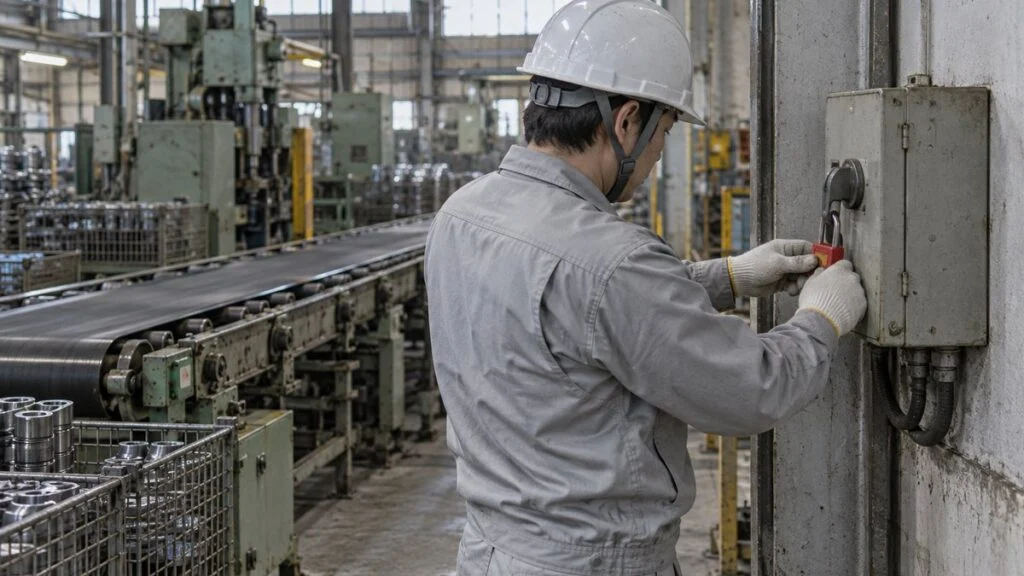
Your plant is owned by a Japanese company, or a production line has just arrived from a Japanese machine builder. The Japanese maintenance manual says to stop the machine, lock the starting switch, and hang a sign. Your corporate EHS team, or an OSHA inspector, expects a written energy control program, machine-specific procedures, and an annual inspection record. Both describe lockout/tagout, but not in the same depth.
Lockout/tagout (LOTO) means cutting off every energy source before people service a machine, then holding that state with locks and tags so nobody can restart it while they work. Japanese law requires the core of this: stop the machine, and lock or sign the starting device. The US standard, OSHA 29 CFR 1910.147, goes further and turns LOTO into a documented program with procedures, training, and periodic inspections.
This guide explains what LOTO covers, which Japanese rules and standards apply, and where they differ from OSHA. It then walks through the six-step sequence, release and group lockout, and common failures. It ends with a checklist and questions for plants that need one LOTO standard across Japanese and local teams. It describes what to check and who decides. It is not a work procedure for any machine.
- LOTO means isolating every energy source and holding it isolated with locks and tags before cleaning, inspection, or repair.
- A lock makes the isolating device physically impossible to operate. A tag tells others who stopped it and why. Locks are the primary means; tags support them.
- In Japan, Articles 107 and 339 of the Ordinance on Industrial Safety and Health require stopping machines and locking or signing starting devices and switches. The law never uses the word "lockout/tagout."
- OSHA 1910.147 adds written procedures, training for three groups of employees, annual inspections, and rules for groups, contractors, and shift changes. The same six-step order works under both, but the Japanese articles do not spell out these program elements.
Contents
- What Is Lockout/Tagout (LOTO)?
- Why "Stopped" Does Not Mean "Safe"
- LOTO in Japanese Law and Standards
- Japanese Law vs. OSHA 1910.147: Where They Differ
- Energy to Isolate: Not Just Electricity
- The Six-Step LOTO Sequence
- Release, Personal Locks, and Group Lockout
- Making LOTO Stick: Procedures, Devices, Training, Inspections
- Common LOTO Failures
- Harmonizing LOTO Across Japanese and Local Teams
- Limits of This Guide
- Lockout/Tagout FAQ
What Is Lockout/Tagout (LOTO)?
Lockout/tagout is a safety method for any job where people reach into a machine's danger zone, such as cleaning, inspection, or repair. You isolate the energy sources and keep them isolated with locks and tags until the job is done. Japanese plants use the English term in katakana, rokku auto / tagu auto, and the abbreviation LOTO.
Lockout means placing a lock on an energy-isolating device, such as a breaker or a main valve, so that nobody can physically operate it. Tagout means hanging a tag on the device, with a message such as "Work in progress. Do not operate," to show who stopped it and why.
The two do different jobs. The lock makes restart impossible, and the tag explains why restart is not allowed. A tag alone can be missed or ignored, so where a device accepts a lock, the lock is the primary means and the tag is used with it.
A lock prevents operation. A tag explains why operation is not allowed.
Under OSHA 29 CFR 1910.147, lockout is the rule for devices that can be locked out. Tagout alone is allowed only when the employer can show it gives protection equivalent to lockout.
"Energy" here is not limited to electricity. It includes compressed air, hydraulic pressure, parts that can fall under gravity, springs, heat, and chemicals in piping. LOTO starts from one idea: any energy that can move the machine or hurt someone must be isolated.
Why "Stopped" Does Not Mean "Safe"
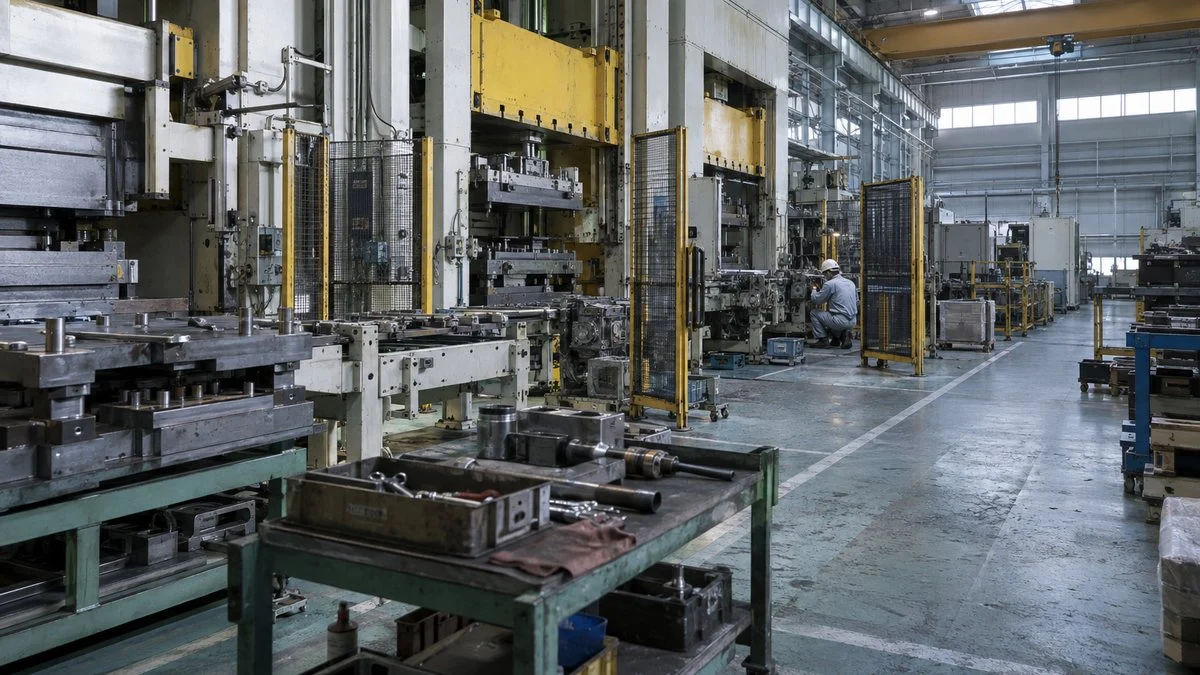
While a machine runs normally, guards and safety devices protect people. Cleaning, lubrication, inspection, repair, and adjustment are different. Workers remove guards or reach inside the machine, so they work with the usual safeguards out of the way. Japan's Ministry of Health, Labour and Welfare (MHLW) counted 4,692 deaths and injuries from machinery caught-in and caught-between accidents in Japanese manufacturing in 2024, nearly one-fifth of the sector's total of 26,676.
Two fatal cases published on MHLW's Workplace Safety Site show how this happens:
- Overhead crane: A maintenance worker inspecting the crane girder was crushed between the moving trolley and an electrical panel. The main power had not been switched off, there was no "Do not operate" sign in the cab, and the inspection had not been scheduled with the crane operators. They moved the crane without knowing anyone was on it.
- Power press: Two workers were on a press. For some reason, the worker at the rear had put his body between the upper and lower dies. His coworker at the front pressed the operating button, and the rear worker was fatally crushed when the dies moved. The rear light-curtain safety device had been out of order for some time and was still in use.
In both cases, "the machine is stopped" and "nobody would start it" were not the same as "the machine cannot start."
The risk appears wherever isolation, locking, or communication is missing.
A typical sequence based on accident cases on the MHLW Workplace Safety Site.
Ideally, these hazards are identified when equipment is introduced or when work procedures are reviewed. Daily routines such as kiken yochi (KY) hazard prediction and hiyari hatto near-miss reports are other chances to spot skipped isolation steps before they cause an injury.
Related: Risk Assessment in Japanese Plants vs. JHA, HSE, ISO 12100
LOTO in Japanese Law and Standards
Japanese law does not use the term "lockout/tagout." Its substance, stopping the machine, locking the starting device, and attaching a sign, is an employer duty under the Ordinance on Industrial Safety and Health (Rodo Anzen Eisei Kisoku, often shortened to Anei-soku). This is the ordinance under Japan's Industrial Safety and Health Act. It applies to workplaces in Japan, not to Japanese-owned plants abroad, which follow local law.
Article 107: Stopping Machines for Cleaning and Similar Work
Article 107 covers cleaning, lubrication, inspection, repair, and adjustment of machines (blade parts are covered separately in Article 108). When the work could endanger workers, the employer must stop the machine. There is an exception for work that can only be done while the machine runs, provided the employer takes measures such as guarding the dangerous parts.
Paragraph 2 says that when the machine is stopped, the employer must lock the starting device, attach a sign to it, or take similar measures so that nobody other than the workers doing the job can run it. This is lockout and tagout in all but name.
Article 339: De-Energized Electrical Work
For electrical work, Article 339 applies. After opening a circuit to work on it, the employer must take one of three measures at the switch used to open it during the work:
- Lock the switch
- Post a "do not energize" notice
- Station an attendant
Residual charge in power cables, power capacitors, and similar equipment must be discharged safely and reliably. For high-voltage and extra-high-voltage circuits, the article also requires confirming the outage with a voltage detector and installing short-circuit grounding devices. Before re-energizing, the employer must confirm there is no shock hazard and that the grounding devices have been removed. Article 350 adds that the work supervisor checks the outage, the locks, signs, or attendants, and the grounding before telling the crew to start.
Design-Side Rules: MHLW Guideline and JIS B 9714
MHLW's Guidelines for Comprehensive Safety Standards of Machinery address machine builders. They ask that every power source can be isolated, that isolating devices are clearly identifiable and, where needed, lockable in the isolated position, and that energy remaining after isolation can be removed without harm.
The matching design standard is JIS B 9714, Safety of machinery: Prevention of unexpected start-up. It corresponds to ISO 14118. Japan published a revised edition on December 25, 2024, following the 2017 revision of ISO 14118. Functional safety reduces risk through reliable control systems. LOTO takes a different approach: it does not rely on the control system and cuts the power source itself.
Related: Interlock Circuit Diagrams: How to Read Japanese Drawings
Three layers: user duties in Japan, design rules for machine builders, and the US program standard.
Summaries only. Check the original texts for scope and exceptions.
Japanese Law vs. OSHA 1910.147: Where They Differ
OSHA 29 CFR 1910.147, The control of hazardous energy (lockout/tagout), covers servicing and maintenance in US general industry. It requires each employer to run an energy control program. The Japanese articles above set the duties at the machine. They do not lay out a full program. The table compares the two as written. Many Japanese companies go beyond the minimum in their own rules, so always ask for the company standard as well.
| Item | Japan: Ordinance Arts. 107, 108, 339, 350 | US: OSHA 29 CFR 1910.147 |
|---|---|---|
| Term "lockout/tagout" | Not used | Used and defined |
| Lock vs. tag | Machines: "lock the starting device, attach a sign, or similar measures." Electrical: lock, notice, or an attendant | Lockout required where the device can be locked out. Tagout alone only if it gives equivalent protection |
| Where the lock goes | Starting device (Art. 107); switch used to open the circuit (Art. 339) | Energy-isolating device. Push buttons and selector switches do not count |
| Written procedures | Not spelled out in these articles | Required, with specific content (narrow exception for simple single-source equipment) |
| Training | Not spelled out in these articles | Authorized, affected, and other employees, each with different content; certified |
| Periodic inspection | Not spelled out in these articles | At least once a year, by an authorized employee other than those using the procedure; certified |
| Group work, contractors, shift change | Not spelled out in these articles (Art. 350 assigns a supervisor for electrical outage work) | Specific rules for each |
| Work that requires power | Allowed with measures such as guarding dangerous parts (Art. 107 proviso) | Minor servicing during normal production exempt only with effective alternative protection |
| Electrical work | Art. 339: discharge, voltage check, grounding for high voltage | Electrical hazards are mainly covered by Subpart S, not 1910.147 |
Two practical gaps come up when Japanese and US practice meet:
- Locking the starting device vs. the energy source. Article 107 names the starting device. OSHA requires the lock on an energy-isolating device and excludes push buttons and selector switches. A Japanese manual that says "lock the start switch" may not meet the US definition.
- "Lock or sign" vs. "lock first." Japanese rules list a lock and a sign as examples of acceptable measures. Under OSHA, a tag alone is the exception. Plants that accepted signs alone in Japan may need locks and hardware at a US site.
For machines shipped to the US, OSHA also requires that energy-isolating devices on equipment installed, replaced, or modified after January 2, 1990 are designed to accept a lockout device. That belongs in the purchase specification. See our guide to equipment purchase specifications, and for electrical panels, UL 508A and NFPA 79 for Japanese control panels.
Energy to Isolate: Not Just Electricity
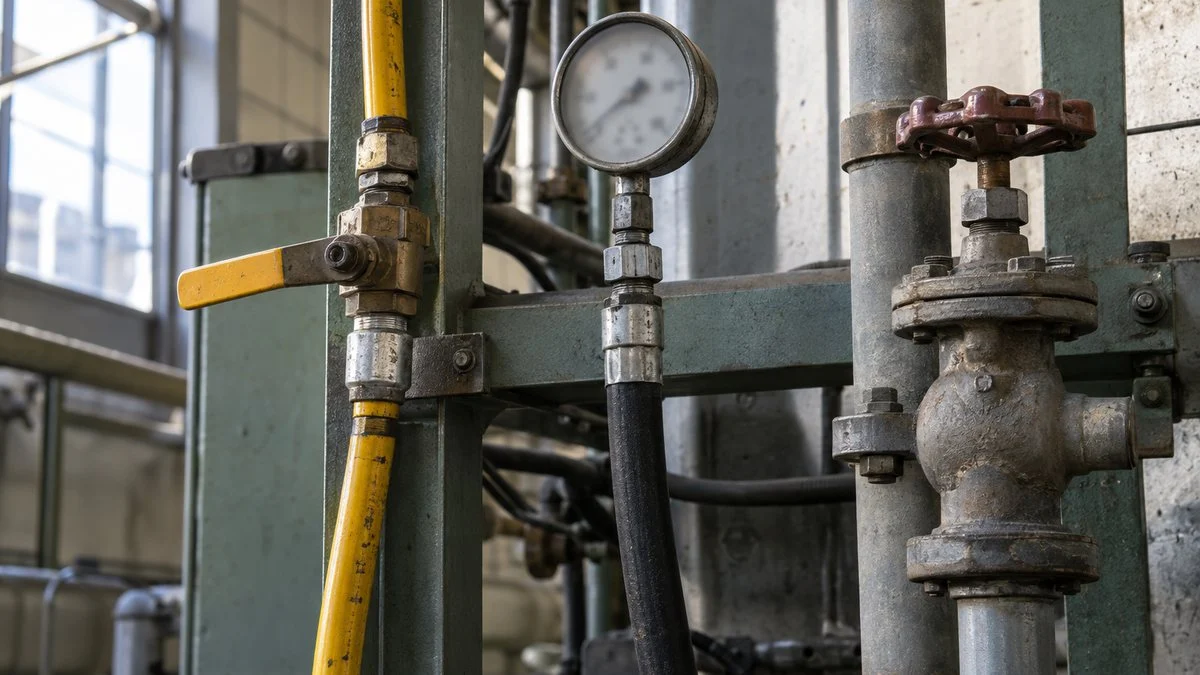
OSHA defines an energy source as "any source of electrical, mechanical, hydraulic, pneumatic, chemical, thermal, or other energy." LOTO often fails when people switch off the electrical breaker and miss the other sources.
A pneumatic cylinder, for example, still holds compressed air in its lines and chamber after the solenoid valve loses power. A press slide or lift table stopped in the raised position can drop under gravity. Capacitors in inverters (VFDs) and servo amplifiers stay charged for some time after power is cut.
A procedure should also state what remains after the isolating devices are operated.
Typical examples only. Which energy remains, and where, depends on the equipment, so each machine's procedure must identify it.
To avoid missing a source, many plants list the energy sources for each machine and show the isolating devices in photos or drawings. A single machine often has several isolating devices, so the procedure needs to say which ones, how many, and in what order. In a robot cell, for example, the list goes beyond the robot's own power to include the air supply to peripheral equipment and the conveyors.
The Six-Step LOTO Sequence
OSHA 1910.147(d) sets the order for applying energy control: preparation for shutdown, shutdown, isolation, applying locks and tags, releasing stored energy, and verifying isolation. The same order works in Japanese plants, so it gives Japanese and local teams a shared framework when they compare procedures. The steps below explain what each stage is for. The actual procedure for a machine comes from its own documented procedure and your site's rules.
Preparation before shutdown and verification after locking belong to the same sequence.
Based on the application sequence in OSHA 29 CFR 1910.147. Work starts only after verification.
Step 1: Prepare
Before work, the machine-specific procedure should show which energy sources the equipment has and where each one is isolated. Locks, tags, voltage testers, pressure gauges, and safety blocks are gathered at this stage. If the equipment has no procedure, or a modification has changed its wiring or piping, this is the point to stop and check before going further. A gap in preparation cannot be recovered in later steps.
Step 2: Notify and Shut Down
Operators and other people affected by the stop are told what work will be done and for how long. In the crane case above, the missing coordination led directly to the accident. The default is the normal stop sequence, not the emergency stop. A sudden stop can leave material jammed or parts halfway through a stroke, which can increase stored energy.
Step 3: Isolate
Every isolating device listed in the procedure, such as the main breaker, disconnect switch, and main air or hydraulic valves, is operated to separate the equipment from its energy sources. A control-circuit stop or a stop switch on the operator panel is not an isolating device. Push buttons and PLC signals can restart the machine through a mistake or a program state, so LOTO isolates on the power-circuit side. See also how to read interlock circuits on Japanese drawings.
Step 4: Apply Locks and Tags
Each worker places a personal lock and tag on each isolating device. Tags usually show the worker's name, department, task, and date and time. Many breakers and valves cannot take a padlock directly, so plants use breaker lockouts, valve lockouts, and plug lockouts. OSHA requires lockout and tagout devices to be:
- Durable
- Standardized within the facility (color, shape, or size)
- Substantial enough to prevent easy removal
- Identifiable, showing who applied them
Step 5: Control Stored Energy
The stored energy listed in Figure 4 is released or blocked. Typical methods are exhausting air, relieving hydraulic pressure, allowing capacitors to discharge, and lowering raised parts or supporting them with safety blocks. If energy could build up again during the job, checks continue until the work is finished. Isolation alone is not enough; the equipment is safe only when no energy remains.
Step 6: Verify
Finally, the worker confirms the machine really cannot move. Common methods are pressing the start button with nobody near the machine and seeing no response, checking for zero voltage with a tester, and confirming zero on a pressure gauge. After a start test, the operating switch goes back to the off position. If it is left on, the machine can start the moment the isolating device is switched back on after the job. Work starts only after verification.
Release, Personal Locks, and Group Lockout
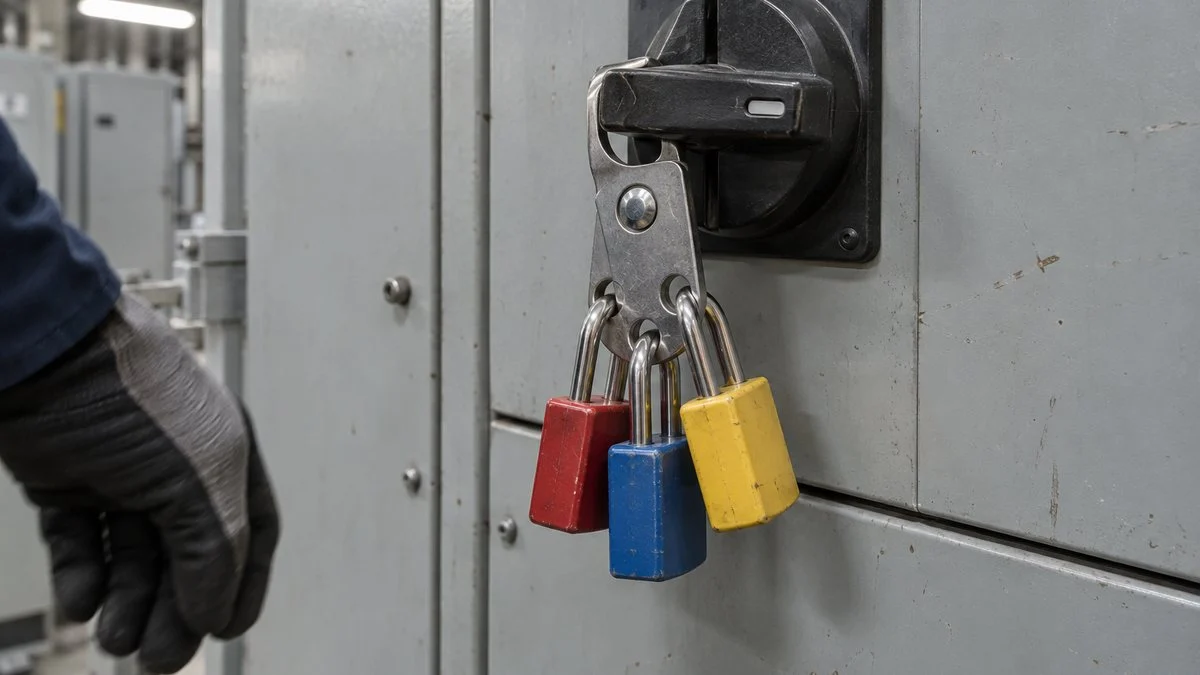
Removing locks is riskier than applying them. People relax when the job is done, check less carefully, and restore energy while someone is still near the machine.
Locks come off only after people and the work area have been checked.
Based on the release requirements in OSHA 29 CFR 1910.147 and Article 104 of Japan's Ordinance on Industrial Safety and Health (start-up signals).
One Person, One Lock, One Key
At the center of LOTO is the rule Japanese plants write as 1人1錠1鍵: each worker has a personal lock, and only that worker holds its key. As long as your lock is on, nobody else can start the machine you are working on, and you created that condition yourself.
Spare keys kept in the maintenance office, or shared locks that open with the same key, break this rule. Plants make lock owners identifiable by color or name label and do not allow lending locks.
Group Lockout for Multiple Workers
When several workers or contractors work on the same equipment, as in a plant turnaround, plants use group lockout. A common method is a lockout hasp, a multi-hole clasp that lets everyone attach a personal lock to one isolating device. For context on Japanese turnarounds, see teishu (plant turnaround) in Japan.
Equipment with many isolating devices often uses a lock box. A responsible person locks each isolating device and puts the keys in the box, and every worker places a personal lock on the box. OSHA requires group lockout to give each worker protection equivalent to a personal lock, with one authorized employee responsible for the group.
The isolating device keys cannot come out until the last worker removes their lock.
The responsible person handles isolation and verification, and starts the restart process only after confirming all personal locks are off.
Shift Changes and Absent Workers
When a job runs across shifts, the incoming worker attaches a lock before the outgoing worker removes theirs. The principle is that there should never be a moment with no lock on the device. OSHA requires specific procedures for this handover.
Sometimes a worker goes home and leaves a lock on. If a manager has to remove it, the plant needs a procedure decided in advance. A typical Japanese procedure confirms that the worker cannot be reached and is not on site, and tells the worker when they next report for work. OSHA allows removal by someone else only under a documented procedure, after verifying the worker is not at the facility and making reasonable efforts to contact them, and the worker must be told before resuming work there.
Making LOTO Stick: Procedures, Devices, Training, Inspections
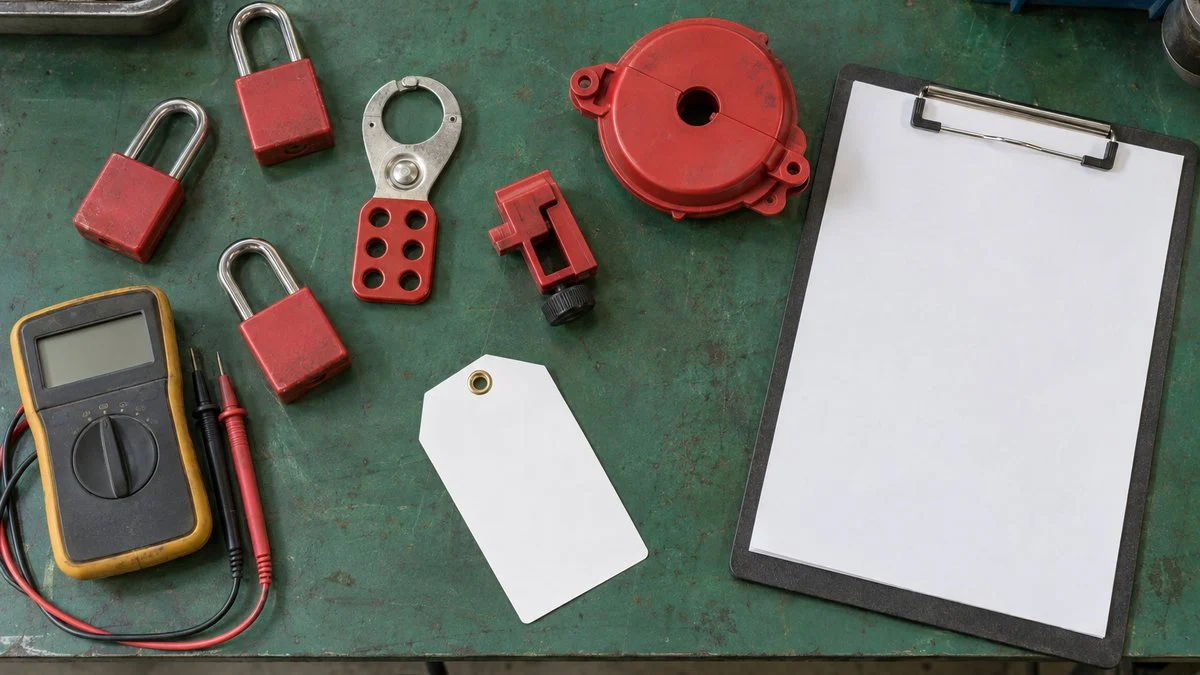
Buying locks and tags does not make LOTO stick. Steps get skipped because "it's a quick job" or "it's the usual machine." LOTO runs as a program only when procedures, devices, training, and inspections are all in place. That is also the structure OSHA requires.
Machine-Specific Procedures
A general rule such as "switch off the power before work" does not tell anyone which devices to operate. A one-page sheet for each machine, posted near it, removes the guesswork. It typically lists the energy sources, the location and number of each isolating device, how stored energy is handled, and how isolation is verified. Sheets with more photos and less text are more likely to be used.
Related: Standardized Work Instructions: Sagyo Hyojunsho Template
Devices and Where They Are Kept
Personal locks, tags, hasps, breaker lockouts, and valve lockouts are kept together at a station in each work area. Some plants color-code locks by group, for example red for maintenance, blue for production, and yellow for contractors. For older equipment whose isolating devices cannot be locked, the plant checks whether add-on lockout devices fit, and if not, puts the equipment in the replacement plan. For new equipment, writing "isolating devices must be lockable" into the specification avoids the problem later.
Training by Role
OSHA splits training into three groups. Authorized employees, who apply locks, learn to recognize energy sources and isolate them. Affected employees, such as operators of the machine, learn the purpose of the procedure. All other employees learn that they must not restart equipment that is locked or tagged out. Training should include production operators and contractors, not only maintenance staff. Maintenance applies the locks, but the person who restarts a machine by mistake is often someone nearby.
Periodic Inspection and Updates
OSHA requires an inspection of each procedure at least once a year by an authorized employee other than the ones using it. Differences found between the procedure and the actual equipment are corrected on the spot. Equipment modifications and wiring changes are also triggers for review. Building LOTO reviews into the maintenance plan, alongside time-based maintenance (TBM) and condition-based maintenance (CBM), helps keep procedures current. See hozen and maintenance types in Japanese plants.
Common LOTO Failures
Most failures come from skipped steps and the assumption that someone else has it covered.
For work that can only be done while the machine runs, Article 107 of Japan's Ordinance requires separate measures such as guarding.
A particularly common shortcut is during short stoppages (choko-tei), such as clearing a jam. The more often a task happens, the stronger the temptation to skip steps. Improving the equipment so the jam happens less often is a fix to consider alongside LOTO. Operator-led routines such as jishu hozen (autonomous maintenance) also have operators clean and inspect equipment, so the plant needs to decide when those tasks require LOTO.
Related: OEE and the 7 Big Losses vs. Six Big Losses in TPM
Harmonizing LOTO Across Japanese and Local Teams
A Japanese-affiliated plant outside Japan often has three sets of expectations: the Japanese parent's safety standard, local law such as OSHA, and the habits of Japanese engineers and contractors who visit for installation or turnarounds. Local law applies at the site. The Japanese standard may add rules, but it does not replace local requirements. Your EHS team and the plant's legal advisers decide how the two combine. The checklist below shows what to confirm.
Checklist: One LOTO Standard for a Japanese-Affiliated Plant
| Check | What to confirm |
|---|---|
| Governing rules | Which local regulation applies, and which parts of the Japanese parent's standard the site also adopts |
| Where the lock goes | The procedure locks energy-isolating devices, not only the start switch or operator panel |
| Lock vs. sign | Whether any task still relies on a sign alone, and if so, how equivalent protection is shown |
| All energy types | Each machine's procedure lists electrical, pneumatic, hydraulic, gravity, spring, thermal, and chemical sources |
| Japanese machines | Isolating devices accept locks; procedures and labels exist in the local language; stored-energy points are identified by the builder |
| Visiting Japanese staff and contractors | Outside workers and the host plant exchange LOTO procedures before work; everyone uses personal locks |
| Lock colors and tags | One color and tag scheme across departments, contractors, and visitors; tags readable in the languages used on site |
| Group lockout and shift changes | A named responsible person; written handover and lock-removal procedures |
| Training | Authorized, affected, and other employees each trained, including Japanese expatriates who work on equipment |
| Inspection and records | Who inspects procedures, how often, and where records are kept |
| Work that needs power | Which tasks run under an exception, and what protection replaces LOTO |
Questions to Ask the Japanese Side
- Does the parent company have a written LOTO standard? Can we get it in English?
- Does the standard require locks on energy-isolating devices, or does it also accept locking the start switch or a sign alone?
- For each machine you supply, can you provide a list of energy sources, isolating device locations, and stored-energy points?
- Do the isolating devices on your equipment accept a padlock without extra hardware?
- When your engineers work at our site, will they follow our LOTO procedure and use our personal locks?
- Which tasks in your maintenance manual are done with power on, and what protection do you specify for them?
Sample Email to a Japanese Equipment Supplier
Subject: LOTO information for [machine name / order number]
Dear [Name],
Our site follows a lockout/tagout program under OSHA 29 CFR 1910.147. To write the energy control procedure for [machine name], could you please send us the following: (1) a list of all energy sources (electrical, pneumatic, hydraulic, gravity, spring, thermal, chemical), (2) the location and drawing number of each energy-isolating device, (3) points where stored energy remains after isolation and how your manual handles them, and (4) confirmation that each isolating device can accept a padlock. If any maintenance task in your manual is done with power on, please tell us which ones and what protection you specify.
Thank you for your help.
Limits of This Guide
- The legal comparison covers only the articles named here. Other Japanese rules, company standards, and industry guidelines may add requirements.
- Article summaries are ours. Check the official text of the Ordinance and of 29 CFR 1910.147 before relying on any point, and note that both can be amended.
- Electrical work, construction, and some industries fall under other OSHA standards. Countries other than the US have their own rules.
- The six steps describe the purpose of each stage. They are not a procedure for any specific machine. Your EHS team and the equipment's documented procedure decide how the work is done.
Lockout/Tagout FAQ
Is lockout/tagout required by law in Japan?
Yes in substance, though the term is not used. Article 107 of the Ordinance on Industrial Safety and Health requires stopping machines and locking or signing the starting device. Article 339 requires locking, posting a notice, or stationing an attendant at the switch for de-energized electrical work.
Does Japanese law require written LOTO procedures like OSHA does?
Articles 107 and 339 do not spell out written procedures, annual inspections, or training categories. OSHA 1910.147 requires all three. Many Japanese companies cover these points in their own standards, so ask for the company document.
Can I use an ordinary padlock for LOTO?
What matters is that the lock meets the requirements: durable, hard to remove, identifiable, and standardized across the site. Repurposing personal padlocks makes owners hard to identify and lets duplicate keys circulate, so plants use dedicated LOTO locks.
Is LOTO needed for a jam that takes a few minutes to clear?
If a worker's body enters the machine's danger zone, the short duration is not an exception by itself. Japan allows work with power on only with measures such as guarding. OSHA's minor servicing exception also requires effective alternative protection. Decide these cases in the procedure, and consider fixing the cause of the jam.
What if the worker who applied a lock has gone home?
A manager may remove it only under a procedure set in advance. The procedure typically confirms that the worker cannot be reached and is not on site, and makes sure the worker is told when they next report for work, so the machine never starts without their knowledge.
Sources
- US Occupational Safety and Health Administration (OSHA), 29 CFR 1910.147, The control of hazardous energy (lockout/tagout) and Control of Hazardous Energy (Lockout/Tagout)
- Rodo Shimbun, Labor Law Search, Ordinance on Industrial Safety and Health, Articles 101–111 and Articles 339–340 (Japanese)
- Shiga Labour Bureau, Hikone Labour Standards Inspection Office, "Safety and Health Management in Manufacturing" (Articles 104 and 107, Japanese)
- MHLW, Guidelines for Comprehensive Safety Standards of Machinery (Japanese)
- Japanese Standards Association, press release on the issue of JIS B 9714:2024, Safety of machinery: Prevention of unexpected start-up (Japanese); ISO, ISO 14118:2017
- MHLW Workplace Safety Site (Shokuba no Anzen Site), accident cases: fatal crushing during inspection on an overhead crane girder; fatal crushing in power press dies (Japanese)
Original article in JapaneseThis guide is adapted from a MONOSCOPE article written for readers in Japan: ロックアウト・タグアウト(LOTO)とは?意味・法令と保全作業のエネルギー遮断6ステップ
About the editor
 MONOSCOPE EditorFOUNDER & EDITOR
Spent about ten years at a plant equipment maker and a plant engineering company, proposing, designing, and commissioning equipment, then moved into web marketing. Now a web consultant for B2B manufacturers, helping them explain their products and technology. Licensed in Japan as an Energy Manager and a Third-Class Chief Electrical Engineer.
Has run an engineering blog since 2017 (500+ articles) and a Japanese YouTube channel with about 20,000 subscribers. Each English guide is written from the Japanese shop-floor point of view and checked against the cited standards.