Poka-Yoke Examples and Types From Japanese Plants
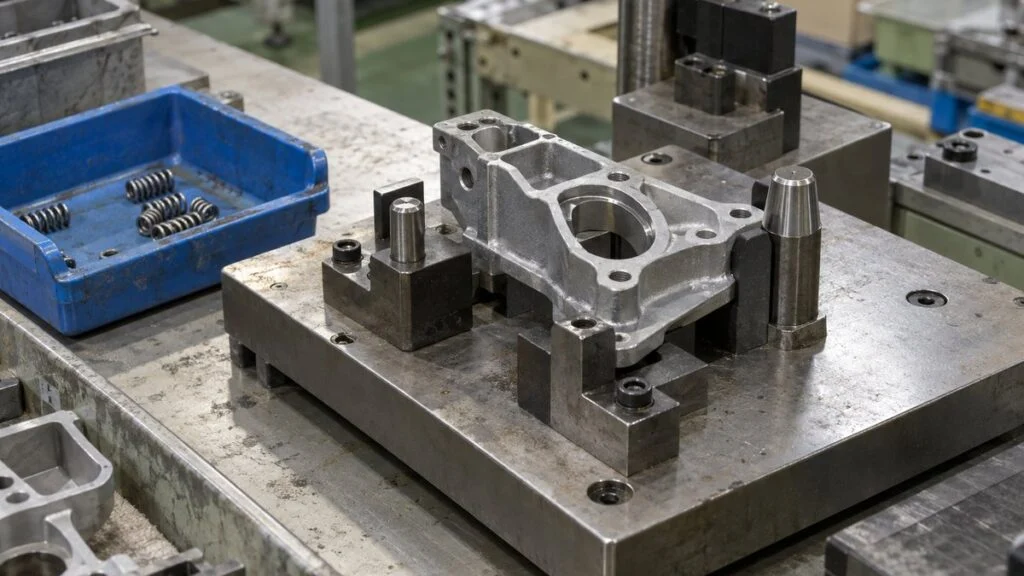
A Japanese customer rejects your 8D report with one comment: "What poka-yoke did you add?" Or you take over a line transferred from a plant in Japan and find asymmetric pins on the fixtures, a small parts dish at every station, and a torque wrench wired to a counter. Both situations call for the same idea. Poka-yoke means building mistake-proofing into the fixture, the equipment, or the work method so that an inadvertent error either cannot happen or is caught on the spot, instead of relying on the operator to pay more attention.
This guide explains what poka-yoke means in Japanese plants, how it differs from foolproofing, fail-safe design, and safety interlocks, and the three common ways to classify poka-yoke types. It then walks through poka-yoke examples in manufacturing, organized by type of error, followed by sensor and vision options, a five-step method for building one, the four reasons poka-yoke devices stop working, and a checklist you can use with a Japanese customer or parent plant.
A note on the examples: the documented examples cite their sources. The examples organized by error type are illustrative, not taken from any specific plant.
Contents
- What Is Poka-Yoke?
- Poka-Yoke vs. Foolproof, Fail-Safe, and Safety Interlocks
- Where the Name Comes From
- Poka-Yoke Types: Three Ways to Classify Them
- Poka-Yoke Examples in Manufacturing
- Poka-Yoke With Sensors, Vision, and Digital Checks
- How to Build a Poka-Yoke in 5 Steps
- 4 Reasons Poka-Yoke Stops Working
- Poka-Yoke Is Not a Machine Safety Interlock
- Checklist: Working With a Japanese Customer or Parent Plant on Poka-Yoke
- Limits of This Guide
- FAQ
- Sources
What Is Poka-Yoke?
Poka-yoke combines two Japanese words: poka (an inadvertent mistake) and yoke (from yokeru, to avoid). It refers to a device or method built into a process, piece of equipment, or fixture (jig, a tool that holds and locates parts) to stop simple mistakes. Toyota describes it on its Japanese-language production system page as a mechanism linked to assembly tools that automatically checks for problems such as unfastened parts and, if there is a problem, signals it with a lamp so that defects are not produced.
Toyota presents poka-yoke alongside jidoka, the principle of stopping when an abnormality occurs so that defects never move to the next process.
What matters is the direction of the fix. Takeshi Nakajo of Chuo University, who has studied this topic in quality management, calls the same idea "error-proofing": instead of making people adapt to the work method, you improve the work method so that it fits people. His lecture material lists three common misconceptions about human error: that it can be prevented by attention, by education and training, or by human inspection and double-checking. In his view, a person's level of alertness naturally varies, and errors occur when that variation meets a poor work method.
The right fix also depends on whether the mistake was inadvertent or whether the person knew the procedure and did not follow it.
Related: Standardized Work Instructions: Sagyo Hyojunsho Template
Poka-Yoke vs. Foolproof, Fail-Safe, and Safety Interlocks
In Japan, poka-yoke is used as a close relative of "foolproof." JIS Z 8115:2019, the Japanese standard for dependability terms, defines foolproof as the property of a system that keeps its reliability and safety even when people act inappropriately or make errors. The term it is most often confused with is fail-safe, which the same standard defines as the property of a system that remains safe when it fails. Foolproofing deals with human mistakes; fail-safe design deals with equipment failure. A connector that cannot be plugged in backward is foolproof. A design that stops in a safe state when the signal is lost is fail-safe.
Foolproofing is a broad term that applies to both product design and equipment design. On the shop floor, "poka-yoke" usually means the subset that targets operator mistakes in manufacturing and is built in as a shop-floor improvement. Keeping that distinction in mind avoids confusion.
The difference is what each one guards against and what it protects.
Foolproof and fail-safe definitions are based on JIS Z 8115:2019. Safety interlocks are covered later in this article.
| Aspect | Poka-yoke | Foolproof | Fail-safe | Safety interlock |
|---|---|---|---|---|
| Guards against | Operator mistakes in production | Human error in general | Equipment or component failure | People reaching hazardous areas |
| Protects | Product quality | Reliability and safety | Safety at failure | The operator's body |
| Typical example | Fixture that rejects a wrongly oriented part | Connector that cannot be inserted backward | Design that stops when the signal is lost | Device that stops the machine when the guard opens |
| Main reference | Shigeo Shingo's classification | JIS Z 8115 | JIS Z 8115 | ISO 14119, JIS B 9710 |
| Who builds it | Shop-floor improvement | Product or equipment designers | Product or equipment designers | Engineers with machine safety expertise |
Where the Name Comes From
The person who systematized and spread poka-yoke was Shigeo Shingo, a production improvement consultant. He set out the approach in a 1985 book published in Japan by the Japan Management Association, and the English translation, Zero Quality Control: Source Inspection and the Poka-Yoke System (Productivity Press, 1986), is why the term poka-yoke is used in English as well. The publisher describes the book's message as combining source inspection with poka-yoke devices to reach zero defects. Rather than inspecting finished products and sorting out the bad ones, you catch the mistakes that cause defects where they occur.
In the English edition, Shingo writes that he first used the term baka-yoke ("fool-proofing"). Around 1963, a worker at Arakawa Auto Body was upset when told why a new device had been installed and asked whether she had really been such a fool. That episode led him to the name poka-yoke. Today poka-yoke is the standard term. You may still see baka-yoke in older documents, but avoid it in your own.
The idea itself is older. According to Toyota's 75-year history, the automatic loom of 1925 had a reserve shuttle box (a holder for spare shuttles, the part that carries the weft thread). If the operator did not insert a shuttle in the correct position, it would not go in. Toyota describes this as a device that could be called the origin of poka-yoke.
Poka-Yoke Types: Three Ways to Classify Them
Classifications of poka-yoke vary by source and by company. Here are three commonly cited classifications. No single one is the only correct choice; use them to look at the errors in your own process from different angles.
Stop or Warn: Control vs. Warning Methods
The first classification, from Shingo's book, is based on what happens once a mistake is detected.
- Control method (kisei-shiki): the work or the equipment cannot continue. The part will not fit the fixture, or the next process will not start.
- Warning method (chui-shiki): a buzzer or lamp alerts the operator, who decides whether to stop.
The control method is more reliable. With a warning method, people get used to the buzzer or miss it in a noisy area. Still, a warning method is the practical choice for manual work where a stop mechanism is hard to add, or for processes where stopping partway would itself create a defect.
How the Error Is Detected: Contact, Fixed-Value, and Motion-Step Methods
The second classification, also from Shingo's book, is based on how the error is detected.
They differ in what clue is used to catch the error.
Classification from Shigeo Shingo, Zero Quality Control (Chapter 6 of the English edition). It is one common way to classify poka-yoke.
Shingo describes the contact method as detecting abnormal shape or size by whether the product makes contact with a detection device. That includes fixture pins and guides as well as detectors such as limit switches. Non-contact sensors that check shape or size are sometimes grouped here too, since they also look at a physical feature of the product.
In practice, a poka-yoke is a combination of the two classifications. Counting tightenings and blocking the next step until the count is complete is "fixed-value × control." Counting and only lighting a lamp is "fixed-value × warning."
Where It Acts: Prevention vs. Mitigation
The third classification is based on where in the chain of events you intervene. In 1984, Takeshi Nakajo and Hitoshi Kume published a paper in Quality, the journal of the Japanese Society for Quality Control. From about 700 foolproofing examples collected on assembly lines for mechanical products, they derived five principles.
The five principles fall into two groups. Three prevent the error from occurring (elimination, replacement, and facilitation). Two keep an error that does occur from spreading (detection and mitigation). This is close to the shop-floor distinction between "prevent occurrence" and "prevent escape."
Some measures stop the error from happening; others keep an error from spreading.
The five principles from Nakajo and Kume, "A Study on Fool-Proofing for Work" (Quality, Vol. 14, No. 2, 1984). The paper's English abstract uses "substitution" and "relaxation of effects" for replacement and mitigation. Descriptions follow an Osaka Municipal Waterworks Bureau document.
People tend to equate poka-yoke with detection, such as a sensor that catches an abnormality. The same framework offers other options: standardize parts so they cannot be mixed up (elimination), automate the tightening (replacement), or color-code the parts bins (facilitation).
Detection only works after an error has already happened. Consider the three prevention principles first, then use detection for what remains. That order keeps the process from turning into a forest of sensors.
Poka-Yoke Examples in Manufacturing

This section starts with three examples you can confirm in published sources, then lays out typical poka-yoke patterns by type of error as illustrative examples.
Documented Examples
1. Toyota's 1925 reserve shuttle box. A shuttle inserted in the wrong position does not fit, so the loom cannot be run with a wrongly loaded shuttle and damaged. It is an early form of the contact × control combination: the shape itself rejects the mistake.
2. Toyota's current assembly process. According to Toyota, a system linked to the assembly tools automatically checks for parts that were not fastened and signals a problem with a lamp. The tool's operation is used to catch an omission, and a lamp, a warning method, reports it.
3. A non-manufacturing case: a water utility. This one is outside manufacturing, but it shows well how to apply the principles. The Osaka Municipal Waterworks Bureau published a case in which an operator confused the speed switch of a distribution pump with the open/close switch of its discharge valve, causing a momentary interruption in water supply. The bureau proposed one countermeasure for each of the five principles:
- Elimination: put a cover on the switch so it cannot be operated easily.
- Replacement: when equipment fails, switch to the standby unit automatically.
- Facilitation: change the discharge valve switch from a lever to a push button so the two switches clearly differ.
- Detection: sound a chime while the discharge valve is moving.
- Mitigation: interconnect two distribution zones so supply continues.
Note that the bureau produced one idea per principle for a single error. Instead of jumping on the first idea, generate options under each principle and then compare them. That makes it easier to find a fix that is both cheap and reliable.
Examples by Type of Error (Illustrative)
The figure below splits common assembly errors into six types and matches each with a detection method and a device. These are illustrative examples to explain the mechanisms, not cases from a specific plant.
The right method depends on how the error happens.
All are illustrative examples. Actual designs depend on workpiece shape, working posture, and takt time.
The parts-dish method comes from Shingo's book. On a push-button assembly line, the operator first put the required number of springs in a small dish. If a spring was left in the dish after assembly, the operator knew one had been left out. You do not need a sensor: create a condition where "anything left over is wrong," and the mistake becomes visible.
Contact methods suit errors you can tell apart by shape, such as wrong orientation or wrong parts. Fixture pins and guides need no electricity, so there is no wiring or setup, and anyone can check their condition by eye. Asking the design team to add a notch or an asymmetric hole to the part is another effective option.
Errors that leave no trace in the shape, such as unfastened bolts or skipped steps, need a device that counts or tracks sequence. That is where sensors and controls come in.
Poka-Yoke With Sensors, Vision, and Digital Checks

For errors that shape cannot reveal, or for checks with too many points for the human eye, plants use sensors, image processing, and data matching. Here are three ways to use them as poka-yoke.
Counting Tightenings
A torque wrench that outputs a signal is a common fix for missed bolts. Tohnichi's poka-yoke torque wrenches send a contact signal from a limit switch when the set torque is reached. According to Tohnichi, combining that signal with a separately sold counter creates a poka-yoke system, and feeding it into a PLC (programmable logic controller) lets you build line-linked tightening verification. If the product cannot move on until the set number of bolts has been tightened, you have a fixed-value × control poka-yoke.
Watch for one weakness: a system that only counts may record the same bolt tightened twice as two bolts. Tohnichi also offers a model with double-tightening detection that shows NG when an already tightened bolt is tightened again. Before you install a counting system, list the conditions under which the count could be wrong.
Checking Presence and Orientation With Vision
When you need to confirm several parts and their orientation at once, plants use vision sensors. Keyence presents an application in which a vision sensor checks that multiple screws are correctly installed during automotive steering wheel assembly. According to Keyence, doing the same job with photoelectric sensors would take one sensor per screw, and slight misalignment could cause false detections, while a single vision sensor can check several points at the same time.
Keyence also lists packaging applications in food and similar industries: missing packets in cup noodles, missing straws, front/back orientation of bags, and whether a best-before date is printed. If you need to detect defects that are harder to define, such as scratches or stains, you are moving into AI visual inspection.
Code Matching and Pick-to-Light
Parts that look alike and differ only in part number can be hard to tell apart with fixtures or vision. For mix-ups like these, barcode or 2D code matching works well: scan the code on the work order and the code on the part, and allow the next step only when they match.
Keyence describes logistics applications such as managing receipts with barcodes or 2D codes to prevent parts from going into the wrong shelf location, and matching items with handheld terminals during receiving, shipping, and inspection. The same idea applies to parts supply and changeovers inside a plant.
Digital picking (pick-to-light) also prevents picking errors. As Aioi Systems describes it, the operator goes to the location where the display lamp is lit and picks the quantity shown. Reading a list, searching, and counting are replaced by a display, which is replacement and facilitation in terms of the five principles.
Each one looks at something different, so each catches different errors.
Cautions summarize general tendencies and vary with the model and installation conditions.
Some services now use cameras to analyze the operator's hand and tool movements and flag omitted or out-of-order steps. They aim to provide motion-step poka-yoke through video analysis.
Before buying equipment, always check whether a fixture or a change in parts layout would do the job. Sensors and cameras bring extra work: handling false detections and checking them every day. Don't add electronics to catch an error that a fixture shape can prevent.
How to Build a Poka-Yoke in 5 Steps

If you keep adding fixtures as ideas come up, you end up with more devices than you can manage. Narrowing the target first and then following these five steps is faster.
Narrow the target, test cheaply, then build it into the standard.
Adapted for manufacturing from the error-proofing flow shown by the Osaka Municipal Waterworks Bureau (identify the error → examine background factors → develop options → evaluate and select).
Step 1: Pick One Error
Start by deciding which single error you will prevent. Gather in-process defect records, customer complaints, and near-miss reports, and choose the errors that occur most often or would cause the most damage if they escaped. See also our guide to hiyari hatto near-miss reports.
Related: 7 QC Tools in Japanese Quality Reports: How to Read Them
A Pareto chart, one of the seven QC tools, helps rank them. Narrow the target to a single motion, such as "bracket installed left-right reversed," rather than a broad bucket like "assembly errors."
New products and new processes have no defect history yet. In that case, take candidates from the failure modes in your process FMEA that come from manual work.
Related: AIAG-VDA FMEA for Japanese Customers: DFMEA vs PFMEA
Step 2: Find the Moment the Error Happens
Next, watch the work on the floor. Which motion goes wrong, and what looks different right after the mistake? Whether the error happens when picking the part, orienting it, or tightening it determines where the device belongs.
At the same time, list how a wrong product differs from a good one: a different shape, a different weight, a part left over. Those differences become your detection clues. If you cannot find one, you need to ask for a marker to be added to the product or part.
Step 3: Choose the Method
Work through the five principles, starting with elimination. Can you standardize parts so they cannot be confused? Can you automate the step? Can color or layout make the mistake less likely? Whatever is left, you catch with detection.
For detection, decide whether a contact, fixed-value, or motion-step method fits, and whether it should stop or warn. Use the control method by default for errors with serious consequences if they escape. If you settle for a warning method, also define what the person who receives the warning must do.
Step 4: Build Cheaply and Test
Do not order a production fixture right away. Build a temporary version from cardboard, plastic sheet, or materials on hand, and try it in the actual work. Check three things:
- When you make the mistake on purpose, does it reliably stop (or warn)?
- When the work is done correctly, does it avoid stopping by mistake?
- Has the work become harder or slower?
The third point is easy to overlook. Operators eventually stop using a device that gets in their way. Have the operators themselves try it at this stage, and incorporate their feedback.
Step 5: Add It to Daily Checks and Standards
Left alone after installation, a poka-yoke gradually stops working through wear or failure. Define a start-of-shift check to confirm it works, and record which error is prevented by which device in the work standard and in process control documents such as the QC process chart (QC kotei-hyo) or control plan. For how these documents fit into the wider flow, see the quality assurance process at Japanese plants.
Related: Quality Assurance Process at Japanese Plants: 8 Steps
As the number of devices grows, keep a register of location, target error, check method, and owner. The goal is to see quickly which poka-yoke devices are affected when you add a product variant or modify equipment.
4 Reasons Poka-Yoke Stops Working
When the same defect comes back after a poka-yoke was installed, the cause is often not the device itself but how it is handled afterward. Our editorial team has grouped the most common pitfalls into four.
What happens after installation makes the difference.
Common examples grouped by the MONOSCOPE editorial team.
Removed or Bypassed
Operators may stop using a poka-yoke because the fixture gets in the way or the scanning takes too long to keep up with takt time. If you treat this as a discipline problem, it will happen again.
First ask the operators why it is hard to use, and fix the device. Then set a rule that removing a poka-yoke or changing its settings is a change that requires approval from the team leader or the quality department.
Safety devices that protect operators are a different matter. Removing or disabling them is restricted by law, as covered later in this article.
The Device Itself Is Broken
A broken sensor wire, a worn pin, or a dirty vision sensor lens can stop detection. The tricky part is that production keeps running normally even when the device is broken, so nobody notices.
The fix is to verify operation regularly. One method is to keep a deliberately defective test sample and run it at the start of the shift to confirm the device stops it. Color the sample and give it a fixed storage place so it never mixes with product.
Too Many False Stops
If good parts keep triggering stops, operators start resetting and passing parts through every time. Eventually they reset the line the same way when a real defect stops it.
False detections come from threshold settings, workpiece misalignment, and similar causes. Record false detections as well, and investigate and fix them the same way you would defects.
Warning Fatigue
If a buzzer or lamp goes off often, it fades into the background. For errors with serious consequences if they escape, switch to a control method wherever possible.
Also, do not stop at detection. If the same poka-yoke triggers again and again, an error-prone cause remains upstream. Look at how often it triggers and go back to prevention. Root-cause tools such as why-why analysis and the 8D report help trace that cause.
Related: 5 Whys Example: Why-Why Analysis Japanese Customers Accept
Poka-Yoke Is Not a Machine Safety Interlock
Some poka-yoke explanations include examples such as a machine that only runs when both hands press the switches. The thinking is similar, but these are safety devices that protect the operator's body, and they should be kept separate from quality-focused poka-yoke.
Interlocking devices that work with a guard to prevent hazardous machine functions have their own design and selection standard: ISO 14119 internationally, and JIS B 9710:2019, which corresponds to the 2013 edition of ISO 14119, in Japan. Besides the types of devices, these standards cover measures to minimize the possibility of defeating them. ISO 14119 was revised in 2024, so check the current edition when designing.
Japanese law also addresses this. Article 28 of Japan's Ordinance on Industrial Safety and Health requires employers to inspect and maintain safety devices so they remain effective, and Article 29 requires workers not to remove safety devices or disable their function. Outside Japan, your local regulations apply.
Safety-related devices are therefore designed by the equipment manufacturer or engineers with machine safety expertise, based on risk assessment and machine safety standards. A shop-floor poka-yoke is no substitute.
Related: Risk Assessment in Japanese Plants vs. JHA, HSE, ISO 12100
Watch the wording, too. Supplier literature sometimes calls a system that links tool signals to the line and blocks the next step until tightening is complete an "interlock." That is a quality interlock between process steps, and its purpose differs from a machine safety interlocking device.
Checklist: Working With a Japanese Customer or Parent Plant on Poka-Yoke
Poka-yoke questions can come up in corrective action reports, supplier audits, and line transfers. Start by choosing one recent error and checking on the floor where it shows up as a visible difference in the product. Then use these lists to prepare. Supplier audits by Japanese customers and kaizen activities in Japanese companies are covered in separate guides.
Before You Propose a Poka-Yoke
- Is the target narrowed to one error in one motion, not "assembly errors" in general?
- Did you consider elimination, replacement, and facilitation before detection?
- Is it a control method? If it is a warning method, is the response to the warning defined?
- Did you test it by making the mistake on purpose, and with correct work to confirm no false stops?
- Did operators try it, and did cycle time stay within takt?
- Is there a start-of-shift check with a marked test sample?
- Is it written into the work standard and the QC process chart or control plan?
- Do removal and setting changes require approval?
- Is it clearly separate from any machine safety interlock?
Questions to Ask When Taking Over a Line From Japan
- Which errors does each poka-yoke on this line prevent? Is there a poka-yoke register?
- Which devices stop the process (control) and which only warn?
- How and how often is each device checked? Are test samples included in the transfer?
- Which devices depend on PLC logic or counter settings, and who can change them?
- Which devices are quality poka-yoke, and which are machine safety devices?
- Which past defects led to each device being added?
Template: Poka-Yoke Register
The rows below are fictional examples showing how to fill in the register.
| No. | Station | Target error | Method | Stop / warn | Check method and frequency | Owner |
|---|---|---|---|---|---|---|
| PY-01 | Station 3 (bracket) | Bracket installed reversed | Contact (asymmetric pin) | Stop | Visual check of pin wear, start of shift | Team leader |
| PY-02 | Station 5 (cover) | Missing bolt (4 per unit) | Fixed-value (signal wrench + counter) | Stop | Run red test sample with 3 bolts, start of shift | Production engineering |
| PY-03 | Kitting area | Wrong part picked | Motion-step (pick-to-light) | Warn | Pick from wrong bin on purpose, weekly | Logistics lead |
Limits of This Guide
- Classifications and terminology for poka-yoke vary by company and source. Your Japanese customer may use different labels for the same ideas.
- The examples by error type and the register entries are illustrative, not data from a specific plant.
- Product features mentioned (torque wrenches, vision sensors, pick-to-light) are described as their makers present them. Check current specifications with the maker before selecting equipment.
- This guide does not cover the design of machine safety devices. Follow the applicable standards and local regulations, and consult qualified specialists.
FAQ
What does poka-yoke mean in English?
Poka-yoke means mistake-proofing, and the Japanese word itself is used in English. It spread after the English edition of Shigeo Shingo's book was published in 1986. A related term is foolproof, which is a broader concept that also covers product and equipment design.
Can I still say "baka-yoke"?
Avoid it. Poka-yoke is the standard term today, and Shingo himself, in the English edition of his book, describes a worker who was hurt by the older name.
Do you need sensors to build a poka-yoke?
No. Fixture pins and guides work well for errors you can distinguish by shape, such as wrong orientation or wrong parts. You can also create a condition where anything left over is wrong, as with kitting parts into a dish so a leftover part reveals an omission.
Should a poka-yoke stop the process or just warn?
Use a control method that stops the work or equipment for errors with serious consequences if they escape. A warning method can be practical for manual work where a stop mechanism is hard to add, but then define what the person who receives the warning must do.
How often should poka-yoke devices be checked?
The basic practice is to confirm operation at the start of each shift, for example by running a deliberately defective test sample to see that the device stops it. Color the test sample and store it in a fixed place so it never mixes with product.
Sources
- Poka-yoke and jidoka at Toyota: Toyota Motor Corporation, Toyota Production System explained (Japanese)
- Reserve shuttle box (1925): Toyota 75-year history, Part 1, Chapter 1, Section 3, Item 2 (Japanese)
- Foolproof and fail-safe definitions: Japanese Standards Association, JIS Z 8115:2019 Glossary of terms used in dependability (Japanese); definition wording checked on a page reproducing the standard (Japanese)
- Shingo's book: National Diet Library record of the 1985 Japanese edition; Routledge, "Zero Quality Control: Source Inspection and the Poka-Yoke System"
- Control/warning and contact/fixed-value/motion-step methods, baka-yoke, parts-dish example: Shigeo Shingo, "Zero Quality Control" (Productivity Press, 1986), Chapters 4 and 6; Lean Blog, "Poka-Yoke and Shigeo Shingo"; ITmedia, IT glossary "Poka-yoke" (Japanese)
- Five principles of foolproofing: Takeshi Nakajo and Hitoshi Kume, "A Study on Fool-Proofing for Work: Principles of Fool-Proofing," Quality, Vol. 14, No. 2 (1984)
- Error-proofing and the three misconceptions: Takeshi Nakajo, Chuo University, "Error-proofing in healthcare" (Japanese)
- Applying the five principles and the error-proofing flow: Osaka Municipal Waterworks Bureau, human error prevention through error-proofing (Japanese)
- Poka-yoke torque wrenches: Tohnichi, poka-yoke torque wrenches (Japanese); Tohnichi, CSPFHW with double-tightening detection (Japanese)
- Vision sensor applications: Keyence, steering wheel assembly check (Japanese); Keyence, food, pharmaceutical, and cosmetics applications (Japanese)
- Code matching: Keyence, preventing mistakes in logistics (Japanese)
- Digital picking: Aioi Systems, digital picking (Japanese)
- Camera-based detection of omitted work: Canon Marketing Japan, "What is poka-yoke?" (Japanese)
- Interlocking device standards: ISO 14119:2024; Japanese Standards Association, JIS B 9710:2019 (Japanese); IDEC, ISO 14119:2013 overview (Japanese)
- Maintaining safety devices: e-Gov, Ordinance on Industrial Safety and Health, Articles 28 and 29 (Japanese)
Original article in JapaneseThis guide is adapted from a MONOSCOPE article written for readers in Japan: ポカヨケの種類と事例|作業ミスを仕組みで防ぐ考え方と作り方
About the editor
 MONOSCOPE EditorFOUNDER & EDITOR
Spent about ten years at a plant equipment maker and a plant engineering company, proposing, designing, and commissioning equipment, then moved into web marketing. Now a web consultant for B2B manufacturers, helping them explain their products and technology. Licensed in Japan as an Energy Manager and a Third-Class Chief Electrical Engineer.
Has run an engineering blog since 2017 (500+ articles) and a Japanese YouTube channel with about 20,000 subscribers. Each English guide is written from the Japanese shop-floor point of view and checked against the cited standards.