FANUC Business Model: What It Means for Buyers and Users
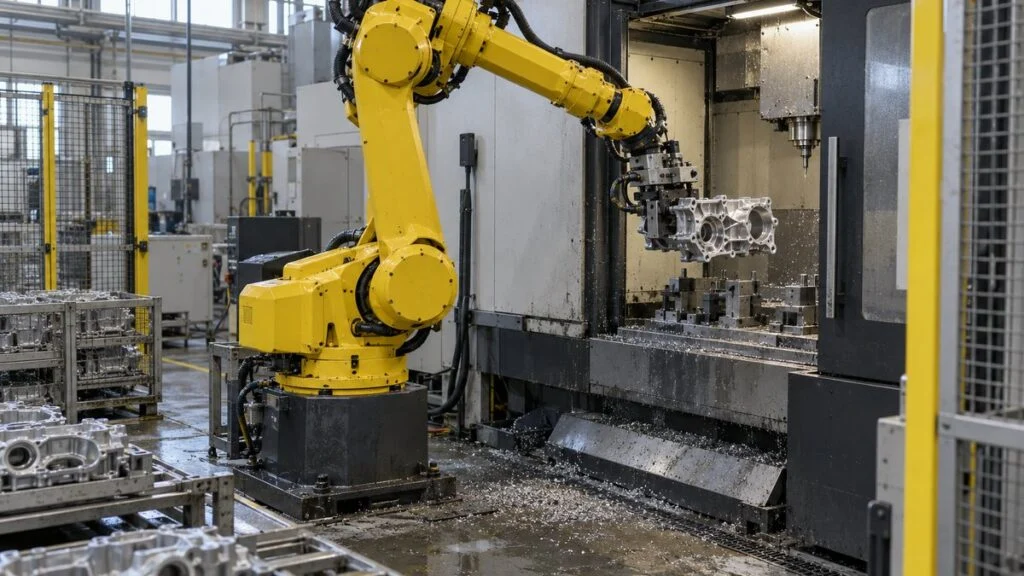
You order a vertical machining center from a Japanese, Taiwanese, or Indian builder, and the control panel says FANUC. Your robot integrator quotes FANUC arms for a welding cell. A supplier's equipment list shows a row of ROBODRILLs. Then a servo alarm stops the machine, and the first question is simple: who do you call, the machine builder or FANUC?
The short answer: FANUC sells its CNC systems and servo motors to machine tool builders as built-in components, and sells robots and ROBOMACHINE products directly to manufacturers as production equipment. It then supports all of them for as long as customers keep using them. In the fiscal year ended March 2026, that model produced net sales of JPY 857.8 billion at a 21.4% operating margin.
This guide uses FANUC's English-language financial results, results briefing slides, integrated report, and news releases to explain what FANUC sells and to whom, where its revenue comes from, why its margins stay high, how it compares with Yaskawa and Keyence, and what it has announced recently. It ends with what all of this means when you buy or run FANUC equipment, including a checklist, questions to ask, and a sample inquiry email.
A note on dates: FANUC's fiscal year runs from April to March, and its English documents call the year ended March 31, 2026, "FY2025." To avoid confusion, this article names each fiscal year by the month it ends.
Contents
FANUC at a Glance
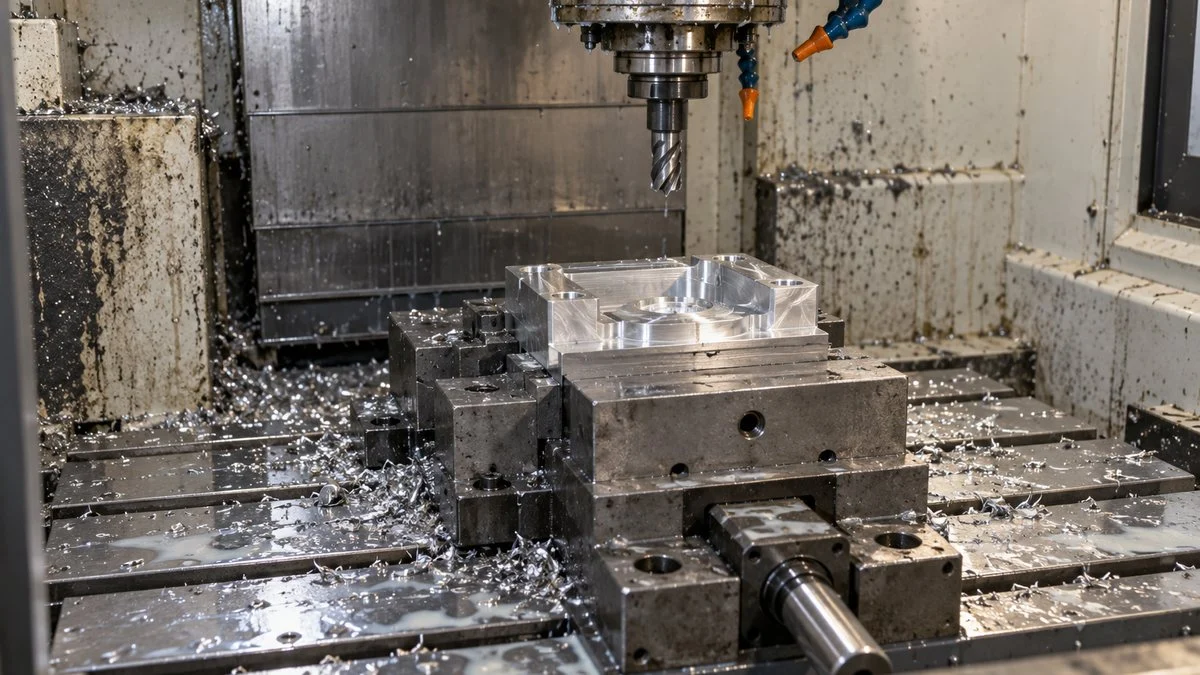
In one sentence, FANUC builds the controls, robots, and compact machines used to automate factories, and maintains them for as long as customers use them. Machine tool builders buy its CNCs and servos as components. Manufacturers with their own plants buy its robots and machines as equipment.
The company is headquartered in Oshino, Yamanashi Prefecture, at the northern foot of Mount Fuji. It started as the NC (numerical control) division of Fujitsu, was spun off as FUJITSU FANUC Ltd. in 1972, and changed its name to FANUC LTD in 1982. FANUC traces its origin to 1956, when its predecessor developed the first NC and servo system in Japan's private sector.
FANUC reports only one business segment. Its financial results explain why: the group uses its CNCs and servo motors to make all of its products. It still breaks out sales by product and service in four divisions: FA, Robot, Robomachine, and Service.
Close to 90% of sales come from outside Japan, and the operating margin is above 20%.
Sources: FANUC Consolidated Annual Financial Results and results briefing slides for the year ended March 31, 2026 (April 24, 2026); Integrated Report 2025 (history, service network). The share of sales outside Japan is calculated from the regional breakdown.
Four Divisions, Two Routes to the Customer
The four divisions sell different products to different buyers. FA products reach you inside someone else's machine: FANUC delivers CNCs and servos as units to machine tool builders, and the end user buys the finished machine tool. Robots and ROBOMACHINE products reach you directly, installed as the end user's own production equipment.
For robots, many plants also work through a system integrator (SIer) that designs and builds the robot cell around the arm. How SIers work in Japan is covered in a separate guide, and how makers, distributors, and SIers fit together in Japanese factory automation in another.
All four divisions rest on the same core technology: CNCs and servos.
Based on FANUC Integrated Report 2025 and the financial results for the year ended March 31, 2026. An SIer (system integrator) designs and builds equipment that incorporates robots.
FANUC's integrated report uses an automotive production line to show how the pieces fit. Machine tools and ROBODRILLs machine the parts, robots handle assembly, transport, and welding, ROBOSHOTs mold the plastic parts, and ROBOCUTs cut the dies and molds. Figure 3 turns that example into the stages a plant goes through.
From installation to daily operation and maintenance, products and services from the same company keep appearing.
A generalized example based on the automotive production line in FANUC Integrated Report 2025 and FANUC's description of its Service division. Every plant is configured differently.
Even if you never buy a CNC from FANUC directly, you deal with FANUC through the operator screen and during maintenance. Being built into other companies' machines is the defining feature of the FA business, and it shapes how support works for you (see "What This Means for Buyers and Users" below).
Where the Revenue Comes From
In the fiscal year ended March 2026, the Robot division was the largest at JPY 378.6 billion, or 44.1% of net sales. FA followed at JPY 208.5 billion (24.3%), then Service at JPY 141.1 billion (16.5%) and Robomachine at JPY 129.6 billion (15.1%).
By region, Japan accounted for only 12.9% of sales. The Americas took 27.1%, China 26.6%, and Europe 17.8%, so close to 90% of sales came from outside Japan. Figure 4 shows what FANUC sells and where its customers are.
Robots are the largest division, and the Americas and China are the two largest markets.
Sources: FANUC Consolidated Annual Financial Results for the year ended March 31, 2026 (information by product and service); results briefing slides, April 24, 2026 (regional composition).
The mix moves a lot from year to year. Four years earlier, in the fiscal year ended March 2022, FA made up 30.9% of sales and Robot 36.6%. By the fiscal year ended March 2026, Robot had risen to 44.1% and FA had fallen to 24.3%.
For the fiscal year ended March 2026, FANUC reported that robot sales rose sharply in China on demand from EV-related and general industries, and that sales in the Americas grew despite concerns about tariffs. Robot sales in Japan declined.
The machine tool industry is the main market for FANUC CNCs, so FA sales tend to track machine tool orders. Machine tool order statistics are one way to read where FANUC is heading. In the fiscal year ended March 2026, strong export demand at Japanese machine tool builders and demand in China and India pushed up CNC sales, while demand in Europe was weak.
According to the integrated report, 80% to 90% of FANUC products are installed outside Japan. Automotive-related customers account for a large share, but robot sales to general industries outside automotive, such as construction machinery, IT, food, pharmaceuticals, and cosmetics, are growing.
Related: Japanese Machine Tool Industry: Builders, Dealers, Service
Five Years of Results
FANUC sells capital goods, which customers buy when they invest in their plants. The company says its products are significantly affected by economic changes, so sales rise and fall with the capital spending cycle.
Even in the weakest year, the operating margin stayed above 17%.
Net salesOperating incomeForecast (revised July 2026)
FY ended Mar 2022Operating margin 25.0%
FY ended Mar 2023Operating margin 22.5%
FY ended Mar 2024Operating margin 17.8%
FY ended Mar 2025Operating margin 19.9%
FY ended Mar 2026Operating margin 21.4%
FY ending Mar 2027 (forecast)Operating margin 23.0%
Sources: FANUC financial results for each fiscal year (years ended March 2022 to March 2026) and Integrated Report 2025 (financial highlights); quarterly results for the three months ended June 30, 2026 (July 31, 2026), which raised the full-year forecast. Amounts are rounded to the nearest JPY 0.1 billion. Bar length is relative to JPY 1 trillion = 100%.
In the fiscal year ended March 2024, net sales fell by about JPY 57 billion and the operating margin dropped to 17.8%. Even in that down year, FANUC kept its operating margin close to 20%, which is high for a manufacturer.
Net sales of JPY 857.8 billion in the fiscal year ended March 2026 were a record, topping the previous high set in the year ended March 2023. Sales for April–June 2026 rose 17.7% year on year to JPY 231.0 billion. On July 31, 2026, FANUC raised its full-year forecast for the fiscal year ending March 2027 to net sales of JPY 948.1 billion and operating income of JPY 218.0 billion, up from JPY 909.6 billion and JPY 212.2 billion in April.
The balance sheet is strong. The equity ratio stood at 89.2% at the end of March 2026, and FANUC's basic policy is a consolidated dividend payout ratio of 60%. When equipment stays in service for 10 to 20 years, the supplier's financial strength is worth checking. For a general method of checking Japanese suppliers, see Japanese supplier financial health: warning signs and checks.
Why FANUC's Margins Stay High
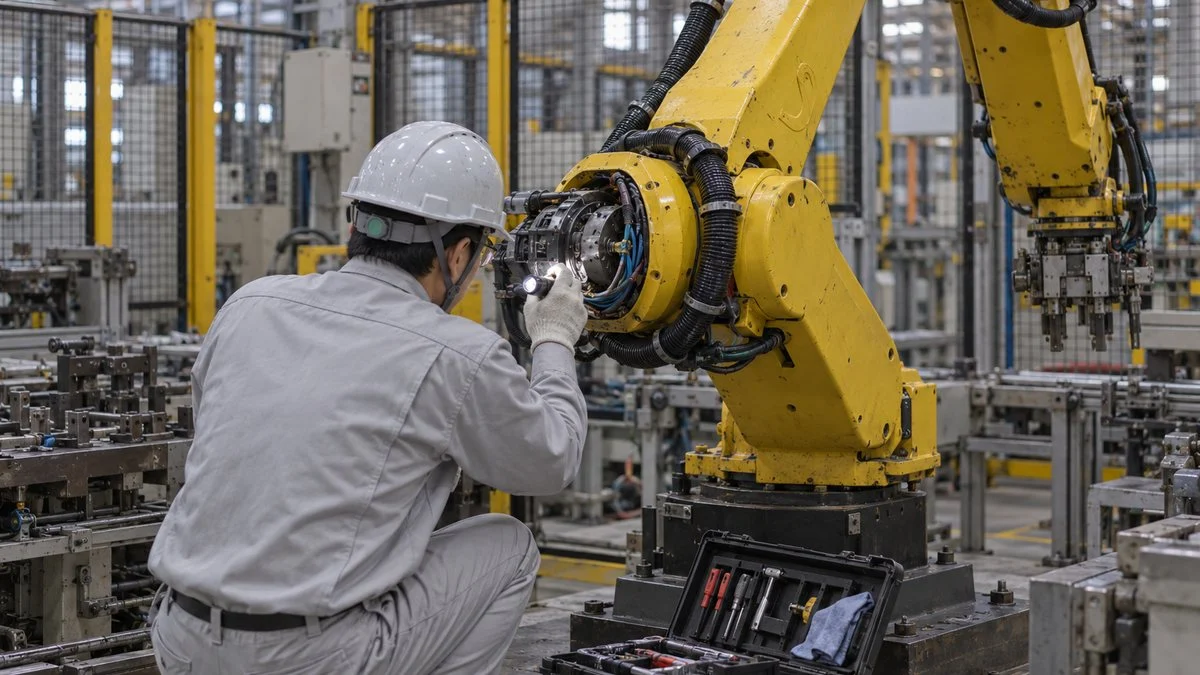
FANUC explains its profitability through a few policies in its integrated report and financial results. Figure 6 groups them into a common foundation, the way profit is built in, and support after installation, plus market share as a competitive edge.
Three businesses sit on one core technology, and service supports them for the long term.
Based on FANUC Integrated Report 2025 and the financial results for the year ended March 31, 2026. FANUC does not disclose how much each factor adds to its margin; the figure organizes the company's own explanation.
One Core Technology Across Every Product
NC tells a machine tool, in numbers, how to move its cutting tool and table. A servo motor then moves to exactly the position and speed the NC commands. FANUC built its business on these two technologies, and its robots and ROBOMACHINE products are applications of them.
Because FANUC focuses on one core technology and applies it across robots and machines, development results and components can be shared across the businesses. The integrated report lists "equipped with CNCs and servos, FANUC's basic products" as a strength of both its robots and its ROBOMACHINE line.
Profit Built In at the Design Stage
On profitability, the integrated report says FANUC focuses on securing profits at the design stage. In practice, that means standardizing, sharing, and modularizing designs as much as possible, designing products to use cheaper parts, and designing for efficient automated production.
Production of these standardized products is concentrated in Japan, at factories in the Headquarters area (Yamanashi), Tsukuba, Mibu (Tochigi), and Hayato. FANUC built the Mibu Factory as a second CNC production site to keep supply going after earthquakes or heavy snow, and it assembles robots in both the Headquarters area and Tsukuba.
Cutting cost after mass production starts only goes so far. If a design already uses fewer part types and fewer assembly steps, profit grows faster as volume grows. Anyone who works in a factory will recognize the logic.
Lifetime Maintenance and "Service First"
FANUC promises Lifetime Maintenance: it maintains its products for as long as customers use them. According to the integrated report, it supports customers in more than 100 countries from more than 280 service locations. More than 2,300 service and support staff worldwide handle telephone support, on-site support, and maintenance parts.
Machine tools and robots often stay in service for 10 or 20 years. That makes the purchase price only part of the decision: buyers also weigh how quickly a stopped machine can be fixed and whether parts for older models are still available. FANUC says customers value it on total cost of ownership (TCO), including future maintenance costs, not just initial cost.
Its product development follows the same idea, summed up as "Reliable, Predictable, Easy to Repair": products should not break, should warn before they break, and should be quick to fix if they do. On top of that, FANUC sells IoT products for predictive maintenance, such as AI Servo Monitor and ZDT (Zero Down Time) for robots. The Service division brought in JPY 141.1 billion in the fiscal year ended March 2026, or 16.5% of net sales.
Related: Predictive Maintenance ROI: How Japanese Plants Justify It
Top-Level Market Share and a Large Installed Base
The integrated report claims "top-level global market share" for CNCs, robots, ROBODRILLs, and ROBOSHOTs, all based on FANUC's own estimates. Cumulative CNC production reached 5 million units in 2022, and cumulative robot shipments reached 1 million units in 2023. FANUC treats market share as a key management indicator, alongside operating margin, ordinary margin, and ROE.
A large installed base helps sustain demand for maintenance services and makes it easier for users to stay with the same maker's equipment. So it is best read less as a direct source of profit than as the base that keeps customers choosing FANUC over the long term.
FANUC vs. Yaskawa vs. Keyence
Yaskawa Electric and Keyence are the two Japanese automation companies most often compared with FANUC. All three serve factory automation, but their main products, customers, and ways of making money differ a lot. For a wider map of Japanese vendors, see Japanese factory automation companies: who makes what.
All three are in factory automation, but their core fields and sales models differ.
Sources: FANUC financial results for the year ended March 31, 2026; Yaskawa Electric results briefing for the year ended February 28, 2026 (April 10, 2026); Keyence financial results materials for the year ended March 31, 2026 (April 24, 2026). Fiscal years and accounting standards differ, so use the figures only to compare scale.
FANUC and Yaskawa overlap in industrial robots and servos. Yaskawa, however, has a large motion control business that sells AC servos, controllers, and inverters into many markets, including semiconductors, electronics, machine tools, and HVAC. FANUC's core is the "brain" of the machine: CNCs and servos sold as a set and built into machine tools. In the latest fiscal years reported, FANUC's robot sales were the larger of the two.
Keyence sells sensing, measuring, and inspection devices through direct sales, and robots and machine tool CNCs are not its focus. Its operating margin is above 50%, higher still than FANUC's, but it earns that margin through a different model, covered in Keyence's business model and direct sales.
A simple rule of thumb: when you are choosing industrial robots, FANUC and Yaskawa are the Japanese names to compare. When you are choosing sensors or vision inspection for a line, Keyence is the one to look at.
Recent Moves: Open Platforms, Physical AI, and Overseas Capacity
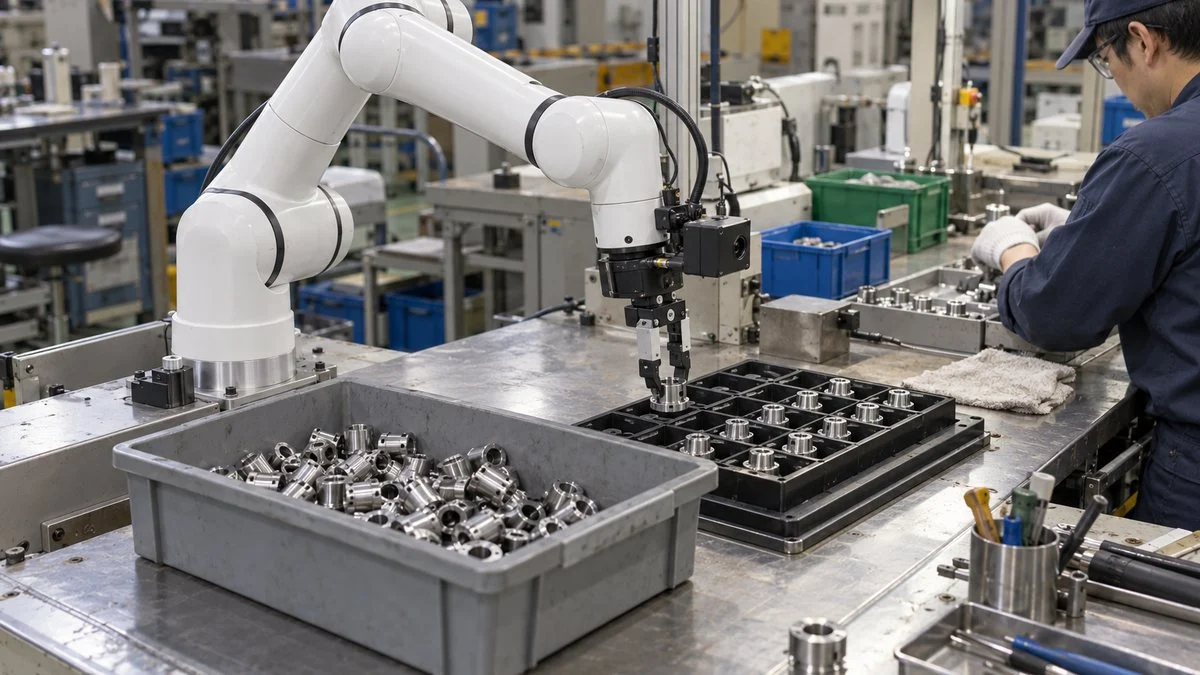
FANUC's announcements over the past year point in two directions. One is opening its robots to outside AI and software. The other is expanding production and service in growth markets such as the US and India.
Open Platform and Physical AI
FANUC has released an open-source ROS 2 driver for its robots on GitHub. ROS 2 is an open-source software framework widely used in robot development. FANUC also says its robot controllers can run Python programs directly, without a separate PC, and that the driver supports 1 ms communication for real-time motion commands from a PC.
On this foundation, FANUC is moving into physical AI, where AI makes decisions from sensor and camera data and moves the robot. It showed its open-platform physical AI system at the International Robot Exhibition in Tokyo in December 2025. In May 2026, it said more than 1,000 robots had shipped for physical AI applications since that launch.
Partnerships have followed. In May 2026, FANUC announced a collaboration with Google, including support for all FANUC robots on Intrinsic's software platform, and deeper integration of its ROBOGUIDE simulation software with NVIDIA Isaac Sim. In July, it agreed with Fujitsu to begin discussing joint business in physical AI. In September, it formed a strategic partnership with Hitachi to commercialize physical AI: the two companies will first validate the technology at Hitachi plants and then plan joint deployment starting in fiscal 2027.
This is a real shift for a company long known for closed, highly reliable in-house controls. At its results briefing, FANUC said these offerings currently tend to win large orders from big customers, and that it has started building packages with SIers to lower the barrier for small and midsize manufacturers.
New Products and Overseas Expansion
New robots in the fiscal year ended March 2026 included the CRX-3iA, an ultra-lightweight portable collaborative robot with a 3 kg (about 6.6 lb) payload, and the M-810/190-20B, designed for machining large parts such as automotive gigacastings. FANUC also developed the new ROBODRILL DC series and ROBOSHOT SC series.
Overseas, FANUC America announced in March 2026 that it will invest USD 90 million (about JPY 14.3 billion) in a new 840,000 sq ft (about 78,000 m²) factory and distribution center in Michigan. The building gives FANUC space to expand robot production in the US and is scheduled for completion in late 2027. In May 2026, FANUC India announced a new 5,000 m² (about 54,000 sq ft) service building at its Bangalore headquarters, housing a call center, a spare parts warehouse, and service offices.
AI partnerships and overseas investment in production and service continue.
- Dec 2025Shows its open-platform physical AI system at the International Robot Exhibition in Tokyo
- Jan 2026Named a Clarivate Top 100 Global Innovator for the fifth year in a row
- Mar 2026FANUC America announces a USD 90 million facility in Michigan (completion planned for late 2027)
- Apr 2026Record net sales for the year ended March 2026; Central Technical Center completed at headquarters
- May 2026Collaboration with Google, deeper work with NVIDIA, new service building at FANUC India
- Jul 2026Begins talks with Fujitsu on physical AI; raises full-year forecast
- Aug 2026Launches a 5-axis integrated technology initiative to spread 5-axis machining
- Sep 2026Strategic partnership with Hitachi to commercialize physical AI
Sources: FANUC news releases and financial results. Dates are announcement dates.
What This Means for Buyers and Users
FANUC's business model affects who you talk to, when, and about what. How it plays out depends on whether you bought a machine with a FANUC control inside or bought FANUC equipment directly.
If FANUC Is Inside a Machine Tool You Bought
For machine tool users, FANUC is the company behind the machine builder. Questions about CNC operation and faults often go to the machine tool builder first, but spare parts and repairs for the CNC and servos themselves connect to FANUC's service network. The builder knows how the CNC is set up on that machine, so agree on the escalation path with the builder before the machine ships.
If You Buy FANUC Robots or ROBOMACHINE Products
When you buy robots or ROBOMACHINE products, confirm the maintenance contact, how you will get spare parts, and how operators will be trained while you are still at the quotation stage. That makes it easier to compare offers as long-life equipment rather than on price alone. If an SIer builds the cell, also confirm which parts of the system the SIer supports and which go to FANUC. FANUC also runs FANUC Academy, a training facility at its headquarters in Oshino that offers courses on CNC and robot operation and maintenance; ask what training is available in your own country. For the quotation process itself, see how to send an RFQ to a Japanese manufacturer.
FANUC Contacts in the US, India, and Southeast Asia
| Region | FANUC group company | Notes from FANUC's own materials |
|---|---|---|
| United States | FANUC America Corporation | Headquarters in Rochester Hills, Michigan, since 1986. Technical support, sales, and service for CNCs and robots across North and South America. New Michigan facility planned for late 2027. |
| India | FANUC India Private Limited | Headquarters in Bangalore, established 1992. 23 service locations, 5 repair centers, and technical centers in Pune, Manesar, Bangalore, Chennai, and Coimbatore. |
| Southeast Asia | FANUC Thai Limited, FANUC Mechatronics (Malaysia) Sdn. Bhd., PT. FANUC Indonesia, FANUC Singapore Pte. Ltd., FANUC Philippines Corporation, FANUC Vietnam Company Limited | Listed among FANUC's customer service locations in Asia and Oceania. Check the FANUC service page for the office that covers your site. |
Checklist Before You Buy FANUC Equipment
- Exact CNC model and servo models on the machine, as written in the builder's specification
- First point of contact for CNC alarms: machine builder, SIer, or FANUC
- Escalation path from the builder or SIer to the local FANUC office
- Local FANUC service location and repair center closest to your plant
- Spare parts: recommended stock list, lead times, and how to order
- Operator and maintenance training: language, location, and schedule
- Monitoring and predictive maintenance options (such as FIELD system, AI Servo Monitor, ZDT) and whether they are offered in your country
- For robots: ROS 2, Python, or PLC interface requirements, if your team plans to add AI or vision
- Total cost of ownership over the expected life, not just the purchase price
Questions to Ask the Machine Builder, SIer, or FANUC
- Which FANUC CNC and servo models does this machine use, and are any options or software functions disabled or locked by the builder?
- When the CNC shows an alarm, who do we call first, and when do you hand the case to FANUC?
- Which FANUC service location and repair center will support our plant?
- Which spare parts do you recommend we keep on site, and what are typical lead times in our country?
- What training is available for our operators and maintenance staff, and in which language?
- Which remote monitoring or predictive maintenance products are available here, and what do they require?
- For a robot cell: which parts of the system does the SIer support, and which go to FANUC?
Sample Inquiry Email
Use this as a starting point when you write to a machine builder, SIer, or the local FANUC office. Replace the bracketed parts.
Subject: Support plan for FANUC-controlled equipment - [machine/cell name], [plant, city]

Hello,

We are evaluating [machine model / robot cell] for [part or process]
at [plant name, city, country].

Before we decide, could you confirm the following?

1. CNC and servo models used (or robot and controller models)
2. First point of contact for alarms and breakdowns, and when
   the case is handed over to FANUC
3. The FANUC service location and repair center that covers our site
4. Recommended spare parts list and typical lead times
5. Operator and maintenance training options (language, location)
6. Remote monitoring or predictive maintenance options available
   in our country

Thank you. We look forward to your reply.

Best regards,
[Name]
[Title, Company]
[Phone / Email]
Limits of This Guide
- Financial figures come from FANUC's English financial results, results briefing slides, and integrated report, in Japanese yen as reported. The figures for the fiscal year ending March 2027 are forecasts.
- Market share claims are FANUC's own estimates, as stated in its integrated report.
- The FANUC, Yaskawa, and Keyence figures cover different fiscal years and accounting standards. Use them only to compare scale.
- Who handles CNC support varies by machine builder, SIer, contract, and country. Confirm it for your own equipment.
- Product availability, options, and service coverage vary by country. Confirm them with the FANUC office that covers your site.
FAQ
What does FANUC make?
FANUC makes CNC systems and servo motors for machine tools, industrial and collaborative robots, and three compact machine lines: ROBODRILL machining centers, ROBOSHOT electric injection molding machines, and ROBOCUT wire EDMs. It also provides maintenance, spare parts, and training for all of them.
What is FANUC's business model?
FANUC builds every product on one core technology, its own CNCs and servos. It sells CNCs to machine tool builders as components, sells robots and machines directly to manufacturers, and maintains its products for as long as customers use them. In the fiscal year ended March 2026, robots made up 44.1% of sales, FA 24.3%, service 16.5%, and Robomachine 15.1%.
How much revenue does FANUC make?
FANUC reported consolidated net sales of JPY 857.8 billion and operating income of JPY 183.8 billion for the fiscal year ended March 2026, a 21.4% operating margin. In July 2026, it forecast JPY 948.1 billion in net sales for the fiscal year ending March 2027.
Is FANUC bigger than Yaskawa in robots?
By reported robot sales, yes, in the latest fiscal years. FANUC's Robot division sold JPY 378.6 billion in the year ended March 2026, while Yaskawa's Robotics segment had JPY 247.0 billion in revenue in the year ended February 2026. Yaskawa also has a large motion control business, and the two companies use different fiscal years and accounting standards.
Who do I call when the FANUC CNC on my machine has a problem?
Usually the machine tool builder first, because it knows how the CNC is set up on that machine. Spare parts and repairs for the CNC and servos themselves go through FANUC's service network. Agree on the exact escalation path with the builder before the machine ships.
Sources
- Results, divisions, regions, management policy: FANUC, Consolidated Annual Financial Results for the Year Ended March 31, 2026 (April 24, 2026)
- Regional composition, margin history, FANUC India, FANUC America: FANUC, results briefing slides for the year ended March 31, 2026 (April 24, 2026)
- First-quarter results and revised forecast: FANUC, Consolidated Quarterly Financial Results for the Three Months Ended June 30, 2026 (July 31, 2026)
- Division mix in the year ended March 2022: FANUC, Consolidated Annual Financial Results for the Year Ended March 31, 2022
- History, financial highlights, market share, factories, service network, profitability policy: FANUC, Integrated Report 2025
- Service network: FANUC, Service
- Physical AI and partnerships: Google collaboration (May 13, 2026), NVIDIA collaboration (May 15, 2026), Fujitsu talks (July 16, 2026), Hitachi partnership (September 30, 2026)
- ROS 2 driver and Python: FANUC America, ROS 2 Driver
- Overseas investment: FANUC America investment in Michigan (March 24, 2026), FANUC India new service building (May 19, 2026)
- Other announcements: 5-axis integrated technology initiative (August 24, 2026), Clarivate Top 100 Global Innovators 2026 (January 22, 2026), Central Technical Center (April 22, 2026)
- New products (CRX-3iA, M-810/190-20B): FANUC, 57th Annual Securities Report (Japanese)
- Group companies in Asia: FANUC global network: Asia, customer service locations in Asia and Oceania
- Yaskawa Electric: Results briefing for the year ended February 28, 2026 (April 10, 2026)
- Keyence: Financial results materials for the year ended March 31, 2026, Business model
Original article in JapaneseThis guide is adapted from a MONOSCOPE article written for readers in Japan: ファナックとは|CNC・ロボット・ロボマシンの3本柱と高収益の理由
About the editor
 MONOSCOPE EditorFOUNDER & EDITOR
Spent about ten years at a plant equipment maker and a plant engineering company, proposing, designing, and commissioning equipment, then moved into web marketing. Now a web consultant for B2B manufacturers, helping them explain their products and technology. Licensed in Japan as an Energy Manager and a Third-Class Chief Electrical Engineer.
Has run an engineering blog since 2017 (500+ articles) and a Japanese YouTube channel with about 20,000 subscribers. Each English guide is written from the Japanese shop-floor point of view and checked against the cited standards.