Yaskawa Electric: Servo, Drive (VFD), and Robot Businesses

Open the control cabinet of a machine built in Japan, and there is a good chance you will find Yaskawa hardware inside: a row of servo amplifiers labeled SERVOPACK, an AC drive running a pump or fan, or a MOTOMAN robot on the line. The Japanese drawings may call the drive an "inverter" (インバータ, inbata), the servo amplifier a "servo pack" (サーボパック), and list everything under the maker's name, 安川電機 (Yaskawa Denki).
Yaskawa Electric is best known for its MOTOMAN robots, but servo systems and AC drives bring in just as much revenue. This guide explains what Yaskawa sells and to whom, how its servo, drive, and robot businesses differ, how its results move with the semiconductor and auto cycles, and how it compares with Fanuc. It ends with a checklist, questions for the machine builder, and a sample email for when you take over or buy equipment with Yaskawa components. Every figure states its fiscal year. Yaskawa's fiscal year ends in February, so "FY2025" in its English reports means the year ended February 28, 2026.
For how Yaskawa fits among Keyence, Fanuc, SMC, Mitsubishi Electric, and Omron, see Japanese Factory Automation Companies: Who Makes What.
Contents
- Yaskawa Electric at a Glance
- Where the Revenue Comes From
- AC Servo vs. AC Drive: What Is the Difference?
- How Yaskawa's Results Move with the Semiconductor and Auto Cycles
- Yaskawa's Strengths
- Yaskawa vs. Fanuc
- Where Yaskawa Is Investing: Dash 35 and Physical AI
- Working with Yaskawa Outside Japan
- Checklist: Equipment with Yaskawa Components
- Questions to Ask the Machine Builder or Yaskawa
- Sample Inquiry Email
- Limits of This Guide
- FAQ
- Sources
Yaskawa Electric at a Glance
Yaskawa sells two kinds of products to machine builders and factories: components that drive motors precisely, and industrial robots. For the fiscal year ended February 2026, revenue was JPY 542.1 billion. The Motion Control segment (AC servos and AC drives) made up 43.5% and Robotics 45.6%, so the two together account for about 90% of sales.
The rest comes from System Engineering (7.1%), which supplies electrical systems for steel plants, port cranes, and water and sewage facilities, and from Other (3.7%), mainly logistics services. The common description of Yaskawa's "three pillars" (servo, drive, and robot) comes from splitting Motion Control into its two businesses: AC servo & controller, and drives.
Headquartered in Kitakyushu, with about three-quarters of revenue from outside Japan.
Sources: Yaskawa Electric, Consolidated Financial Results for FY2025 (April 10, 2026) and YASKAWA Report 2026. Fiscal year ends in February.
Almost all customers are businesses. Machine builders design AC servos into their equipment. Makers of air-conditioning units, cranes, and pumps, and factories that run that equipment, use the AC drives. Automakers, auto parts suppliers, and electronics plants put the robots on their production lines.
The "three pillars" are the two Motion Control businesses plus Robotics.
Sources: YASKAWA Report 2026 ("YASKAWA at a glance"); Yaskawa's annual securities report for FY2025 (Japanese).
Reading Yaskawa Terms on Japanese Documents
Japanese drawings, parts lists, and manuals often use Japanese names for Yaskawa products. The table below maps the ones you are most likely to see.
| On the Japanese document | Meaning | What to search for in English |
|---|---|---|
| 安川電機 (Yaskawa Denki) | Yaskawa Electric Corporation | Yaskawa, Yaskawa Electric |
| サーボパック (sabo pakku) | Servo amplifier / servo drive | SERVOPACK, plus the series name (e.g., Σ-X) |
| サーボモータ (sabo mota) | Servo motor | Yaskawa servo motor, plus the model number |
| インバータ (inbata) | AC drive, variable frequency drive (VFD) | Yaskawa AC drive or VFD, plus the series name (e.g., GA700) |
| マシンコントローラ (mashin kontorora) | Machine controller (motion controller) | Yaskawa machine controller, plus the model number |
| モートマン (motoman) | MOTOMAN industrial robot | MOTOMAN, plus the robot model |
The series names above (Σ-X servo drives, GA700 AC drives) are examples Yaskawa shows in its 2026 report. The exact model on your equipment is on its nameplate. Whether that model is sold and supported in your country is a separate question. Ask your local Yaskawa office.
Where the Revenue Comes From
Robotics brings in slightly more revenue, but Motion Control earns the higher margin.
Robotics and Motion Control are close to equal. Japan, the Americas, and China each account for more than 20%.
Sources: Yaskawa, Consolidated Financial Results for FY2025 and Results Briefing for FY2025 (April 10, 2026); YASKAWA Report 2026. Shares are calculated from revenue from external customers. Regions are based on the location of group companies.
Japan accounted for 27.4% of revenue, so more than 70% came from outside Japan. In the United States, sales of drives for air conditioning, including data center cooling, and of PV inverters grew in the fiscal year ended February 2026.
Each business also leans on different customer industries. For AC servos, electronics-related applications (semiconductors, LCDs, and electronic components) are the largest group, at about 40% in FY2024 according to Yaskawa's Japanese-language investor briefing. For robots, automotive applications such as arc welding and painting make up about 44% of segment revenue (FY2025). So the same company can see one business grow while another shrinks.
AC Servo vs. AC Drive: What Is the Difference?
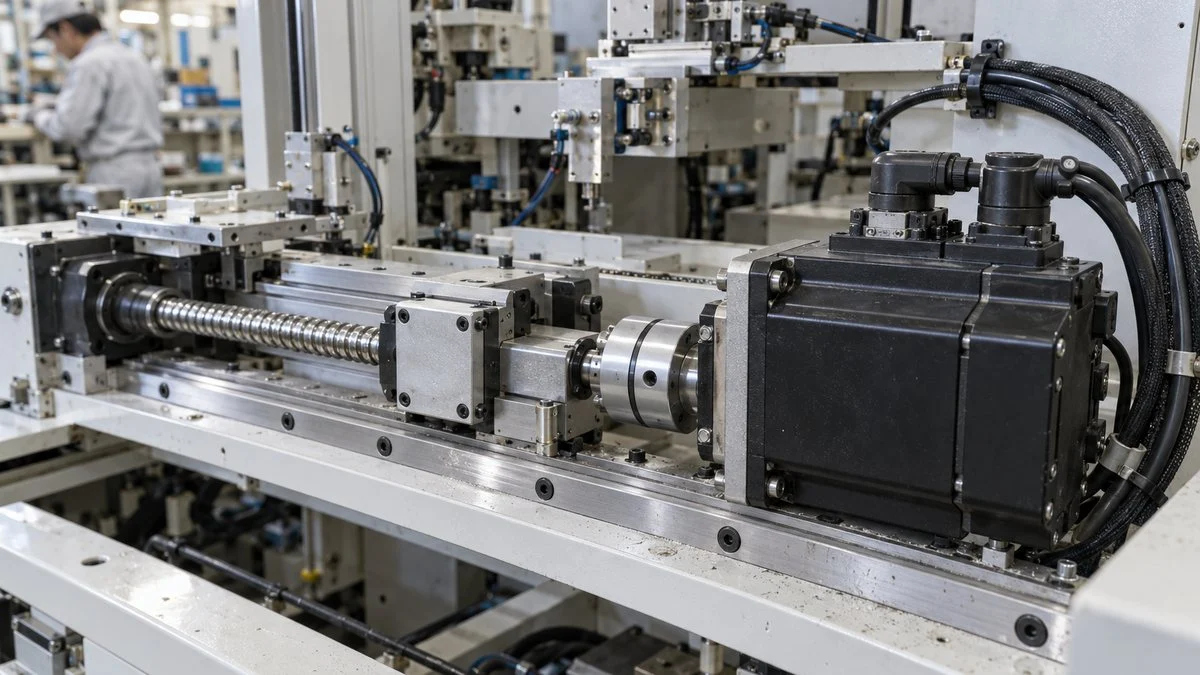
Both Motion Control products control electric motors electronically, but they control different things. A servo decides how far and how fast an axis moves. A drive (the "inverter" on Japanese drawings) decides how fast a motor keeps turning.
Do you need to position an axis, or change a motor's speed? The answer decides the component.
Product categories and applications follow Yaskawa's investor briefing materials (February 2026, Japanese). The selection points are general considerations, not Yaskawa's selection procedure.
An AC servo system works as a set: the motor, the servo drive (SERVOPACK) that powers it, and an encoder that reads the motor's position. Moving wafers, placing components on circuit boards, and opening and closing molds all depend on the speed and accuracy of these axes, which set the machine's output. That is why a servo brand, once designed into a machine, is hard to replace.
An AC drive adjusts motor speed by changing the frequency of the AC power it supplies. Yaskawa's investor materials cite an estimate that motors use 46% of the world's electricity (MOTOR SUMMIT 2012) and explain that high-efficiency motors cannot run without drives. Demand for drives tends to grow as energy-efficiency rules tighten.
Within Motion Control (JPY 236.1 billion in FY2025), the AC servo & controller business made up 51% and the drives business 49%. Yaskawa has a near-equal mix of parts that make machines more precise and parts that make facilities use less energy.
How Yaskawa's Results Move with the Semiconductor and Auto Cycles
Yaskawa sells capital goods, so its results rise and fall with its customers' capital spending, especially in semiconductors and automotive.
Revenue peaked in the year ended February 2024. Operating margin has since fallen to 8–9%.
ActualCompany forecast
Sources: YASKAWA Report 2026, Long-term Financial Data (IFRS); Consolidated Financial Results for the First Half of FY2026 (October 9, 2026). The forecast is the revised figure of October 9, 2026; the original forecast of April 10, 2026 was JPY 580.0B revenue and JPY 60.0B operating profit.
Operating profit peaked at JPY 68.3 billion (12.3% margin) in the year ended February 2023 and then fell for three straight years. In the year ended February 2026, Motion Control profit rose 6.0% on stronger AC servo sales to the electronic components and machine tool markets. Robotics profit fell 14.0%: automotive sales dropped in Japan, the Americas, and Europe, though large projects lifted sales in China and the rest of Asia. Exchange rates and higher indirect costs also weighed on the company total.
Yaskawa itself has acknowledged the shortfall. Reviewing its previous mid-term plan, Realize 25 (FY2023–FY2025), it concluded that it had missed the company-wide targets of JPY 650.0 billion in revenue and JPY 100.0 billion in operating profit for FY2025.
Watch where Yaskawa's customers are investing, and you can tell which business will move.
Sources: Yaskawa, Consolidated Financial Results for FY2025 (April 10, 2026) and for the First Half of FY2026 (October 9, 2026). FY2025 = year ended February 2026.
The latest results show the split clearly. For the six months ended August 31, 2026, revenue rose 9.8% to JPY 285.6 billion on strong data center and semiconductor demand, but operating profit fell 5.5% to JPY 22.1 billion. Motion Control revenue grew 21.7% and its operating profit 32.8%. Robotics revenue slipped 0.7%, and its operating profit dropped 43.3%. Yaskawa attributed the profit decline to the effects of a new ERP system on production and shipments, higher indirect costs, and one-time restructuring costs in Europe.
On October 9, 2026, Yaskawa raised its full-year revenue forecast from JPY 580.0 billion to JPY 600.0 billion, citing a weaker yen. It cut its operating profit forecast from JPY 60.0 billion to JPY 57.5 billion to reflect the ERP effects. For a buyer, the practical point is this: tailwinds and headwinds often hit Yaskawa's businesses separately, so the servo side and the robot side can be in very different situations at the same time.
Yaskawa's Strengths
Yaskawa's own published materials support the four strengths below.
Mechatronics: Robots Built on Motor Technology
In 1969, Yaskawa introduced the concept of "mechatronics," combining mechanisms and electronics. According to its integrated report, it launched the Minertia motor, the basis of today's servo motors, in 1958, and in 1977 the MOTOMAN-L10, Japan's first all-electric vertical articulated industrial robot.
Every joint of an industrial robot contains a servo motor, so a servo company building robots is a natural step. Yaskawa says it uses in-house motors in MOTOMAN NEXT so the robot can reproduce its motion plans accurately. Owning both the motor and the control is part of how it builds robot performance.
Related: Japanese Robot Makers: Pendants, Service, and Safety Rules
Global Share in AC Servos
YASKAWA Report 2026 gives global market shares of 14% for its AC servo & controller business, 7% for robots, and 5% for drives. In Japanese-language investor materials (February 2026), Yaskawa calls itself No. 1 in global AC servo share for FY2024, based on its own estimate. In Japan, it reports a 100% share of electrical systems for blast-furnace steel plants. Market size and competitors differ by product, so these shares do not rank one business against another.
For engineers, a high servo share means Yaskawa servos appear on many machines worldwide and are a common option when you design or specify equipment. Yaskawa also says it aims to protect profitability in the high-end segment while local makers in China grow at the low end. In semiconductor equipment, servos handle wafer transfer and stage positioning, which helps explain why AI-related chip investment affects Yaskawa's orders.
Servos and Robots Made in One Plant
Yaskawa's Robot Factory No. 5 in Kitakyushu, which began operating in FY2025 and reached full-scale operation in July 2026, produces industrial robots and the AC servo motors that go into them at the same site. Instead of a conventional production line, it uses a "distributed cell production system": multiple independent cells that can each do the same work. Yaskawa says this lets production continue even when demand, product mix, staffing, or equipment conditions change.
The plant runs on Yaskawa's own robots, servos, and controllers and links equipment data over time to improve quality. Yaskawa also uses the plant as a showcase, so customers can see its automation running in real production. One example it describes: MOTOMAN NEXT detecting its own screw-tightening errors and redoing the task.
Broad Markets and Local Production
Because Yaskawa's customers range from semiconductors and automotive to HVAC and steel, a slump in one industry is less likely to hit the whole company. As Figure 6 shows, however, a downturn in semiconductors and autos at the same time would hit both main businesses together.
Yaskawa follows a policy of local production for local consumption. In FY2025, 47% of production and 54% of employees were outside Japan. In the US, it is building a new campus in Franklin, Wisconsin, to consolidate Yaskawa America's headquarters and production. It is also developing its Vietnam PCB plant into a hub that supplies circuit boards to its plants in North America, Europe, and India. Both moves help Yaskawa build closer to where it sells, which reduces its exposure to tariffs and currency swings.
Yaskawa vs. Fanuc
Fanuc, which also makes robots and servos, is the company most often compared with Yaskawa. Both serve factory automation, but they sell servos differently, their robot businesses differ in size, and their margins are far apart.
The key difference: Yaskawa sells stand-alone servos to builders of many kinds of machinery; Fanuc packages them with its CNC systems for machine tools.
Sources: Yaskawa, Consolidated Financial Results for FY2025; Fanuc, financial results for the fiscal year ended March 2026. Fiscal years and accounting standards differ, so use the figures only for a sense of scale.
Fanuc supplies CNC systems, the "brains" of machine tools, together with servos, and earns a high margin. Yaskawa sells servos as stand-alone components to many industries and also has AC drives for energy savings. In the latest results, Fanuc's robot business is the larger of the two.
If your work involves motion control on semiconductor or electronics assembly equipment, or energy savings on HVAC and pumps, start with Yaskawa. If it involves machine tool or machining center controls, start with Fanuc. For welding and handling robots, both are major makers and worth comparing side by side.
Related: FANUC Business Model: What It Means for Buyers and Users
Where Yaskawa Is Investing: Dash 35 and Physical AI
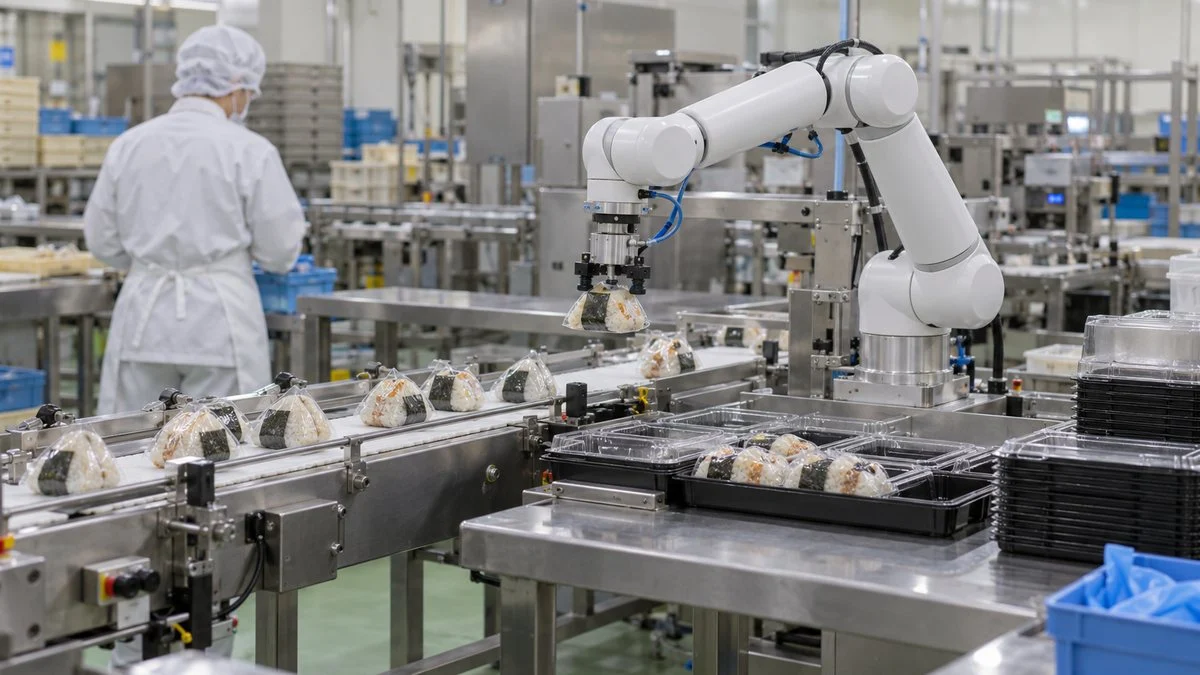
On May 22, 2026, Yaskawa published its long-term plan "Vision 2035" (FY2026–FY2035) and the first four-year mid-term plan under it, "Dash 35" (FY2026–FY2029). The plans tell you where the company will put its money.
Dash 35 Targets
Dash 35 targets revenue of JPY 650.0 billion and a record operating profit of JPY 100.0 billion (15.4% margin) in FY2029. By segment, the targets are a 17.3% operating margin for Motion Control and 15.5% for Robotics. Because the previous plan fell short, Yaskawa says it will focus on raising profitability in the first two years. Planned investment over the four years totals JPY 250.0 billion: JPY 130.0 billion in capital expenditures and JPY 120.0 billion in strategic investments. Under Vision 2035, Yaskawa names operating margin as its most important indicator and targets 20.0% or more by FY2035.
MOTOMAN NEXT and Physical AI
At the center of the growth plan is "physical AI": robots that use AI to act on their own in the real world. MOTOMAN NEXT, launched in November 2023, uses sensors and AI to recognize its surroundings and create its own motion plans. The collaborative AI robot MOTOMAN NEXT-NHC12 won the main award in the Nikkan Kogyo Shimbun's 10 Best New Products Awards for 2025.
Yaskawa has signed a memorandum of understanding with SoftBank Corp. on AI and communication technologies for robots, and the two companies have tested robotic handling of soft objects. In July 2026, it announced a link between MOTOMAN NEXT and Google DeepMind's generative AI model Gemini Robotics ER 1.6, aiming to build work sequences without detailed programming. Dash 35 also plans to develop "advanced actuators" for humanoid robots as core components. In FY2025, Yaskawa made Tokyo Robotics Inc. a wholly owned subsidiary and began developing humanoid robot actuators.
New Plants, Overseas Sites, and New Applications
On the production side, Yaskawa plans to expand capacity in India, which it names, along with the US, as a key growth market. In June 2025, Yaskawa America announced a USD 180 million investment over eight to ten years in the Franklin, Wisconsin, campus. The campus will bring together headquarters and production functions now in Illinois and Wisconsin, along with training and industrial robot manufacturing.
Yaskawa is also taking automation into new fields. A cucumber harvesting robot developed with JA Zen-Noh (the National Federation of Agricultural Cooperative Associations) began operating on farms in February 2026. Maholo, a dual-arm robot that automates medical and pharmaceutical lab work, is used in a robot-based automated cell culture system that received a US FDA advanced manufacturing technology designation, the first for a Japanese company.
Physical AI, production capacity, and a new business plan are all moving at once.
- Jun 2025Yaskawa America announces a new campus in Franklin, Wisconsin (USD 180 million over 8–10 years)
- FY2025Tokyo Robotics becomes a wholly owned subsidiary; MOU with SoftBank Corp.
- Early 2026MOTOMAN NEXT-NHC12 wins the 10 Best New Products main award; cucumber harvesting robot begins operating on farms
- May 2026"Vision 2035" and "Dash 35" announced
- Jul 2026Robot Factory No. 5 (Kitakyushu) reaches full-scale operation; link between MOTOMAN NEXT and Google DeepMind's Gemini Robotics ER 1.6 announced
- Aug 2026Collaborative robot MOTOMAN-HC12 (12 kg payload) launched in Japan
- Oct 2026Seven-axis large painting robot MOTOMAN-PA3050HB (3,050 mm reach) launched in Japan; first-half results and revised full-year forecast (JPY 600.0B revenue, JPY 57.5B operating profit)
Sources: Yaskawa news releases; Results Briefing for FY2025; YASKAWA Report 2026; Yaskawa Global news release (June 19, 2025). Launch dates are for Japan; check availability in your region.
Working with Yaskawa Outside Japan
Yaskawa has its own sales and service companies in many of the regions MONOSCOPE readers work in. In the US, Yaskawa America is consolidating into the Franklin, Wisconsin, campus. In India, Yaskawa India Private Limited has its headquarters and drives & motion control division in Bengaluru and its robotics division in Gurgaon, with branch offices in other cities. Yaskawa's regional directory also lists sales and service companies in Singapore, Thailand, and Vietnam. Office lists change, so confirm your current contact on Yaskawa's global website.
How you buy depends on the product. Machine builders usually buy servos and drives through Yaskawa's sales companies or distributors, with technical support for selection. Factories often buy robots through a system integrator that builds the whole cell, including peripheral equipment, rather than directly from Yaskawa. If the equipment was built in Japan, the machine builder may be your first point of contact, not Yaskawa.
Checklist: Equipment with Yaskawa Components
Use this list when you take over a Japanese-built machine or line with Yaskawa servos, drives, or robots, or when you specify Yaskawa for a new project.
- Full model numbers from the nameplates of every SERVOPACK, servo motor, AC drive, controller, and robot (not just the series name)
- Whether each model is sold and supported in your country, or is a Japan-market model with a local equivalent
- Supply voltage and frequency of each drive and servo amplifier vs. your plant supply (Japanese equipment is often built for Japan's voltage and frequency)
- Network and interface between the servos and the machine's controller (for example, the fieldbus used)
- Parameter backups for every servo drive and AC drive, and robot program backups, with the software tool and version needed to open them
- Language of drive keypads, alarm lists, and manuals; English manuals for each model before acceptance
- Local support route: Yaskawa's local office, a distributor, a system integrator, or the Japanese machine builder
- Recommended spare parts (drives, motors, encoder cables, robot spares) with lead times quoted for delivery to your country
- Product life-cycle status: whether any model is scheduled for discontinuation and what the replacement is
Questions to Ask the Machine Builder or Yaskawa
- Which Yaskawa components on this equipment are Japan-market models, and what are the equivalents sold in our country?
- Who is our first contact for Yaskawa servo, drive, and robot issues: you, a local integrator, or Yaskawa's local office?
- Can you send the servo and drive parameter files and robot programs, plus the software versions used to create them?
- What is the lead time for the recommended spares if we order them locally?
- Are any of these models nearing end of life? If so, is the replacement drop-in, or will it need parameter or wiring changes?
- Does replacing a drive or servo amplifier require any re-tuning or safety re-validation on this machine, and who should do it?
Sample Inquiry Email
Subject: Yaskawa components and local support for [equipment name], [PO number]
Dear [Name],
We are preparing to operate [equipment name], delivered under [PO number], at our plant in [city, country]. Before acceptance, please send us the following for the Yaskawa components on this equipment:
- A list of all Yaskawa servo drives (SERVOPACK), servo motors, AC drives (inverters), controllers, and robots, with full model numbers and quantities
- For any Japan-market model, the equivalent model available in [country]
- Backups of servo and drive parameters and robot programs, with the software versions used
- English manuals and alarm lists for each model
- A recommended spare parts list with lead times for delivery to [country]
- The local support contact for Yaskawa products
If any component is scheduled for discontinuation, please tell us the replacement model.
Best regards,
[Your name]
[Company, department]
Limits of This Guide
- All financial figures come from Yaskawa's and Fanuc's published results and reports for the fiscal years stated. Yaskawa's fiscal year ends in February and Fanuc's in March, and the two use different accounting standards.
- Market shares are Yaskawa's own figures and estimates.
- Local offices, product availability, and service coverage vary by country and change over time. Confirm them with Yaskawa's office in your region.
- Product launches listed here are for Japan unless stated otherwise. Overseas release dates may differ.
- The selection points for servos and drives are general considerations. Final component selection and any safety-related changes belong to the machine builder and your engineering team.
FAQ
What does Yaskawa Electric make?
Yaskawa makes AC servo motors and servo drives, AC drives (inverters/VFDs), and MOTOMAN industrial robots, plus electrical systems for steel plants and infrastructure. In the fiscal year ended February 2026, Robotics made up 45.6% of revenue and Motion Control (servos and drives) 43.5%.
Is Yaskawa a Japanese company?
Yes. Yaskawa Electric was founded in 1915 and is headquartered in Kitakyushu, Fukuoka Prefecture. About 73% of its revenue comes from outside Japan, and it has sales and service companies in the Americas, Europe, China, India, and Southeast Asia.
What is the difference between a Yaskawa servo and a Yaskawa drive?
A servo (servo motor plus SERVOPACK servo drive) controls the position and speed of a machine axis. An AC drive, called an "inverter" on Japanese drawings, controls the speed of a motor in continuous operation, such as a pump, fan, or conveyor.
Yaskawa vs Fanuc: which is bigger?
Fanuc is bigger. Its revenue was JPY 857.8 billion for the fiscal year ended March 2026, against Yaskawa's JPY 542.1 billion for the year ended February 2026. Fanuc's operating margin (21.4%) is also far higher than Yaskawa's (8.7%). Yaskawa sells servos as stand-alone components to many industries and also has an AC drive business.
What is MOTOMAN?
MOTOMAN is Yaskawa's brand of industrial robots, covering welding, painting, handling, collaborative, and wafer transfer robots. The first, the MOTOMAN-L10 of 1977, was Japan's first all-electric vertical articulated industrial robot. The newest line, MOTOMAN NEXT, uses AI to plan its own motions.
Sources
- Yaskawa Electric: Consolidated Financial Results for FY2025 (IFRS) (April 10, 2026)
- Yaskawa Electric: Results Briefing for FY2025 (April 10, 2026)
- Yaskawa Electric: Consolidated Financial Results for the First Half of FY2026 (IFRS) (October 9, 2026)
- Yaskawa Electric: YASKAWA Report 2026 (market shares, business breakdown, long-term financial data, history, Robot Factory No. 5)
- Yaskawa Electric: New Long-term Business Plan "Vision 2035" and New Mid-term Business Plan "Dash 35" (May 22, 2026) and Dash 35 presentation
- Yaskawa Electric: Yaskawa Establishes a New Campus in Franklin, Wisconsin (June 19, 2025)
- Yaskawa Electric: Investor briefing for individual investors (February 2026, Japanese)
- Yaskawa Electric: news releases on Google DeepMind collaboration (July 15, 2026, Japanese) and MOTOMAN-PA3050HB (October 7, 2026, Japanese)
- Yaskawa India: Yaskawa India and Asia Pacific directory
- Fanuc: Financial results for the fiscal year ended March 2026 (Japanese)
Original article in JapaneseThis guide is adapted from a MONOSCOPE article written for readers in Japan: 安川電機とは|サーボ・インバータ・ロボットの3本柱と強み
About the editor
 MONOSCOPE EditorFOUNDER & EDITOR
Spent about ten years at a plant equipment maker and a plant engineering company, proposing, designing, and commissioning equipment, then moved into web marketing. Now a web consultant for B2B manufacturers, helping them explain their products and technology. Licensed in Japan as an Energy Manager and a Third-Class Chief Electrical Engineer.
Has run an engineering blog since 2017 (500+ articles) and a Japanese YouTube channel with about 20,000 subscribers. Each English guide is written from the Japanese shop-floor point of view and checked against the cited standards.