Japanese Robot Makers: Pendants, Service, and Safety Rules
Your plant in Thailand, India, or the US is taking over a line built in Japan. It runs a FANUC robot for welding, a Yaskawa robot for handling, and an Epson SCARA on the assembly station. Each one came with its own controller, its own teach pendant, and its own programming language. The Japanese documents add terms such as 教示 (kyoji, teaching), "special education," and "80 W or less," which have no obvious meaning outside Japan.
This guide is for the engineers who install, run, and maintain those robots. It covers how an industrial robot system is put together, what each Japanese maker calls its controller and pendant, what to confirm about spare parts and service before the line ships, and how Japan's robot safety rules differ from ISO 10218. It ends with a checklist, questions for the Japanese side, and a sample inquiry email.
Contents
- Why So Many Robots in Your Plant Come From Japan
- What Counts as an Industrial Robot
- Robot Types and What They Do Best
- Same Basics, Different Names: Japanese Maker Terminology
- Spare Parts and Service: What to Confirm Before the Line Ships
- Robot Safety Rules: ISO 10218 vs. Japan's Ordinance
- Checklist: Taking Over Japanese Robots at Your Plant
- Questions to Ask the Japanese Supplier or SIer
- Limits of This Guide
- FAQ
- Sources
Why So Many Robots in Your Plant Come From Japan
According to the International Federation of Robotics (IFR), about 542,000 industrial robots were installed worldwide in 2024, and about 4,664,000 were in operation. Japan installed about 44,500 that year, second only to China.
Japan matters even more as a maker. Statistics from the Japan Robot Association (JARA) put Japan's 2025 industrial robot production at about JPY 945 billion, and exports made up about 80% (79.5%) of total shipment value. Japanese robots work in factories around the world, often inside cells built outside Japan. For a profile of the main makers, see Japanese Factory Automation Companies: Who Makes What.
What Counts as an Industrial Robot
ISO 8373 defines an industrial robot as an automatically controlled, reprogrammable, multipurpose manipulator, programmable in three or more axes, for use in industrial automation. It can be fixed in place or mounted on a mobile platform. Automated guided vehicles (AGVs) and autonomous mobile robots (AMRs) have no arm and are usually classed separately, but an arm mounted on a mobile base counts as an industrial robot under the current definition.
The defining feature is reprogramming. A dedicated machine is designed around one product or process. It repeats simple motions in the shortest cycle and suits long runs of the same product, but it needs modification or rebuilding when the product changes and often ends its life with the line. A robot is slower than a dedicated machine at simple repetitive moves, but it can move from welding to handling to assembly when you change its end effector and program, and it can be reused on another process. Real lines often combine both.
A Robot Is a System, Not Just an Arm
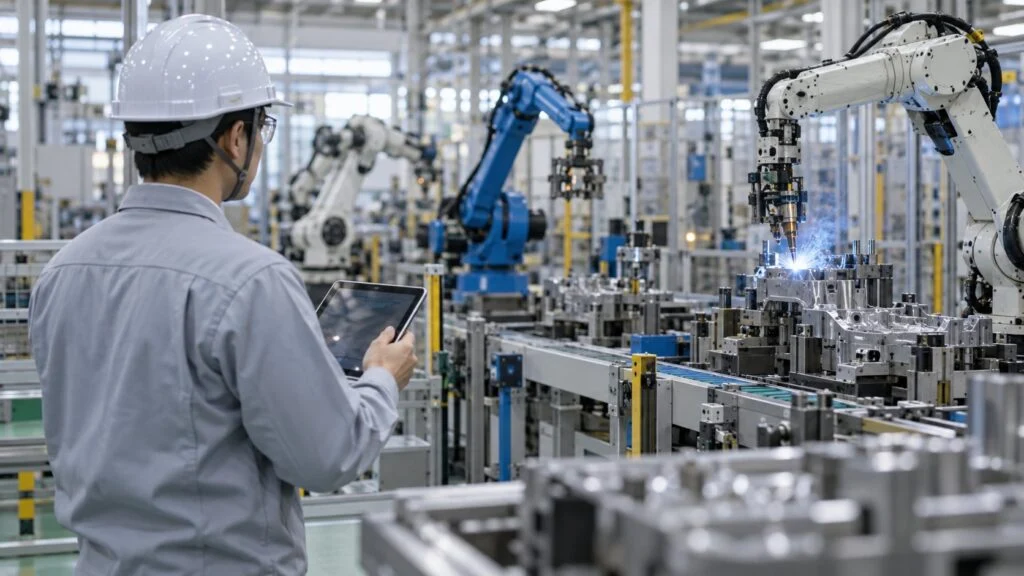
The arm cannot work on its own. In practice, it runs as a robot system: a controller, the arm, an end effector, peripheral equipment, and safety devices. The controller exchanges signals with the line's PLC so the robot keeps pace with the equipment before and after it.
The arm, the controls, and the peripherals work as one unit.
Whether to add a camera or force sensor depends on the task and the accuracy it needs.
The controller is the brain. From the positions and speeds in the program, it calculates how far to turn each joint motor. A teach pendant, the handheld unit used to jog the robot and record positions, plugs into the controller. Each joint contains a servo motor, a reducer (gear unit), and an encoder that measures the actual rotation angle.
Peripheral equipment is the other half: conveyors and fixtures that bring the workpiece to a set position, cameras that read its position, and fences and sensors that stop the robot when a person comes near. Because a robot moves faster and with far more force than a person, separating people from the robot's working area is the starting point of robot safety.
Designing the whole system, including the gripper, peripherals, and programs, is called system integration. It often takes more time and money than the robot itself. In Japan, the companies that do this are called SIers; see Japanese Robot System Integrators: RFP, Quotes, Acceptance.
How the Robot Hits the Same Point Every Time
A robot repeats a motion in three stages. First, someone decides the pick and place positions and the task sequence, teaches the tool position and orientation point by point, and arranges the points into a program with order and speed. Next, the controller calculates a smooth path between the points and the joint angles along it, and keeps sending small steps of target angle and speed to the motors. Finally, encoders measure the actual motion and the controller corrects any error. If a camera reads the part position, the target is adjusted for each part before the robot moves. Four principles make this work, and each one points to parts that maintenance teams look after.
- Joint coordination. To reach any position and orientation in space, a robot generally needs six joints (six axes). The controller works backward from the target tool position to the angle of each joint, and repeats this calculation in very short cycles so that the tool follows a straight line or an arc.
- Servo motors and feedback control. The encoder on each servo motor constantly measures how far it has actually turned. The controller compares that angle with the commanded angle and corrects any difference. This measure-compare-correct loop is what lets a robot return to the same point tens of thousands of times.
- Precision reducers. A motor spins fast but with little torque, so each joint has a reducer that trades speed for force. Even slight play (backlash) in a reducer becomes a large error at the tool tip, so robots use low-backlash, high-rigidity precision reducers, a component Japanese makers are known for.
- Sensors. With only the principles above, a robot can return accurately to the taught points but cannot adapt when things change. If parts arrive in slightly different positions, the tool misses or collides. Cameras that read the part position and wrist force sensors that measure pushing force let the robot correct each motion. Picking randomly piled parts from a bin and assembly that fits parts together depend on these sensors.
Robot Types and What They Do Best
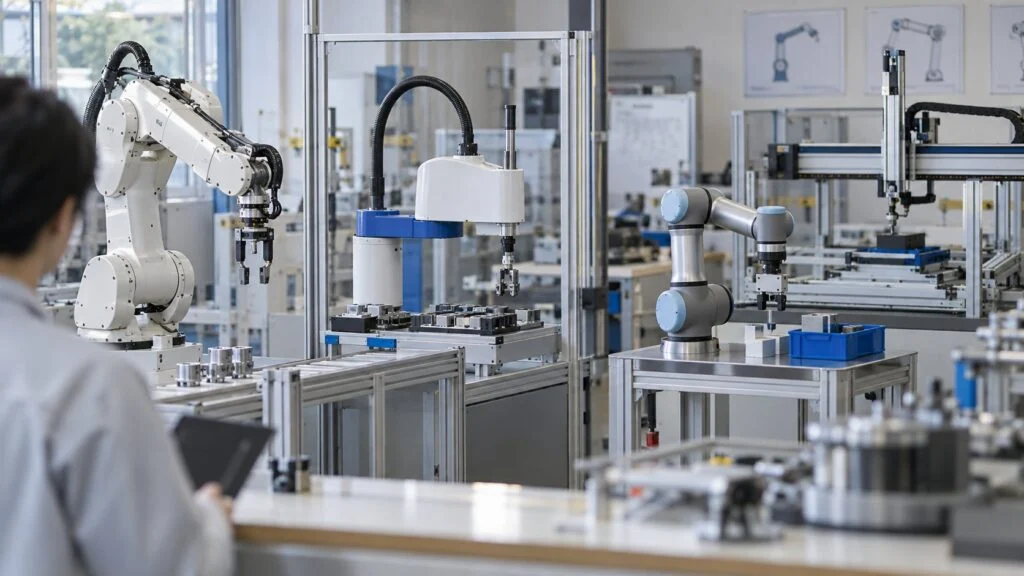
The IFR, following ISO 8373, groups industrial robots into six types by mechanical structure: articulated, SCARA, Cartesian (linear), parallel (delta), cylindrical, and polar (spherical). The first four are the main types used today.
The structure decides the reach and the jobs each type handles well.
Cylindrical and polar robots also exist, but the four types above are the main ones today.
Articulated robots have joints that work like a waist, shoulder, elbow, and wrist, usually six axes. They can change the part's orientation while moving in 3D, so their uses run from welding and painting to heavy handling. Sizes range from small units carrying a few kilograms to large ones that lift car bodies. The trade-offs: more joints make motion calculation and teaching more complex, and the robot needs a wide safety zone around its reach.
SCARA robots have two horizontal rotary joints and a separate axis for vertical motion. They are compliant in the horizontal direction and stiff in the vertical, which suits inserting parts into holes. With high speed and a small footprint, they are common on electronics and precision assembly lines.
Cartesian robots combine straight-line motion in three directions. They are easy to control and hold accuracy even with large parts. Take-out robots on plastic injection molding machines belong to this group. Parallel-link (delta) robots hang from above and hold one tool with about three arms. The light arms make them very fast at picking food and small items off a moving conveyor.
Collaborative Robots
Collaborative robots (cobots) are a separate category, defined by how they work rather than by structure. They are designed to work close to people, with functions such as stopping when they detect contact. When safety is confirmed, people and cobots can share tasks without a fence. Because cobots limit their speed and force to avoid injuring people, their cycle times tend to be longer than those of a large robot doing the same job. Choose a conventional robot when speed comes first, and a cobot when sharing work with people or flexible placement matters more.
When choosing any robot type, start from four factors: workpiece weight and size, the range of motion needed, the required speed, and the available floor space. The best type for the same task can change with the line conditions.
Same Basics, Different Names: Japanese Maker Terminology
Every maker builds the same kind of system, but each uses its own names for the controller, the pendant, and the programming language. A technician trained on one brand needs separate training and software for the next. The table lists current examples from each maker's own materials. Your robots may use older or newer models, so check the nameplate on the controller.
| Maker | Controller (current examples) | Pendant name | Robot language | Offline programming software |
|---|---|---|---|---|
| FANUC | R-30iB Plus | iPendant (iPendant Touch), Tablet TP | TP programs (taught on the pendant) | ROBOGUIDE |
| Yaskawa (MOTOMAN) | YRC1000, YRC1000micro | Programming pendant, Smart Pendant | INFORM | MotoSim |
| Kawasaki | F series (F60), E series | Teach pendant | AS language | K-ROSET |
| Nachi (Nachi-Fujikoshi) | FD11 | Teach pendant | Check the manual | FD on Desk |
| DENSO | RC8A | Teaching pendant, mini pendant | PacScript | WINCAPS III |
| Epson | RC700 series | Teach pendant (TP3, TP4) | SPEL+ | Epson RC+ |
| Mitsubishi Electric (MELFA) | CR800 series | Teach pendant (R32TB, R56TB) | MELFA-BASIC | Check with the supplier |
On Japanese drawings and manuals, the pendant is usually ティーチングペンダント (teaching pendant), shortened to TP or ペンダント. Teaching itself is ティーチング or 教示 (kyoji). Programming on a PC with a 3D model is オフラインティーチング (offline teaching), which lets you prepare programs without stopping the line, and is spreading at plants with frequent changeovers.
The specification sheet uses its own set of terms. The ones below appear in almost every Japanese robot quote and spec.
Terms you will see on Japanese specifications and in meetings.
Two of these terms cause most of the confusion. Repeatability is listed as a value such as ±0.02 mm. It tells you how well the robot returns to the same point, not how accurately it reaches a commanded position. Payload includes the gripper. If you size the robot on part weight alone, it can fall short once the gripper is added, so allow a margin on the combined weight of gripper and part.
Spare Parts and Service: What to Confirm Before the Line Ships
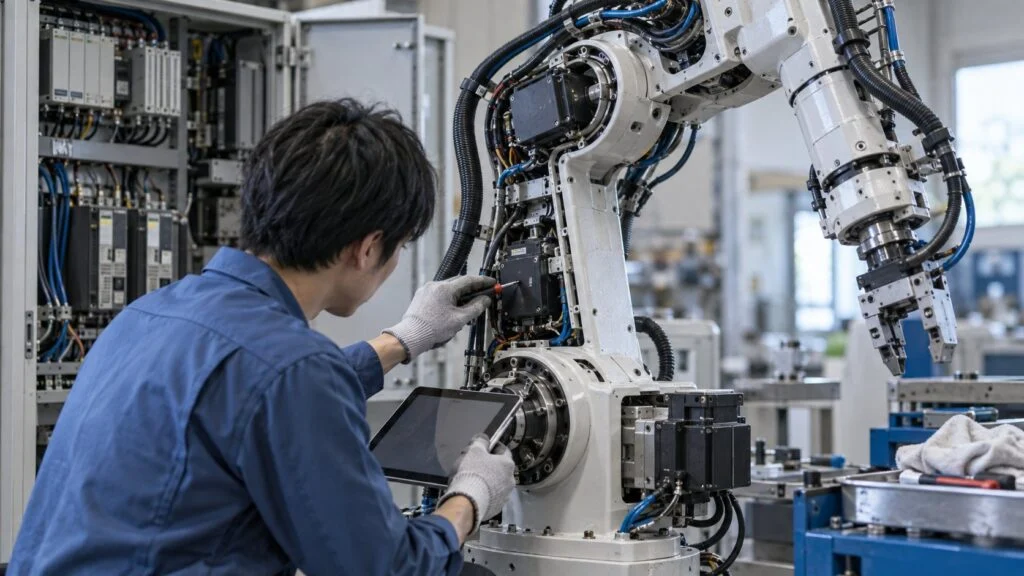
When a line is built in Japan and shipped abroad, the Japanese SIer or machine builder is often the first contact for problems, while the robot maker's local subsidiary handles the robot itself. Settle who does what before the line leaves Japan, not after the first breakdown.
- Exact models. Get the model and serial number of each arm, controller, and pendant, plus the controller software version. These decide which parts, manuals, and software fit.
- Regional version. Ask whether the controller is the version for your country: supply voltage and frequency, certification marks, and the pendant display language. Some pendants let you switch languages; Kawasaki's F60 spec sheet, for example, lists English, Chinese, and Japanese. For voltage questions, see Japan Industrial Voltage: 200V 3-Phase and 50/60 Hz.
- Local maker support. Check which subsidiary or distributor of the robot maker covers your country, where its nearest service and repair locations are, and whether it supports the exact models you received. For FANUC and Yaskawa, see FANUC Business Model: What It Means for Buyers and Users and Yaskawa Electric: Servo, Drive, and Robot Businesses.
- Spare parts list. Ask for a recommended spare parts list with lead times. Robot-specific parts such as servo motors, reducers, encoders, cables, and pendants usually have to come through the maker's network, while grippers, sensors, and fixtures may come from the SIer or other suppliers. Pendants and cables are often tied to a controller generation: Mitsubishi Electric's replacement notes, for example, mark its older R33TB pendant as not compatible with the CR800-based models, which use the R32TB.
- Program backups. Get backups of all robot programs and settings, and ask which software and license you need to load and edit them.
- Training. Ask what operator and maintenance training the maker offers in your country, and in which language.
Robot Safety Rules: ISO 10218 vs. Japan's Ordinance
A Japanese-built cell is designed to meet Japanese law, and your plant must meet the rules where it operates. The two overlap but are not the same, so expect differences in the safety documents.
ISO 10218 and the US Adoption
ISO 10218 is the international safety standard for industrial robots. The current editions were published in early 2025. Part 1 covers the robot itself, the safety functions its maker must provide. Part 2 covers the robot application and cell, which is the integrator's job. Most of the collaborative robot requirements from ISO/TS 15066 were folded into Part 2. The 2025 edition also sorts robots into Class I and Class II by their maximum capability, with different safety function requirements.
In the US, ANSI/A3 R15.06-2025, released in September 2025, is the national adoption of ISO 10218-1 and -2:2025. OSHA has no robot-specific standard. It enforces robot safety through rules such as lockout/tagout (29 CFR 1910.147), machine guarding (1910.212), and the General Duty Clause, and treats consensus standards such as R15.06 as the reference. For lockout rules, see Lockout/Tagout in Japan: Japanese Law vs. OSHA 1910.147. In India and Southeast Asia, check with your safety team or regulator which national rules apply and whether they reference ISO 10218.
Japan: The Ordinance on Industrial Safety and Health
In Japan, robot safety is set by law, in the Ordinance on Industrial Safety and Health (労働安全衛生規則). The main robot articles cover safety measures during teaching (Article 150-3), fences or enclosures during operation (Article 150-4), stopping the robot for inspection, repair, adjustment, and cleaning (Article 150-5), and checks before starting teaching (Article 151).
Two Japanese rules have no direct match in ISO 10218:
- The 80 W cutoff. Under a 1983 Ministry of Labour notice, machines whose largest drive motor is rated at 80 W or less fall outside Japan's legal definition of an industrial robot, and the fence requirement in Article 150-4 applies to robots above 80 W. ISO 10218 has no such power threshold; its 2025 classes are based on mass, speed, and force.
- Special education (特別教育, tokubetsu kyoiku). Workers who teach a robot inside its range of motion, or who inspect, repair, or adjust it there, must complete special education under Article 36, items 31 and 32. This is a Japanese legal requirement. A Japanese certificate does not replace the training your own country requires.
Japan opened the way to fenceless collaborative operation in 2013. Under a Ministry of Health, Labour and Welfare notice (Kihatsu 1224 No. 2, December 24, 2013), the Article 150-4 fence requirement does not apply when a risk assessment shows that contact with the robot no longer poses a danger to workers. The notice also accepts measures defined in ISO standards. This change helped cobots spread to small and mid-sized plants and to high-mix, low-volume production. Japan's own JIS B 8433-1 and -2 correspond to the 2011 edition of ISO 10218; we could not confirm whether a JIS based on the 2025 edition has been issued.
| Topic | Japan | ISO 10218:2025 / US |
|---|---|---|
| Legal status | Law: Ordinance on Industrial Safety and Health | Voluntary standard; R15.06-2025 in the US, applied through OSHA's general rules |
| Who is covered | Robots whose largest drive motor is above 80 W (with other exclusions) | Industrial robots with no power threshold; Class I and Class II by mass, speed, and force |
| Fencing | Required when contact could endanger workers (Art. 150-4); fenceless allowed after risk assessment (2013 notice) | Safeguarding decided by the integrator's risk assessment under Part 2 |
| Collaborative operation | Allowed by risk assessment or ISO measures | Requirements in ISO 10218-2:2025 (formerly mostly ISO/TS 15066) |
| Worker training | Special education required for teaching and for inspection within the range of motion | Set by local law and company procedures |
| National standard | JIS B 8433-1/-2 (based on ISO 10218:2011) | ISO 10218-1/-2:2025, ANSI/A3 R15.06-2025, CSA Z434 in Canada |
Where the Differences Show Up in Practice
- A small robot described in Japan as "80 W or less, no fence needed" is still an industrial robot under ISO 10218 and needs a risk assessment where you install it.
- The Japanese risk assessment for the cell is written against Japanese law. Ask whether the integrator also assessed the cell against ISO 10218-2 or your local rules, or plan to do it locally. For the Japanese method, see Risk Assessment in Japanese Plants vs. JHA, HSE, ISO 12100.
- Training records from Japan show that people completed Japan's special education. Your plant still needs training that meets local requirements.
- For control panels shipped with the cell, US and EU electrical standards bring their own requirements; see Japanese Machine Control Panels: UL 508A, NFPA 79, and CE.
Who decides: the safety requirements for your cell are set by your plant's safety manager and the integrator, under the law where the cell runs. This guide only shows what to ask about.
Checklist: Taking Over Japanese Robots at Your Plant
- Maker, model, and serial number of each arm, controller, and pendant, with controller software version
- Controller version for your country: supply voltage, frequency, and certification marks
- Pendant language setting and English manuals for operation and maintenance
- First contact for robot alarms (SIer, machine builder, or robot maker) and the escalation path
- Local subsidiary or distributor of each robot maker, and the nearest service and repair location
- Recommended spare parts list with lead times (servo motors, reducers, cables, pendant)
- Backups of all programs and settings, and the software and licenses needed to edit them
- Payload check: gripper plus workpiece within the rated payload, with margin
- Risk assessment against ISO 10218-2 or local rules, not only Japanese law
- Safety devices and fencing that match the local assessment, including any fenceless or cobot areas
- Operator and maintenance training that meets local requirements, in a language your team uses
Questions to Ask the Japanese Supplier or SIer
- Which robot makers and models are in this line, and which controller software versions?
- Are the controllers and pendants the versions for our country, or Japanese domestic versions?
- When a robot alarm occurs, who do we call first, and when do you pass the case to the robot maker?
- Which robot maker office will support us locally, and has it confirmed support for these models?
- Can you provide a recommended spare parts list with part numbers and lead times?
- Which offline programming software and licenses do we need to edit these programs?
- Was the risk assessment done to Japanese law only, or also to ISO 10218-2? Can we get a copy in English?
- Are any robots in the line treated as 80 W or less, or run without fencing, in the Japanese design?
- What training do you or the robot makers provide for our operators and maintenance staff, and in which language?
You can adapt this short email when the line is still in Japan:
Subject: Robot details and support for [line name] before shipment
Dear [Name],
Before the [line name] ships to our [city] plant, please send us the following for each robot: maker, model, serial number, controller and pendant model, and controller software version. Please also confirm whether each controller is the version for [country] (supply voltage, frequency, certification marks).
We would also like a recommended spare parts list with lead times, backups of all robot programs, and the name of the robot maker office that will support us locally. Finally, please tell us whether the risk assessment covers ISO 10218-2, and send a copy in English if available.
Thank you for your help.
Best regards,
[Name]
Limits of This Guide
- Model names in the maker table are current examples. Lines often include older controllers and pendants with different names and software.
- Service networks and parts availability differ by maker, country, and model. Confirm them with each maker's local office.
- The summary of Japanese law and ISO 10218 is simplified. It does not replace the standards, local law, or a risk assessment by qualified people.
- Figures for robot installations and Japanese production are from the IFR and JARA reports cited below and will change with each new edition.
FAQ
Who are the major Japanese industrial robot makers?
FANUC and Yaskawa (MOTOMAN) are the best known. Kawasaki, Nachi-Fujikoshi, DENSO, Epson, and Mitsubishi Electric also make industrial robots, each with its own controller, pendant, and programming language.
What is a teach pendant called on FANUC and Yaskawa robots?
FANUC calls its pendant the iPendant (iPendant Touch on current models). Yaskawa calls it a programming pendant, and its touchscreen model is the Smart Pendant. In Japanese documents, both are usually called a teaching pendant (ティーチングペンダント) or TP.
Does a robot cell built to Japanese law meet ISO 10218?
Not automatically. Japanese law and ISO 10218 overlap, but they differ in scope, such as Japan's 80 W cutoff, and in how fencing and collaborative operation are decided. Ask the integrator whether the cell was assessed against ISO 10218-2, and confirm with your safety team.
Does Japan require fences around industrial robots?
Yes, when contact with a robot whose drive motor exceeds 80 W could endanger workers. Since 2013, a robot can run without a fence if a risk assessment shows that contact no longer poses a danger, or if measures defined in ISO standards are in place.
What is "special education" for robots in Japan?
It is legally required training for workers in Japan who teach a robot, or who inspect, repair, or adjust it, within its range of motion. It applies under Japanese law and does not replace robot safety training required in your country.
Sources
- Robot definition and types (ISO 8373), installations and operational stock: International Federation of Robotics, World Robotics 2025 report press release (September 2025)
- Japanese production and export share: Japan Robot Association, annual industrial robot statistics 2025 (members and non-members) (Japanese)
- Japanese robot law summary (Articles 36, 150-3 to 151, the 80 W notice, the 2013 notice): Japan Robot Association, "Excerpt of Laws on Industrial Robots" (Japanese, PDF)
- Collaborative operation under the 2013 notice: Ministry of Health, Labour and Welfare pamphlet (Japanese, PDF)
- JIS B 8433 and ISO 10218 correspondence: Japan Robot Association, list of robot safety standards (Japanese, PDF)
- Special education: Japan Robot Association, "Special Training for Robots" (Japanese)
- ISO 10218:2025 changes and ISO/TS 15066: A3, "Updated ISO 10218: FAQs"
- Robot classes in ISO 10218-1:2025: ANSI Blog, ISO 10218-1:2025
- ANSI/A3 R15.06-2025: A3, revised R15.06 industrial robot safety standard
- OSHA and robots: OSHA, Robotics: Standards
- FANUC controllers and pendants: FANUC America, robot controllers; FANUC Europe, ROBOGUIDE
- Yaskawa controllers, INFORM, MotoSim: Yaskawa Motoman, controllers; Yaskawa Europe, MotoSim
- Kawasaki F60 and K-ROSET: Kawasaki Robotics, F60 controller spec sheet (PDF); Kawasaki Robotics, K-ROSET
- Nachi FD11: Nachi-Fujikoshi, FD controller
- DENSO RC8A and PacScript: DENSO Robotics, RC8A robot controller (A3 product listing)
- Epson pendants and RC+: Epson, Teach Pendant TP4; Epson RC+ 8.0
- Mitsubishi Electric controllers and pendants: Mitsubishi Electric, MELFA Technical News BFP-A6079-0288E, replacing RH-CH with RH-CRH models (PDF)
Original article in JapaneseThis guide is adapted from a MONOSCOPE article written for readers in Japan: 産業用ロボットとは?仕組みと基本原理を図解でわかりやすく解説
About the editor
 MONOSCOPE EditorFOUNDER & EDITOR
Spent about ten years at a plant equipment maker and a plant engineering company, proposing, designing, and commissioning equipment, then moved into web marketing. Now a web consultant for B2B manufacturers, helping them explain their products and technology. Licensed in Japan as an Energy Manager and a Third-Class Chief Electrical Engineer.
Has run an engineering blog since 2017 (500+ articles) and a Japanese YouTube channel with about 20,000 subscribers. Each English guide is written from the Japanese shop-floor point of view and checked against the cited standards.