SUS304, SUS316, SUS430: JIS Grades and AISI/ASTM Equivalents
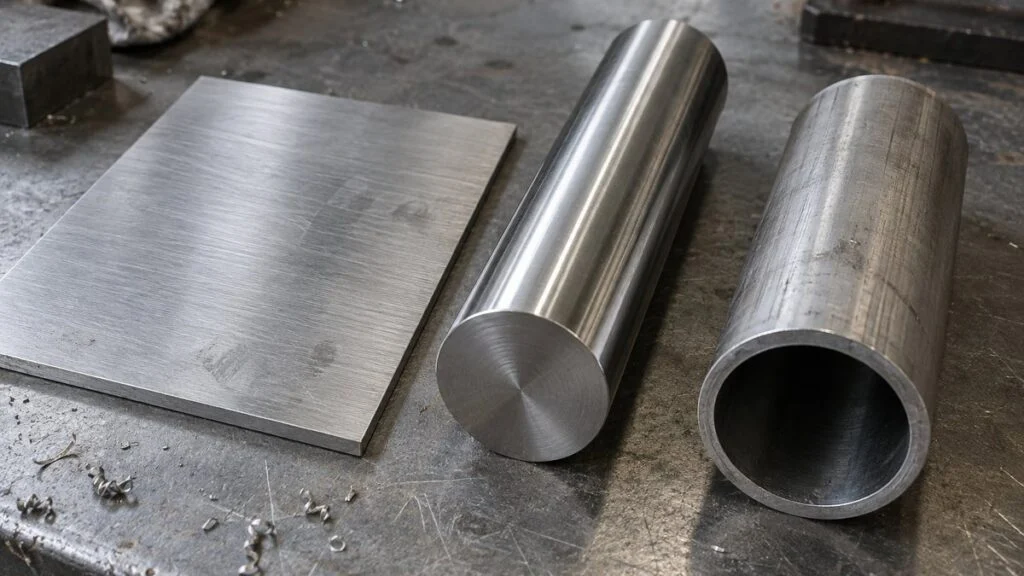
If you work with Japanese drawings, quotes, or mill certificates (mill test certificates, often called "mill sheets" or ミルシート in Japan), you will see stainless steel written as SUS304, SUS316L, or SUS430, often in the material box of the title block, labeled 材質 (zaishitsu, "material"). These are JIS (Japanese Industrial Standards) grade designations. Each one has a close counterpart in the AISI/ASTM system you already know: SUS304 corresponds to Type 304, SUS316 to Type 316, and SUS430 to Type 430.
"Close counterpart" is not the same as "identical," though. The JIS and ASTM limits for the same grade can differ slightly, and a JIS grade name says nothing about the product form or the standard the material was made to. This guide gives you a quick-reference table of the closest equivalents, explains how the three most common grades differ, and lists what to confirm with your Japanese supplier before you substitute local material.
Contents
- How to Read a JIS Stainless Steel Grade
- The Five Stainless Steel Families
- Quick Reference: JIS Stainless Grades and Their Closest Equivalents
- SUS304 vs. SUS316 vs. SUS430 at a Glance
- What Each Alloying Element Does
- Corrosion Resistance: Chlorides and Welds
- Magnetism, Thermal Properties, and Strength
- Machining, Forming, Welding, and Cost
- Choosing a Grade: A Six-Step Check
- What to Confirm Before You Substitute
- Limits of This Guide
- Summary
- FAQ
- Sources
How to Read a JIS Stainless Steel Grade
"SUS" stands for Steel Use Stainless, the JIS prefix for stainless steel. The three digits that follow are based on the AISI numbering, so the first digit tells you the alloy family, just as it does for AISI types.
Letters at the end show a variation on the base grade. The "L" in SUS316L, for example, means extra-low carbon, and Japanese drawings often specify it for welded parts. Suffixes such as J1 or J2 mark grades developed in Japan, which may have no direct AISI counterpart.
Break the designation into prefix, number, and suffix to see what the grade is.
Suffix: L = extra-low carbon / F = free-machining / N1, N2 = nitrogen added / J1, J2 = Japan-specific grade / Se = selenium added
Based on the Japan Stainless Steel Association (JSSA) FAQ on JIS grade numbers and suffix letters.
The Five Stainless Steel Families
Stainless steels fall into five families based on their microstructure (crystal structure) at room temperature. The family determines whether the steel is magnetic, whether heat treatment can harden it, and how easily it can be formed.
Austenitic grades such as SUS304 are by far the most common. According to the Japan Stainless Steel Association (JSSA), they make up more than 60% of all stainless steel production. Ferritic SUS430, which contains almost no nickel, comes next, and together these two families cover most of the stainless steel you see day to day.
Differences in microstructure show up as differences in magnetism, hardness, and formability.
Based on the JSSA classification. This guide compares SUS304, SUS316, and SUS430, the most widely stocked general-purpose grades.
Quick Reference: JIS Stainless Grades and Their Closest Equivalents
The table below lists the grades you are most likely to see on Japanese drawings, with the AISI/ASTM type, UNS number, and EN (European) steel number that cross-reference tables most often pair with them. Treat these as the closest equivalents, not identical specifications. Each standard sets its own composition limits and mechanical properties.
| JIS grade | Family | AISI / ASTM type | UNS | EN number (name) |
|---|---|---|---|---|
| SUS303 | Austenitic (free-machining) | 303 | S30300 | 1.4305 (X8CrNiS18-9) |
| SUS304 | Austenitic | 304 | S30400 | 1.4301 (X5CrNi18-10) |
| SUS304L | Austenitic, low carbon | 304L | S30403 | 1.4307 (X2CrNi18-9) or 1.4306 (X2CrNi19-11) |
| SUS316 | Austenitic, Mo-bearing | 316 | S31600 | 1.4401 (X5CrNiMo17-12-2) |
| SUS316L | Austenitic, Mo-bearing, low carbon | 316L | S31603 | 1.4404 (X2CrNiMo17-12-2) |
| SUS430 | Ferritic | 430 | S43000 | 1.4016 (X6Cr17) |
Product Standards: Which JIS Matches Which ASTM
A grade name alone does not define the material you will receive. Japanese mill certificates also name the JIS product standard, and the ASTM side uses different specifications for each product form. For the forms covered here, the usual pairings are:
| Product form | JIS standard | Closest ASTM specification |
|---|---|---|
| Bars | JIS G 4303 (Stainless steel bars) | ASTM A276/A276M (Stainless steel bars and shapes). Free-machining grades such as 303 fall under a separate specification, ASTM A582/A582M |
| Hot-rolled plate, sheet, and strip | JIS G 4304 (Hot-rolled stainless steel plate, sheet and strip) | ASTM A240/A240M (Chromium and chromium-nickel stainless steel plate, sheet, and strip for pressure vessels and for general applications) |
| Cold-rolled plate, sheet, and strip | JIS G 4305 (Cold-rolled stainless steel plate, sheet and strip) | ASTM A240/A240M |
Related: JIS ERW vs Seamless Pipe: E, S, B Codes vs ASTM A53/A106
SUS304 vs. 304 and SUS430 vs. 430: Close, Not Identical
The minimum mechanical properties show why "equivalent" needs care. For annealed sheet, JIS G 4305 and ASTM A240 set the same yield strength and elongation for these grades, but different tensile strengths:
| Property (minimum) | SUS304 (JIS G 4305) | 304 (ASTM A240) | SUS430 (JIS G 4305) | 430 (ASTM A240) |
|---|---|---|---|---|
| Tensile strength | 520 MPa (75 ksi) | 515 MPa (75 ksi) | 420 MPa (61 ksi) | 450 MPa (65 ksi) |
| Yield strength (0.2% proof) | 205 MPa (30 ksi) | 205 MPa (30 ksi) | 205 MPa (30 ksi) | 205 MPa (30 ksi) |
| Elongation | 40% | 40% | 22% | 22% |
As a result, 304 sheet that meets A240 can still fall below the JIS tensile minimum of 520 MPa, and 430 made to JIS can fall below the A240 minimum of 450 MPa. To avoid this, ask for dual-certified material or check that the actual values on the mill certificate meet both minimums. If the drawing specifies a JIS standard, ask the Japanese customer or designer in writing whether an ASTM or EN equivalent is acceptable.
SUS304 vs. SUS316 vs. SUS430 at a Glance
The comparison below uses JIS limits for composition and mechanical properties, and JSSA data for physical properties and corrosion trends. A simple way to remember it: start from 304. Add molybdenum for chloride resistance and you get 316. Take out the nickel to cut cost and you get 430.
Use 304 as the baseline: 316 adds salt resistance, and 430 drops the nickel to lower cost.
Composition: JIS ranges for the main elements only. Tensile strength and elongation: JIS G 4305 (cold-rolled sheet) minimums. Thermal conductivity and expansion: typical values from JSSA (expansion over 0–100°C). Always check actual values on the mill certificate.
Reading across the table, most of the differences between the three grades come down to nickel and molybdenum. Nickel makes the structure austenitic, which drives the differences in formability and magnetism. Molybdenum adds resistance to salt.
These are material specifications and typical values. A finished part's performance also depends on its shape, surface finish, and service environment, so the sections below look at each factor in turn.
What Each Alloying Element Does
If you know what chromium, nickel, molybdenum, and carbon each do, you can read the material specified on a drawing without memorizing grades.
Chromium is nearly the same. The differences are in nickel and molybdenum.
A higher number means better resistance to chloride pitting. (JSSA's table, based on typical compositions: 304 = 19.0 / 316 = 25.0 / 430 = 17.0)
Bars show each element's JIS range on a 0–30% scale. Based on JSSA's JIS composition tables.
Chromium: The Basis of Corrosion Resistance
Chromium forms the protective surface film that makes stainless steel stainless. All three grades contain 16–20% chromium, so there is little difference here. Similar chromium levels do not mean 430 resists corrosion as well as 304. The other elements make the difference.
Nickel: Structure and Formability
Nickel stabilizes the austenitic structure at room temperature. Austenite is tough and ductile, which makes bending, deep drawing, and welding easier. It is also why annealed 304 and 316 do not attract a magnet. SUS316 carries more nickel than 304 (10–14% versus 8–10.5%).
SUS430 is a ferritic grade with nickel capped at 0.60%, and leaving out the nickel makes it cheaper than 304. Nickel is expensive, and buyers should expect the price of austenitic grades to follow the nickel market.
Molybdenum: Resistance to Chlorides
The defining feature of SUS316 is its 2–3% molybdenum. Molybdenum raises resistance to pitting (small, deep pits) and crevice corrosion caused by chloride ions. JSSA uses a pitting index of Cr + 3.3Mo as a guide; its table gives 19.0 for 304 and 25.0 for 316.
If you use the JIS minimum values instead (our calculation), 316 still comes out ahead: 22.6 versus 18.0 for 304. That margin is why engineers choose 316 for seawater and other chloride environments.
Carbon: Low Levels for Welded Parts
When welding heats the metal, carbon combines with chromium and depletes it from the steel near the weld. This causes intergranular corrosion (see below). "L grades" such as SUS304L and SUS316L limit carbon to 0.030% to reduce this risk.
For comparison, SUS304 allows up to 0.08% carbon, while SUS304L allows 0.030%. JIS also sets a slightly higher nickel range for SUS304L (9–13%) than for SUS304 (8–10.5%).
Corrosion Resistance: Chlorides and Welds
JIS G 0203 defines stainless steel as an alloy steel with at least 10.5% chromium and no more than 1.2% carbon, made for higher corrosion resistance. The name comes from the English word "stainless": although iron is the main element, it rusts far less than ordinary carbon steel.
Stainless steel resists rust because chromium reacts with oxygen to form a dense passive film only a few nanometers thick. Unlike paint or plating, this film repairs itself after a scratch as long as oxygen is present. Where the film cannot repair itself, stainless steel can rust. "Rust-resistant, not rustproof" is the right starting point for choosing a grade.
A thin chromium-rich film protects the metal and rebuilds itself when damaged.
When you choose between 304 and 316, the first question is whether chlorides (salt) are present.
In an 8-year coastal exposure test reported by JSSA, SUS304 lost 0.10 mg/cm² of mass and SUS430 lost 0.16 mg/cm². Galvanized steel sheet lost 39.0 mg/cm². Both stainless grades lost hundreds of times less mass than galvanized steel, but 304 still lost less than 430.
Stainless steel rarely corrodes evenly. Corrosion concentrates in specific spots, so knowing the main types tells you where to look.
All four start where the passive film is locally weakened.
Based on the JSSA FAQ on corrosion resistance and corrosion phenomena, and material from a Japanese housing-industry council (hia-net.gr.jp).
Pitting and Crevice Corrosion: Use 316 Where Salt Is Present
Pitting leaves small holes in the surface. Crevice corrosion develops inside gaps, such as under bolt heads or gaskets. Both are more likely where chloride or other halide ions are present. The surface rust may look minor even when the damage underneath is deep.
For outdoor equipment near the coast, piping that carries seawater or brine, and equipment cleaned with chlorine-based cleaners, molybdenum-bearing 316 is the first choice. JSSA also recommends higher-chromium or higher-molybdenum grades for chloride environments.
Intergranular Corrosion: Consider L Grades for Welded Parts
Where welding heat reaches the metal, chromium and carbon can combine at the grain boundaries, leaving chromium-depleted zones. This is called sensitization, and it lets corrosion run along the grain boundaries.
The fix is to use low-carbon 304L or 316L. Grades stabilized with titanium or niobium, which tie up the carbon, serve the same purpose. Welded tanks and piping are often specified as SUS316L to get both salt resistance and corrosion-resistant welds.
Stress Corrosion Cracking: Reduce Stress or Change Grade
This cracking mainly affects austenitic grades. Residual tensile stress from welding or bending can cause it when chlorides or other corrosive agents are also present, so choosing 304 or 316 alone does not protect you.
In hot, chloride-containing environments, reduce residual stress through design or heat treatment, or consider a duplex or ferritic grade, which resists this cracking better.
Iron Contamination: Keep Iron Off the Surface
Many reports of "rusty stainless" on the shop floor turn out to be rust from iron particles stuck to the surface, not corrosion of the stainless itself. Typical causes are grinding dust from carbon steel or scratches from steel tools. Chlorine-based detergents left on the surface can also cause rust.
Early-stage rust can usually be removed with a dedicated stainless cleaner, restoring the original surface. To keep the corrosion resistance, use separate tools and brushes for stainless, and clean the surface after fabrication.
Related: JIS Plating Callouts (Ep-Fe/Zn8/CM2) and ASTM Equivalents
Magnetism, Thermal Properties, and Strength
After corrosion resistance, the next big differences are magnetism and thermal behavior. They are easy to overlook, but for parts near sensors or electromagnetic equipment, or parts exposed to heat, they can decide the grade.
430 conducts heat better and expands less with temperature changes.
Magnetism: SUS304 and SUS316 nearly non-magnetic when annealed / SUS430 ferromagnetic
Based on JSSA's table of physical properties (conductivity, permeability, thermal expansion).
Magnetism
Annealed 304 and 316 barely attract a magnet, while 430 does, so a magnet is a common quick check to tell 304 from 430 on the shop floor.
Cold work such as bending or stamping can change part of the austenite in 304 and make it magnetic. JSSA states that this magnetism does not affect corrosion resistance. A magnet that sticks does not prove the part is 430, so confirm the grade from the mill certificate or the stamped markings.
Magnetism can also be a problem. If a part must be non-magnetic, for example near a sensor or in electromagnetic equipment, choose the material and the forming method together, allowing for magnetism that forming can introduce.
Heat Conduction and Thermal Expansion
At 26.4 W/(m·K), 430 conducts heat much better than 304 and 316 (16.3). Its coefficient of thermal expansion is 10.4 × 10⁻⁶/K, compared with 17.3 for 304, so its dimensions change less with temperature. Along with its lower price, these thermal properties explain why 430 is common in cookware and appliance parts.
Austenitic grades, by contrast, hold heat and expand more as they warm up. During welding and other hot processes, heat builds up locally and the parts tend to distort, so you need good fixturing and a planned weld sequence.
Strength and Elongation
Under JIS G 4305 (cold-rolled sheet), all three grades have the same minimum yield strength of 205 MPa. Minimum tensile strength is 520 MPa for 304 and 316, and 420 MPa for 430.
The clear difference is elongation: 40% minimum for 304 and 316, compared with only 22% for 430. For deep-drawn containers or sheet-metal parts with tight bends, the higher elongation of 304 and 316 gives you more margin.
Machining, Forming, Welding, and Cost
A grade that meets every property requirement can still add lead time and cost if it is hard to fabricate. Choose the grade with the fabrication method in mind at the design stage to avoid rework.
Machining: 304 Is a "Gummy" Material
304 is tough and work-hardens easily, so the machined surface gets harder as you cut. Its low thermal conductivity also traps cutting heat at the tool tip, which leads to fast tool wear and stringy chips that tangle.
For parts that are mostly machined, SUS303, which contains at least 0.15% sulfur for better machinability, is an option. Its composition differs from 304, though, so where corrosion resistance or welding matters, check that 303 is acceptable in place of 304 before you specify it.
Stamping and Bending: Elongation Makes the Difference
With their high elongation, 304 and 316 suit cold forming such as deep drawing and bending. Deep-drawn products such as sinks and containers are usually made from 304 and similar austenitic grades.
Because 430 stretches less, it has a higher risk of cracking in deep drawing. For shallow forming or nearly flat parts, 430 is a reasonable way to save cost.
Welding: Easy with 304, but Watch for Distortion
Austenitic grades weld well and are widely used in welded structures. The points to watch are the intergranular corrosion described above and distortion from their high thermal expansion. For parts that will see a corrosive environment after welding, consider specifying an L grade.
430 is generally considered less weldable than 304. If you plan to use it in a welded structure, test the welds before you commit to it.
Cost: Nickel and Molybdenum Drive the Price
In general, 430 costs the least, 304 falls in the middle, and 316 costs the most. Japanese material suppliers and equipment makers both describe 430 as cheaper than 304, and 316 (and 316L) as more expensive. The difference comes from the amount of nickel and molybdenum, both expensive alloying elements.
When you compare costs, look beyond the material price per kilogram:
- How easy the grade is to fabricate
- Whether it needs surface treatment
- How long it lasts before replacement
In some cases, 316 that lasts for years costs less overall than cheap 430 that rusts and needs early replacement.
Choosing a Grade: A Six-Step Check
Apply the criteria above in order, and the choice gets simpler: start from 304, then move to 316 or 430 as conditions require.
Check the environment and conditions first, then adjust for cost at the end.
Where SUS304 Fits
304 balances corrosion resistance, formability, and weldability, and it is used across a wide range of applications:
- Food processing equipment
- Architectural hardware
- General chemical equipment
- Bolts and nuts
Without a specific reason to choose otherwise, engineers usually start with 304. Typical uses include tanks, piping, and conveyors in food plants.
Where SUS316 Fits
316 is mainly used for:
- Equipment exposed to seawater or salt spray
- Outdoor equipment in coastal areas
- Chemical and pharmaceutical equipment that handles corrosive raw materials or solutions
Some equipment makers use 316L for the wetted and powder-contact parts of pharmaceutical equipment. Another option is to replace 304 with 316 only where pitting or crevice corrosion has occurred.
For welded structures, 316L is the usual callout, and you will often see "SUS316L" on Japanese piping and vessel drawings. Because 316 costs more than 304, a practical option is to use 316 only where it is needed.
Where SUS430 Fits
430 is used in relatively mild environments. Typical uses include:
- Kitchen equipment
- Appliance parts
- Interior architectural materials
- Automotive parts
For indoor parts with little risk of condensation or salt, and with little deep drawing or welding, switching from 304 to 430 may lower costs. Because 430 is magnetic, it is also used for parts held in place by magnets.
If you switch from 304 to 430 outdoors or in wet areas, assume it will not resist rust as well as 304, and test it before you switch.
What to Confirm Before You Substitute
When a Japanese drawing, quote, or mill certificate specifies a SUS grade and you want to source locally or accept an equivalent, settle these points in writing with your Japanese customer, designer, or supplier before you order.
- Which JIS product standard applies? Is it G 4303 (bars), G 4304 (hot-rolled flat), G 4305 (cold-rolled flat), or a pipe or forging standard? This tells you which ASTM specification to compare against.
- Is an ASTM or EN equivalent acceptable? If so, should it meet the JIS minimum values as well (for example, the 520 MPa tensile minimum for SUS304), or only the substitute standard?
- Is an L grade or dual-certified material acceptable? For example, can 304/304L dual-certified material be used where SUS304 is specified?
- Can SUS303 replace SUS304 on machined parts, or the other way around? The two differ in corrosion resistance and weldability.
- Must the part be non-magnetic? If so, does that include magnetism introduced by forming?
- What surface finish is required? The drawing should state it together with the grade.
- What documents must you submit? Usually a mill certificate that shows actual chemistry and mechanical properties and names the standard.
Limits of This Guide
- The equivalents above are the pairings most cross-reference tables use. They are not guaranteed to be interchangeable for every application, and some references pair grades differently.
- Values are standard minimums or typical values from the sources listed below. Standards are revised, so check the current editions of JIS, ASTM, and EN before you rely on any number.
- Regulated equipment, such as pressure vessels, piping under a design code, or food-contact and medical parts, may require a specific standard. The owner, the designer of record, or the code authority decides whether a substitute is acceptable.
- Pipe, tube, fittings, castings, and forgings are covered by other standards and are not mapped here.
Summary
- SUS304, SUS316, and SUS430 are the JIS counterparts of Types 304, 316, and 430 (UNS S30400, S31600, S43000). They are close equivalents, not identical specifications.
- Stainless steel contains at least 10.5% chromium and resists rust through a self-repairing passive film. It is rust-resistant, not rustproof.
- Start from 304: add molybdenum for chloride-resistant 316, or remove nickel for lower-cost 430.
- Use 316 where chlorides are present, and consider L grades where weld corrosion is a concern.
- 304 and 316 are non-magnetic when annealed, and 430 is magnetic. 430 conducts heat better and expands less.
- Compare fabrication and service life as well as price, and confirm the JIS product standard and substitution rules with your Japanese supplier.
FAQ
Is SUS304 the same as 304 stainless steel?
SUS304 is the JIS designation that corresponds to AISI/ASTM Type 304 (UNS S30400) and EN 1.4301. The compositions are very close, but the limits are not identical. For example, JIS G 4305 sets a 520 MPa minimum tensile strength for SUS304 sheet, while ASTM A240 sets 515 MPa for 304.
What are the equivalents of SUS316 and SUS316L?
SUS316 corresponds to Type 316 (UNS S31600, EN 1.4401), and SUS316L corresponds to Type 316L (UNS S31603, EN 1.4404). The "L" grades limit carbon to 0.030% in JIS to protect welds from intergranular corrosion.
Is SUS430 magnetic?
Yes. SUS430 is a ferritic grade and is magnetic. SUS304 and SUS316 are nearly non-magnetic when annealed but can become magnetic after cold work, so a magnet test alone cannot confirm the grade.
Which ASTM specification matches JIS G 4305?
JIS G 4305 covers cold-rolled stainless steel plate, sheet, and strip. The closest ASTM specification is ASTM A240/A240M, which also covers hot-rolled flat products (JIS G 4304). For bars, JIS G 4303 corresponds most closely to ASTM A276/A276M.
Can I substitute local 304 for SUS304 on a Japanese drawing?
In many cases, yes, but get written approval from the Japanese customer or designer first. Confirm which standard the material must meet, whether the JIS minimum values still apply, and what certificate you need to submit.
Sources
- Stainless steel families and features: Japan Stainless Steel Association (JSSA), "Types" (Japanese)
- Passive film and exposure test results: JSSA, "Features" (Japanese)
- Magnetism and pitting index: JSSA, "Properties" (Japanese)
- Grade designation suffixes: JSSA FAQ, JIS grade numbers and suffix letters (Japanese)
- Physical properties: JSSA FAQ, conductivity, permeability, and thermal expansion (Japanese)
- Corrosion types and countermeasures: JSSA FAQ, corrosion resistance and corrosion phenomena (Japanese)
- Chemical composition: JSSA, JIS austenitic grades (Japanese), JIS ferritic grades (Japanese)
- EN/US grade cross-reference: TWI, "What are the equivalent European and American standards for common stainless steels?"
- Type 430 / EN 1.4016: Aperam, 430 – 1.4016; Type 304L / EN 1.4307: Teamedelstahl, 1.4307
- ASTM A240 minimum properties: ATI 304, ATI 430
- JIS product standard titles: JIS G 4303:2021, JIS G 4304:2021, JIS G 4305:2021 (Japanese Standards Association previews)
- JIS G 4305 mechanical properties: Sekidou Kouhan, SUS304 (Japanese), SUS316 (Japanese), SUS430 (Japanese)
- Iron contamination and care: hia-net.gr.jp, "Stainless steel" (Japanese)
- ASTM A276 scope: ASTM A276/A276M-17, Standard Specification for Stainless Steel Bars and Shapes
Original article in JapaneseThis guide is adapted from a MONOSCOPE article written for readers in Japan: ステンレスの種類と違い|SUS304・SUS316・SUS430の選び方
About the editor
 MONOSCOPE EditorFOUNDER & EDITOR
Spent about ten years at a plant equipment maker and a plant engineering company, proposing, designing, and commissioning equipment, then moved into web marketing. Now a web consultant for B2B manufacturers, helping them explain their products and technology. Licensed in Japan as an Energy Manager and a Third-Class Chief Electrical Engineer.
Has run an engineering blog since 2017 (500+ articles) and a Japanese YouTube channel with about 20,000 subscribers. Each English guide is written from the Japanese shop-floor point of view and checked against the cited standards.