JIS vs ASME (ANSI) vs JPI Flanges: How to Match Them
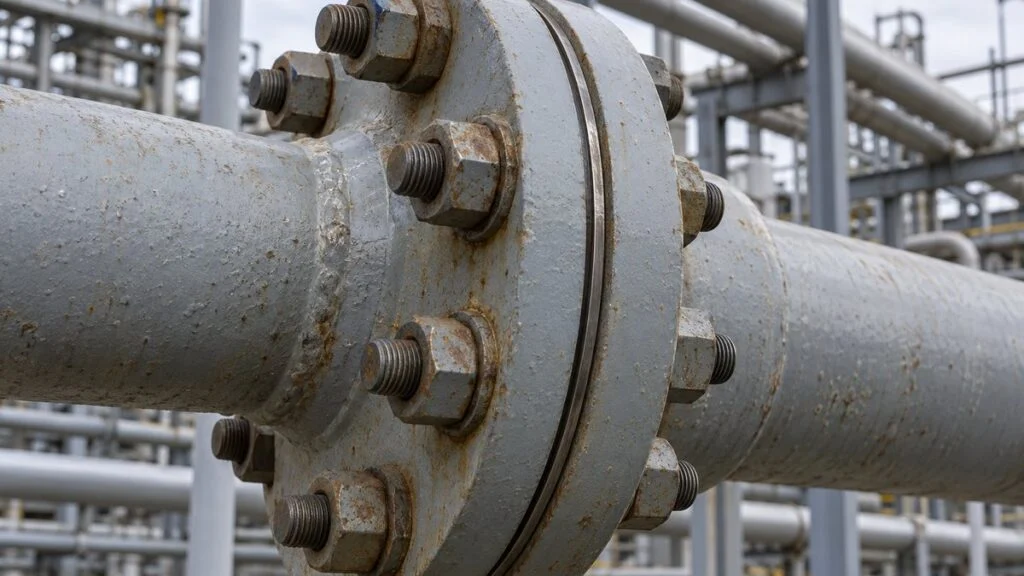
A skid arrives from Japan with flanges marked "10K." Your site piping is ASME B16.5 Class 150. The nominal sizes match and the pressures look close, but when the fitters lift the spool into place, the bolt holes don't line up. On projects that mix Japanese equipment with ASME piping, matching nominal sizes and similar pressure numbers do not guarantee that flanges fit.
The short answer: JIS flanges (JIS B 2220) and ASME/ANSI flanges (ASME B16.5) are separate dimensional systems and do not bolt together directly. JPI flanges (JPI-7S-15), used in Japanese refineries and petrochemical plants, are much closer to ASME. They follow B16.5 and share almost all of its dimensions, but they differ in two ways: the weld-end (hub) diameter, which is made for Japanese pipe, and the gasket-face finish.
This guide starts with ANSI vs. ASME, moves on to JPI and then JIS, shows where the dimensions diverge, and ends with a quick-reference table and a checklist you can use before anything gets bolted up.
ASME and JPI belong to the same family. JIS uses its own pressure ratings and its own dimensions.
Based on ASME B16.5-2025, JPI-7S-15-2011, and JIS B 2220:2012, the latest editions as of October 2026. ASME Class 2500 goes up to NPS 12 only. B16.5 covers pressure-temperature ratings, materials, dimensions, and testing. Larger sizes are covered by separate standards such as ASME B16.47 and JPI-7S-43.
Two Japanese terms come up constantly on drawings and data sheets. "A" and "B" are Japan's two ways of writing nominal pipe size: 100A is the millimeter-based designation and 4B is the inch-based one, and both mean NPS 4. "K" marks the JIS nominal pressure class, yobi-atsuryoku (呼び圧力). A 10K flange is a JIS B 2220 flange in the 10K pressure class.
Contents
ANSI vs. ASME: Same Flange, Two Names
If your spec says "ANSI Class 150" and the Japanese drawing says "ASME B16.5 Class 150," they mean the same flange. ASME writes the standard through its B16 committee. ANSI, the American National Standards Institute, does not write standards itself. It accredits developers like ASME and approves their work as American National Standards.
B16.5 used to carry the ANSI name. It was published as "ANSI B16.5," and the 1988 edition appeared as "ANSI/ASME B16.5." That history is why catalogs and older drawings still say "ANSI flange" or "ANSI Class 150." In flange specifications, "ANSI" almost always means ASME B16.5.
ANSI approves; ASME writes. Either name points to the same B16.5 standard.
ANSI approves standards from many other organizations, so "ANSI standard" does not always mean flanges.
JPI-7S-15: How It Differs from ASME
JPI-7S-15, "Steel Pipe Flanges for Petroleum Industry," is issued by the Japan Petroleum Institute. It was based on ASME B16.5, so most of its dimensions match ASME, including flange OD and bolt pattern. It uses the same Class 150–2500 ratings, and its tables also give the European PN designation, for example "Class 150 (PN20)." If equipment for a Japanese refinery or petrochemical plant shows "JPI Class 300" on the drawing, the flanges are made to JPI-7S-15.
The differences come down to two points.
Difference 1: Weld-End Diameter (JIS Pipe vs. ASME Pipe)
The weld end of a JPI flange is made for JIS steel pipe, and JIS pipe differs from ASME B36.10 pipe in OD (and bore) at several sizes. At 100A (NPS 4) they are identical, but at 65A and 150A the gap exceeds 3 mm.
The same nominal size can have a different OD. JPI flange hubs match JIS pipe.
JIS values are for pipe such as JIS G 3454; ASME values are ASME B36.10 ODs. The JPI-7S-15 hub-end diameters (21.7, 76.3, 165.2 mm, and so on) are the same as the JIS pipe ODs.
This matters when you weld a JPI flange to ASME pipe, or the reverse. On a butt weld (BW), the mismatch shows up as a step between the hub end and the pipe. On a socket weld (SW), the pipe may not enter the socket, or it may fit too loosely.
Related: Socket Weld vs Butt Weld: SW/BW on Japanese Piping Specs
Difference 2: Gasket-Face Finish (Serrated or Not)
ASME B16.5 calls for a serrated gasket face: fine concentric or spiral grooves that bite into the gasket and help prevent slippage and leaks. Per the 2003 edition, raised faces and other gasket faces get a serrated finish of Ra 3.2–6.3 µm (125–250 µin), with roughly 1.8–2.2 grooves per mm (about 45–55 per inch). On a flat-face (FF) flange the serration covers the whole face; on a raised-face (RF) flange it covers the contact area.
Related: Flat Face vs Raised Face Flange: JIS FF/RF and ASME Guide
The 2005 edition of JPI-7S-15, as shown in flange-maker literature, gives the same roughness range but no groove count, and flanges for the Japanese domestic market sometimes arrive without serrations. If you need serrations, write them into the purchase specification.
What a standard requires and what suppliers actually deliver are two separate questions.
ASME: 2003 edition, as summarized by Enerpac. JPI: 2005 edition; JIS B 2220 figure, as summarized by Nankai Flange. Under every standard, the recommended finish depends on the gasket type.
The table below compares ASME and JPI on the points to check when ordering or connecting.
| Item | ASME (ANSI) | JPI |
|---|---|---|
| Standard | ASME B16.5 (formerly ANSI B16.5) | JPI-7S-15 (Steel Pipe Flanges for Petroleum Industry) |
| Issued by | ASME | Japan Petroleum Institute |
| Pressure ratings | Class 150–2500 | Class 150–2500 (same numbers) |
| Flange OD and bolt holes | Nearly the same as JPI | Nearly the same as ASME |
| Weld-end diameter | Sized to US pipe OD | Sized to JIS pipe OD |
| Gasket face | Serrated as standard | May be supplied without serrations |
| Typical use | Projects outside Japan, imported equipment | Refineries and petrochemical plants in Japan |
Can you bolt a JPI flange to an ASME flange? Some engineers say a soft gasket makes the joint work at low pressure, but at higher pressure you risk a leak. We do not recommend joining flanges from different standards without a design review. If it has to be done, go through the checklist below first.
JIS B 2220 vs. ASME B16.5: Why the Bolt Holes Don't Line Up
In general piping in Japan, JIS B 2220, "Steel Pipe Flanges," is more common than JPI or ASME. JIS rates flanges by nominal pressure (5K, 10K, 20K, and so on) and uses its own set of dimensions, separate from ASME and JPI. The table compares two common sizes.
| Size | Flange | Flange OD | Bolt circle (PCD) | Holes (no. × dia.) | Bolts |
|---|---|---|---|---|---|
| 100A (NPS 4) | JIS 5K | 200 | 165 | 8 × 19 | M16 |
| JIS 10K | 210 | 175 | 8 × 19 | M16 | |
| JIS 20K | 225 | 185 | 8 × 23 | M20 | |
| JPI Class 150 | 230 | 190.5 | 8 × 19 | 5/8 in UNC | |
| ASME Class 150 | 228.6 (9.00 in) | 190.5 (7.50 in) | 8 × 19.1 (0.75 in) | 5/8 in | |
| ASME Class 300 | 254.0 (10.00 in) | 200.0 (7.88 in) | 8 × 22.2 (0.88 in) | 3/4 in | |
| 150A (NPS 6) | JIS 5K | 265 | 230 | 8 × 19 | M16 |
| JIS 10K | 280 | 240 | 8 × 23 | M20 | |
| JIS 20K | 305 | 260 | 12 × 25 | M22 | |
| JPI Class 150 | 280 | 241.3 | 8 × 22 | 3/4 in UNC | |
| ASME Class 150 | 279.4 (11.00 in) | 241.3 (9.50 in) | 8 × 22.2 (0.88 in) | 3/4 in | |
| ASME Class 300 | 317.5 (12.50 in) | 269.9 (10.62 in) | 12 × 22.2 (0.88 in) | 3/4 in |
At 100A, JIS 10K and ASME Class 150 differ in OD, bolt circle (175 vs. 190.5 mm), and bolt thread. At 150A the trap is subtler. The ODs are essentially the same and the bolt circles differ by only 1.3 mm (240 vs. 241.3 mm), so the flanges look interchangeable. They are not. The holes are 23 mm vs. 22.2 mm, the bolts are metric M20 vs. 3/4 in UNC, and with eight bolts, you cannot count on every bolt passing through its hole. The closer two flanges look, the easier they are to mix up.
JIS 20K and ASME Class 300 do not match either: at 100A the bolt circles are 185 vs. 200 mm, and at 150A, 260 vs. 269.9 mm.
JIS 10K vs. Class 150: How the Pressure Ratings Compare
ASME/JPI classes and JIS nominal pressures are both rating systems: each sets a maximum allowable working pressure that depends on material and temperature. The class number alone is not the allowable pressure. Figure 5 shows the near-ambient ratings for carbon steel flanges. Use it to compare magnitudes only; it is not an equivalence table.
Class 150 falls between JIS 10K and 16K. Class 300 is about the same as JIS 30K.
ASME: B16.5 (2017), Material Group 1.1 (e.g., ASTM A105), −29 to 38°C, metric table values of 19.6 and 51.1 bar (285 and 740 psi). JIS: JIS B 2220:2012 pressure-temperature ratings, carbon steel (e.g., material groups 002 and 003a), category I, 120°C and below, from a valve maker's excerpt. The temperature steps differ between the standards, so treat this as a rough guide only.
For reference, 1.4 MPa is about 203 psi and 0.7 MPa is about 102 psi. Both ratings drop as temperature rises. At 300°C (572°F), for example, Class 150 is rated at 1.02 MPa (about 148 psi) and JIS 10K at 1.0 MPa (about 145 psi). Stainless steel and other materials have their own values.
Related: SUS304, SUS316, SUS430: JIS Grades and AISI/ASTM Equivalents
Even when the pressures are close, JIS flanges and ASME/JPI flanges do not connect directly, because the dimensions differ. Select the class or nominal pressure from the design pressure and design temperature in the piping specification rather than by matching numbers across standards.
Quick Reference: Will It Connect?
Use this table for a first-pass check. "Bolt together?" asks only whether the bolt pattern matches. The dimension comments apply to the 100A and 150A sizes checked above; for any other size, compare the tables in both standards.
| Japanese side | Site side | Bolt together? | What to check |
|---|---|---|---|
| JPI Class 150 / 300 | ASME B16.5, same class | Nearly the same (verify) | Same size: bolt pattern nearly the same, but verify PCD, holes, and hole count. Weld-end OD vs. pipe OD, serrated or not, gasket, bolt thread |
| JIS 10K | ASME Class 150 | No | 100A: OD and PCD differ. 150A: PCD 240 vs. 241.3 mm, holes 23 vs. 22.2 mm, M20 vs. 3/4 in |
| JIS 5K | ASME Class 150 | No | PCD 165 vs. 190.5 mm (100A), 230 vs. 241.3 mm (150A) |
| JIS 20K | ASME Class 300 | No | PCD 185 vs. 200 mm (100A), 260 vs. 269.9 mm (150A) |
| JIS 10K | JIS 10K, same size | Yes (same standard) | Facing (FF/RF), gasket per JIS B 2404, bolts, service conditions |
Checklist: What to Verify Before Connecting
When a Japanese flange must mate with a site flange, verify at least the following on both the drawings and the actual parts.
- Standard and rating: standard and edition (JIS B 2220, JPI-7S-15, ASME B16.5) and rating (5K/10K/20K or Class 150/300)
- Dimensions: OD, bolt circle (PCD), hole diameter, and hole count
- Bolting: thread (inch UNC or metric) and bolt length
- Facing: face type (FF or RF) and finish (serrated or not)
- Gasket: dimensions and material, ordered to the flange standard actually installed (JIS flanges use gaskets dimensioned per JIS B 2404)
- Pipe connection: pipe OD (JIS or ASME B36.10) and weld type (butt weld or socket weld)
- Service conditions: design pressure and temperature within the ratings of both standards
Related: JIS Bolt Grades 8.8 vs 10.9 vs 12.9: Strength and Torque
Questions for the Japanese Supplier
The cleanest fix is to settle the flange standard before the equipment ships, ideally by specifying ASME B16.5 nozzles in the purchase order. Another option is to have the equipment supplier provide companion flanges (ai-furanji, 相フランジ) that match the equipment nozzles. Questions worth sending early:
- Which flange standard, edition, and rating are used on each nozzle? Please list them on the nozzle schedule.
- Can the nozzles be supplied with ASME B16.5 flanges instead of JIS B 2220?
- If the nozzles remain JIS, can you supply matching JIS companion flanges, gaskets, and bolts?
- For JPI flanges: is the weld end made for JIS pipe or ASME pipe? Is the gasket face serrated?
- Are the bolts metric or inch (UNC)?
Related: Mating Flange (Companion Flange): Who Supplies It?
Limits of This Guide
- Dimensions are shown only for 100A and 150A. Other sizes and ratings (JIS 16K and 30K, ASME Class 400 and above) need their own comparison.
- Values come from the standards as reproduced in manufacturer catalogs and technical data. Always confirm against the current edition of each standard and the supplier's drawings.
- Pressure ratings shown are for carbon steel near ambient temperature. Other materials and temperatures have different values.
- Large-diameter flanges (above NPS 24 / 600A) fall under ASME B16.47 and JPI-7S-43, which are not covered here.
- Whether a mixed-standard joint is acceptable depends on the project specification and applicable codes.
FAQ
Are ANSI and ASME Flanges Different Standards?
No. For flanges they are the same thing: ASME writes B16.5, and ANSI approves it as an American National Standard. The old name, ANSI B16.5, still appears on catalogs and drawings.
What Is the Difference Between ANSI and JPI Flanges?
They differ in the same two ways described above for ASME and JPI. The weld end is made for different pipe (ASME B36.10 vs. JIS), and ASME requires a serrated face while JPI-7S-15 sets a roughness range but no groove count. Flange OD and bolt holes are nearly the same.
Is a 150 lb Flange Limited to 150 psi?
No. "150 lb" (also written 150#) is shop-floor shorthand for Class 150, not a pressure limit. A carbon steel flange in Material Group 1.1 is rated 285 psi (about 1.96 MPa) at ambient temperature, and the rating drops as temperature rises, so check the B16.5 table at your operating temperature.
Can a JIS 10K Flange Connect to an ASME Class 150 Flange?
No. At 100A the flange OD and bolt circle both differ. At 150A the OD is the same, but the bolt circle, hole diameter, and bolt thread differ. When the equipment is built to a different standard, specify a companion flange made to that equipment's standard.
Is JIS 20K Equivalent to ASME Class 300?
Not dimensionally. JIS 20K is rated 3.4 MPa for carbon steel at 120°C and below, while Class 300 is rated 5.11 MPa near ambient, closer to JIS 30K. The bolt circles also differ (185 vs. 200 mm at 100A).
Sources
- ASME B16.5 scope, classes, and current edition: ASME, "B16.5 Pipe Flanges and Flanged Fittings: NPS 1/2 Through NPS 24 Metric/Inch Standard"
- ANSI's role (approves rather than writes standards): ANSI Blog, "Who Develops Standards If It Is Not ANSI?"
- 1988 edition designation: New Zealand Building CodeHub, "ANSI/ASME B16.5: 1988 Pipe flanges and flanged fittings"
- JIS 10K and JPI-7S-15 Class 150 dimensions, PN designation, JPI vs. ASME pipe OD: Nichias gasket product catalog (Japanese)
- JIS 5K and 20K dimensions: Sunhy, "JIS B2220" dimension tables
- ASME Class 150 and 300 dimensions: Engineering ToolBox, "ASME/ANSI B16.5 Flanges and Bolt Dimensions"; Texas Flange, "ANSI B16.5 Class 150 Forged Flanges"
- JIS B 2220 scope, draft developer, and contents: Japanese Standards Association, JIS B 2220:2012 preview (Japanese)
- JIS B 2220:2012 as the current edition: Japanese Standards Association, JIS B 2220:2012 details (Japanese)
- JIS B 2220 and ASME/JPI pressure-temperature ratings: Motoyama, technical data on steel pipe flange pressure-temperature ratings (Japanese)
- ASME B16.5 pressure-temperature ratings (Class 150 and 300, Group 1.1): Fike Technical Bulletin TB8106
- JIS B 2220 and JPI-7S-15 gasket-face finish: Nankai Flange, flange surface finish (Japanese)
- ASME B16.5 (2003) gasket-face finish: Enerpac, "Choosing the Right Flange Surface Finish"
- JPI-7S-15 latest edition (2011): Japan Petroleum Institute, equipment standards list (Japanese)
- JIS steel pipe OD: Nichias, technical data "Steel Pipe Dimensions" (Japanese)
- ASME (B36.10) pipe OD: InfraBuild, "Pipe & Fittings Data Charts"
- Gasket dimensions for JIS flanges: Japanese Standards Association, JIS B 2404:2018 preview (Japanese)
Original article in JapaneseThis guide is adapted from a MONOSCOPE article written for readers in Japan: フランジ規格ASMEとJPIの違いとは?ANSI・JISとの関係も整理
About the editor
 MONOSCOPE EditorFOUNDER & EDITOR
Spent about ten years at a plant equipment maker and a plant engineering company, proposing, designing, and commissioning equipment, then moved into web marketing. Now a web consultant for B2B manufacturers, helping them explain their products and technology. Licensed in Japan as an Energy Manager and a Third-Class Chief Electrical Engineer.
Has run an engineering blog since 2017 (500+ articles) and a Japanese YouTube channel with about 20,000 subscribers. Each English guide is written from the Japanese shop-floor point of view and checked against the cited standards.