Toyota’s Michigan Battery Center: What Changes for Suppliers

On October 1, 2026, Toyota Motor North America (TMNA) opened the Toyota Battery Center of North America at its R&D campus in Saline, Michigan (Toyota USA Newsroom, October 1, 2026). The center tests and evaluates batteries for every type of electrified Toyota, and it supports Toyota's battery plant in North Carolina and its vehicle plants across North America.
Toyota already makes batteries in North Carolina, and with this center it can test them in the US as well. If you work for a supplier in Toyota's North American battery chain, whether a US company or the US arm of a Japanese one, that shift can change where evaluation requests and field-issue questions come from: Michigan rather than Japan. This article sums up what the center is, why Toyota is building battery capability in the US, and what suppliers should check with their customer. It ends with a list of questions and an email template you can adapt.
Contents
What Toyota Opened in Michigan
The center covers about 2,800 m² (30,000 sq ft), and Toyota describes it as its central hub for battery development and evaluation in North America. It is not limited to EVs: the center handles batteries for hybrids (HEVs), plug-in hybrids (PHEVs), hydrogen fuel cell vehicles, and battery-electric vehicles (BEVs). That matches Toyota's multi-pathway approach to electrification, which keeps hybrids in the mix alongside full EVs.
Toyota's release does not give an investment figure, but US media report about $50 million. In June 2023, Toyota announced plans to spend nearly $50 million on a battery lab at its Michigan R&D headquarters, with operations expected to start in 2025. The new center appears to be that plan, opened about a year later than first expected.
This is a test and development center, not a production plant.
"Toyota" = Toyota's official release. "Media" = US media reports.
What the Battery Center Does
Toyota says the center's team works across the whole battery cycle, from sourcing raw materials to technology evaluation, vehicle applications, and recycling. That does not mean every step happens inside the building. Plants and suppliers do the actual sourcing and production. A simple way to read the center's role: at each stage, it checks whether the battery meets its performance and quality targets.
The center does the checking. Partners make, collect, and recycle.
MONOSCOPE summary based on Toyota's announcement. Toyota has not published how work is split between internal teams and partners at each stage.
Testing Cells, Modules, and Packs
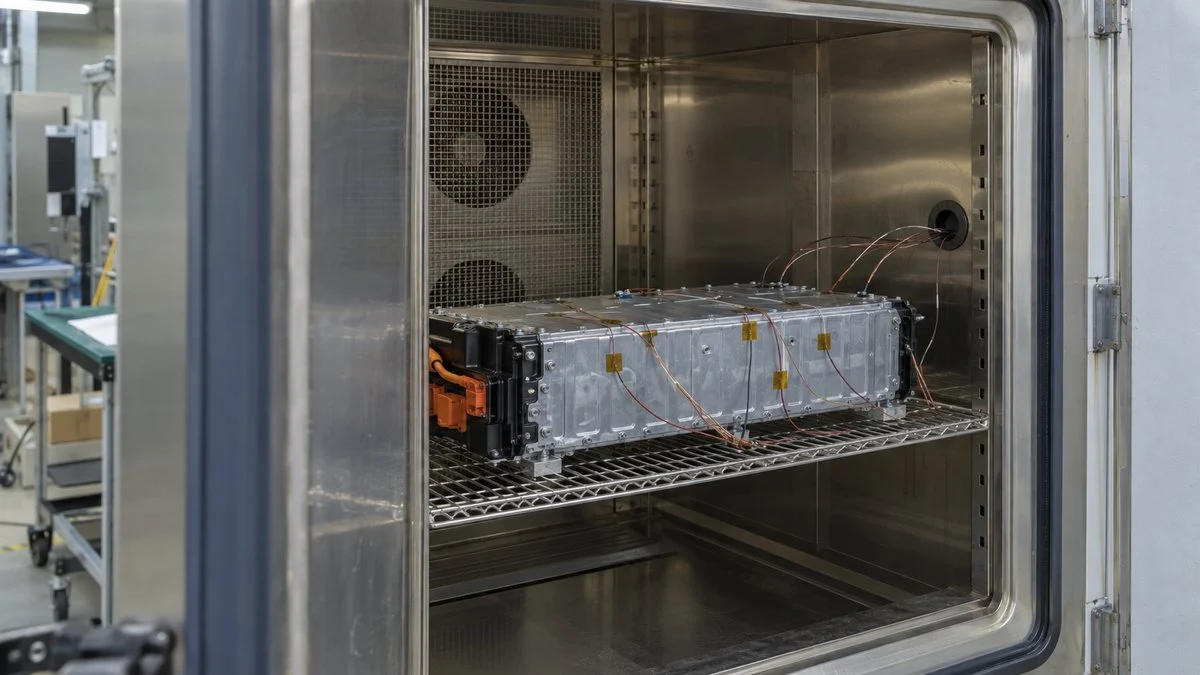
The center has thermal chambers that test batteries across a range of temperatures, plus labs for trying out new technologies. Media reports also mention vibration rigs and cycling equipment that simulates charge and discharge for cells, modules, and full packs. Batteries are assembled in stages, with cells grouped into modules and modules into the vehicle pack, so engineers need equipment that pinpoints the stage where performance or life drops off.
The 2023 plan also listed evaluations using Level 2 and DC fast charging and connections to power sources and infrastructure. Toyota also said it was upgrading chassis dynamometers (test stands that hold a vehicle in place and simulate driving) on its Michigan R&D campuses so they could handle full BEV evaluations.
Solving Field Issues Closer to the Source
Toyota says the center will let engineers detect and resolve field concerns faster and closer to the source. It also aims to develop longer-lasting batteries suited to the conditions American drivers face.
North America has wide swings between hot and cold regions, and drivers tend to cover long distances. If batteries that fail under those conditions have to go back to Japan for analysis, root-cause investigations take longer. With a test site in the US, engineers can more easily reproduce a failure under the conditions where it happened. For how Japanese customers expect suppliers to report on a field failure, see our guide to writing an 8D report and the Toyota 8-step method.
Related: How to Write an 8D Report: D0–D8 and the Toyota 8-Step
University of Michigan Partnership and Talent
Toyota will open the center's testing and evaluation capabilities to students, researchers, and other research partners through the University of Michigan Electric Vehicle Center, of which Toyota is a founding member. The aim is to train the next generation of battery engineers and technicians in Michigan.
Toyota has been in Michigan for more than 50 years, and Michigan Public reports that about 2,000 people work at the R&D campus where the center sits. In batteries, too, Toyota is building a team that develops products locally while training local engineers.
Why Toyota Is Developing Batteries in the US Now
Toyota gives three official reasons for the center: to support its North American production network with battery evaluation, to respond to field issues faster, and to develop batteries suited to US driving conditions. The background below is MONOSCOPE's reading of what makes US battery work more important. Toyota has not cited tariffs or tax credits as reasons for the center, so treat those as context, not as Toyota's stated motives.
Demand, production, and policy all make local battery work more important.
Toyota's stated reasons are supporting North American production, faster field-issue response, and batteries for US conditions. The policy factors are MONOSCOPE's analysis.
Nearly Half of US Sales Are Electrified
TMNA sold 2,518,071 vehicles in the US in 2025. Of those, 1,183,248 were electrified vehicles (HEVs, PHEVs, BEVs, and others), or 47.0% of the total.
With batteries in that many vehicles, knowing how they age in the US climate and under US driving patterns is basic to quality assurance. Given this sales mix, it makes sense that the center covers hybrid batteries as well as BEV batteries.
The North Carolina Battery Plant Is Running
In December 2021, Toyota announced a battery plant in North Carolina, with an initial investment of about $1.29 billion and plans to start with lithium-ion batteries for hybrids. Investment grew in stages to about $13.9 billion. The plant, Toyota Battery Manufacturing, North Carolina (TBMNC), held its grand opening in November 2025.
TBMNC is Toyota's first in-house battery plant outside Japan and is expected to create up to 5,100 jobs. Reports say that at full capacity it will run 14 lines with about 30 GWh of annual output, building batteries for HEVs, PHEVs, and BEVs. At the opening, Toyota also confirmed plans to invest up to an additional $10 billion in the US over the next five years.
Once a company mass-produces batteries in the US, placing the team that evaluates those batteries day to day nearby follows standard quality-control logic. For the wider picture of factory investment returning to the US, see US manufacturing reshoring and Japanese manufacturers' role.
Tariffs and Tax Credits Changed
In 2025, the US imposed an additional 25% Section 232 tariff on imported vehicles (from April) and auto parts (from May). Under the US–Japan agreement, the tariff on Japanese autos and auto parts was reduced to 15% in September 2025. The more a company sources and produces inside the US, the less these tariffs affect it. For current rates and how they are calculated, see US tariffs on Japanese imports in 2026.
Meanwhile, the One Big Beautiful Bill Act, signed in July 2025, ended the federal tax credit for new EVs. The credit, worth up to $7,500, applies only to vehicles acquired by September 30, 2025. With EV demand harder to forecast, a battery program that can serve everything from hybrids to BEVs fits Toyota's multi-pathway strategy.
In May 2024, after a four-year review, the US also decided to raise Section 301 tariffs on Chinese goods. The tariff on Chinese lithium-ion EV batteries rose from 7.5% to 25% in 2024, and the tariff on non-EV lithium-ion batteries is set to rise to 25% in 2026. Policy is pushing for battery supply chains that do not depend on China.
Within five years of the plant announcement, Toyota had both production and evaluation in the US.
- North Carolina battery plant announcedInitial investment about $1.29 billion; production to start with hybrid batteries
- Michigan battery lab announcedNearly $50 million; opening originally expected in 2025
- Redwood Materials agreement expandedSourcing of recycled cathode material and anode copper foil
- 25% tariff on autos and partsCut to 15% for Japanese autos and parts in September
- Federal EV tax credit endsThe up-to-$7,500 credit covers new vehicles acquired by this date
- North Carolina battery plant opensTotal investment about $13.9 billion; up to $10 billion more for the US announced
- Battery Center of North America opensSaline, Michigan; Toyota's North American hub for battery evaluation and development
Compiled by MONOSCOPE from Toyota announcements, US media, and Nikkan Kogyo Shimbun (Japanese).
How Research, Production, and Recycling Connect
On its own, the Michigan center looks like a modest test facility. Across North America, though, Toyota is spreading battery work over separate sites and companies: research and evaluation, cell and pack production, vehicle assembly, and recycling of used batteries.
Evaluation, production, assembly, and recycling are starting to link up inside the US.
Reports say TBMNC ships hybrid battery modules to Toyota's Kentucky plant and to Mazda Toyota Manufacturing in Alabama.
Batteries built at TBMNC go to vehicle plants across North America, and Toyota states that the Michigan center supports battery evaluation for both TBMNC and those vehicle plants. So wherever a problem shows up, from production to installation to use on the road, it comes back to the evaluation hub.
For end-of-life batteries, Toyota and Redwood Materials expanded their partnership in November 2023. Toyota agreed to source cathode active material (the main material coated on the positive electrode that stores energy) and anode copper foil from Redwood's recycling operations for future battery production. Redwood said the cathode material would contain at least 20% recycled nickel, 20% recycled lithium, and 50% recycled cobalt, and it is aiming to use recycled copper in the anode foil as well. In other words, US-recycled content is already written into supply terms.
What Changes for Parts and Materials Suppliers
Toyota has not announced new requirements for its suppliers. The rest of this article separates facts you can confirm from public sources from changes that may follow. When an automaker moves development and evaluation work abroad, the effect reaches beyond Tier 1 suppliers (those that ship directly to the automaker). Tier 2 and lower parts and materials suppliers also start getting questions and evaluation requests. For how the tiers fit together, see the Japanese automotive supply chain: tiers, keiretsu, and pricing.
Confirmed facts, possible changes, and questions for your customer, kept separate.
"Possible changes" is MONOSCOPE's assessment, not terms published by Toyota.
Battery Materials and Component Suppliers
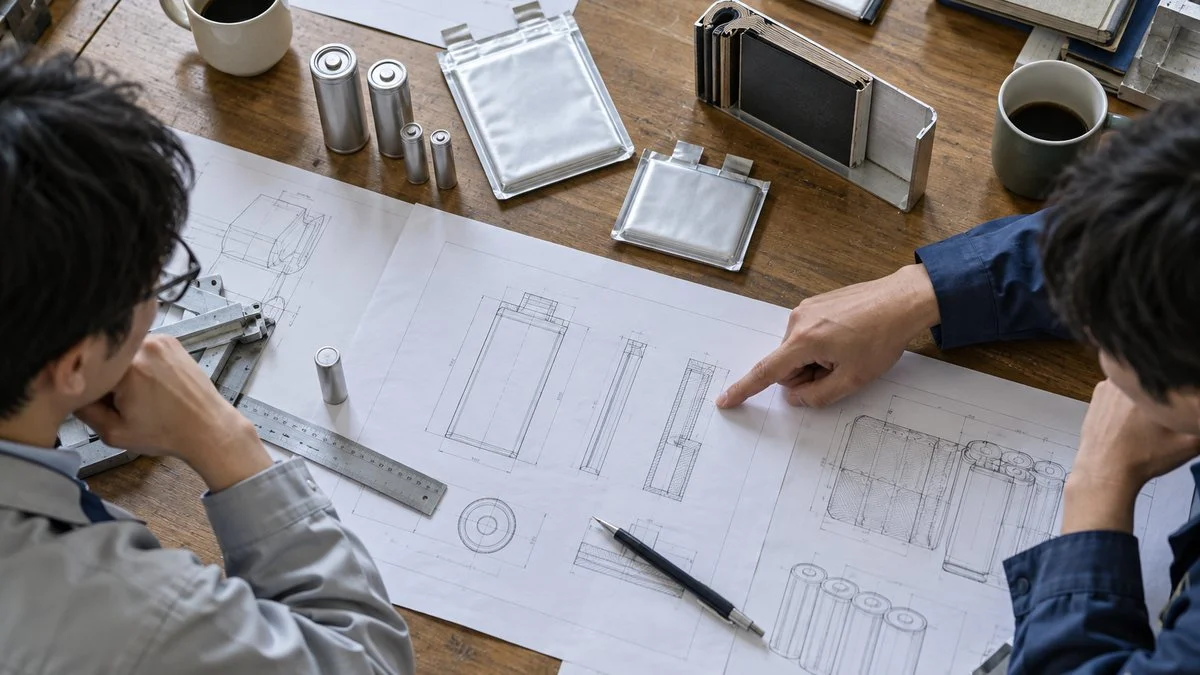
If you make cathode or anode materials, copper foil, separators (the film between the positive and negative electrodes), or electrolyte, the key question is where and how your material will be evaluated. With an evaluation center in the US, materials for US-made batteries will likely be judged more often on US test data. The recycled-content targets in the Redwood agreement are one signal of where Toyota's sourcing policy is heading.
Thermal Management, Electrical, and Enclosure Suppliers
Pack cooling parts, busbars (metal strips that connect cells), wire harnesses, and enclosures directly affect battery life and safety. Because the center aims to develop batteries for US driving conditions, test conditions that assume heat, cold, and long distances may start to show up in part specifications.
The goal of solving field issues faster in the US may also mean that requests to help with root-cause investigations come straight from the US. A supplier that can respond only through its head office in Japan may look slow by comparison.
Test Equipment and Production Equipment Suppliers
For companies that sell charge-discharge test systems, environmental chambers, or safety test equipment, demand for battery evaluation in the US is growing. This is not limited to Toyota. The more automakers and parts makers in North America build out battery evaluation, the more the ability to maintain and calibrate equipment locally after installation becomes a reason to choose one supplier over another.
Five Questions to Ask Before Your Next Design Review
If you already supply battery-related parts or materials for North America, or plan to, raise these points at your next sales meeting or design review. Pair each question with an honest check of whether your own organization can respond.
For each item, pair what to ask your customer with what to prepare on your side.
- 1Where, and under what conditions, will evaluation happen?Is evaluation in Japan enough, or will there be added testing in the US? Ask about temperature and driving-condition assumptions.
- 2Who handles spec changes and field issues?Does the US development team or the Japan head office decide? Set your own contact person and response deadlines too.
- 3Will sourcing-region or origin requirements change?Check whether your parts are affected by tariffs and whether you could shift to US or third-country production.
- 4Are there recycled-content or environmental requirements?Find out what may become an evaluation criterion, such as recycled-material ratios or CO2 emissions from production.
- 5Do you have people and equipment to respond locally?Take stock of who on your side can handle failure analysis and technical meetings in the US, and how fast.
These are not requirements Toyota has given its suppliers. MONOSCOPE compiled them from public information.
Question 2, about who handles changes and issues, is often overlooked. Once an evaluation center opens in the US, technical questions can start coming from the US instead of Japan. Agreeing at the start on who decides and who you answer to makes a big difference to how quickly you can respond to the first field issue.
On question 3, tariff rules may keep changing, so plan to review your sourcing decision regularly rather than treating it as settled.
Related: US Manufacturing Reshoring in 2026: Data and Japan’s Role
Building the local support in question 5 takes time, because you cannot add local staff overnight. If you have no US presence, list what local distributors, partners, or engineers on business trips can cover, and build the gaps into your mid-term plan.
Email Template: Asking Your Customer About Evaluation and Contacts
Adapt this to your situation. Replace the bracketed parts.
Subject: [Part name / P/N]: evaluation conditions and contacts for North America

Hi [Name],

With Toyota's Battery Center of North America now open, we want to make
sure we support [project / program name] the right way. Could you help us
confirm the following?

1. Evaluation: Will [part name] be evaluated in Japan only, or will there
   be added testing in the US? If so, what temperature and driving
   conditions should we design and test to?
2. Contacts: For spec changes and field issues, should we work with the
   US team, the Japan team, or both? Who approves the final decision?
3. Sourcing: Are there any changes expected to origin, local-content,
   or recycled-content requirements for this part?
4. Response time: What response time do you expect for a first reply on
   a field issue?

On our side, [name] in [location] will be the main contact for
technical questions, with support from [team / location].

Best regards,
[Your name]
[Company]
Limits of This Article
- Everything about supplier impact is MONOSCOPE's reading of public information. Toyota has not published new supplier requirements tied to the center.
- Toyota does not cite tariffs or tax credits as reasons for the center. They are context only.
- The $50 million figure and the TBMNC line count and capacity come from media reports, not from Toyota's center announcement.
- Tariff rates and incentives change often. Check current rules before you make sourcing decisions.
- Who decides on evaluation and spec changes differs by customer, part, and program. Confirm it for each project.
Summary
- On October 1, 2026, Toyota opened its North American hub for battery evaluation and development in Saline, Michigan.
- The center covers batteries for HEVs, PHEVs, fuel cell vehicles, and BEVs, and handles evaluation, field issues, and development for US conditions.
- Electrified vehicles made up 47% of Toyota's 2025 US sales, and the North Carolina battery plant is now in production.
- Research, production, vehicle assembly, and recycling are starting to connect within North America.
- Suppliers should confirm evaluation conditions, contacts, sourcing region, recycled content, and their own local support.
The center makes the most sense as one part of a North American flow that makes, tests, and recycles batteries. Tariffs and tax rules will keep shifting, so start with the parts of this picture that touch your own business.
FAQ
What is the Toyota Battery Center of North America?
It is Toyota's central hub for battery development and evaluation in North America, opened on October 1, 2026, at its R&D campus in Saline, Michigan. It covers about 2,800 m² (30,000 sq ft) and evaluates batteries for hybrids, plug-in hybrids, fuel cell vehicles, and BEVs.
Does the Michigan center make batteries?
No. It tests, evaluates, and develops batteries. Toyota mass-produces batteries at Toyota Battery Manufacturing, North Carolina (TBMNC), which opened in November 2025.
How much did Toyota invest in the Michigan battery center?
Toyota's release does not state an amount. US media report about $50 million, which matches the battery lab plan Toyota announced in June 2023.
Does the center change what Toyota requires from suppliers?
Toyota has not announced new supplier requirements. Suppliers may see more US-based evaluation and more questions from US teams, so confirm test conditions and decision-makers with your customer.
Where does Toyota get recycled battery materials in the US?
Under a November 2023 agreement, Toyota will source recycled cathode active material and anode copper foil from Redwood Materials. Redwood said the cathode material would contain at least 20% recycled nickel, 20% recycled lithium, and 50% recycled cobalt.
Sources
- Center opening and role: Toyota USA Newsroom, "Toyota Battery Center of North America Unveiled at Michigan R&D Campus" (October 1, 2026)
- Investment, field issues, US driving conditions: CBT News, "Toyota opens $50 million Michigan battery research center"
- Test equipment: GreenCars, "Toyota opens nearly $50M Michigan battery lab"
- Investment and campus headcount: Michigan Public, "Toyota unveils its main North American battery testing facility in Washtenaw County" (October 1, 2026)
- 2023 battery lab plan: InsideEVs, "Toyota Building $50 Million Battery Lab At Its Michigan R&D HQ" (June 2023); MotorFan (Japanese)
- North Carolina plant announcement: Toyota Motor Corporation news release (Japanese) (December 7, 2021)
- North Carolina plant opening and additional US investment: Toyota Motor Corporation news release (Japanese) (November 13, 2025); Fox Business; Office of the Governor of North Carolina (November 12, 2025)
- Plant capacity and shipments: electrive (November 13, 2025); Plant Services
- 2025 US sales: Toyota Motor North America Reports 2025 U.S. Sales Results (January 5, 2026)
- Recycled materials: Toyota USA Newsroom, "Toyota and Redwood Materials Agree to Battery Recycling, Materials Procurement" (November 16, 2023)
- Auto tariff reduction: Nikkan Kogyo Shimbun, Newswitch (Japanese); C.H. Robinson, "US – Japan Agreement Implementation" (September 17, 2025)
- End of EV tax credits: Plante Moran, "The OBBB and the end of EV tax credits"
- Section 301 tariffs on lithium-ion batteries: Mayer Brown, "USTR Finalizes 4-Year Review of Section 301 Tariffs" (May 17, 2024)
Original article in JapaneseThis guide is adapted from a MONOSCOPE article written for readers in Japan: トヨタが米国に電池研究拠点|現地開発で部品メーカーに何が起きるか
About the editor
 MONOSCOPE EditorFOUNDER & EDITOR
Spent about ten years at a plant equipment maker and a plant engineering company, proposing, designing, and commissioning equipment, then moved into web marketing. Now a web consultant for B2B manufacturers, helping them explain their products and technology. Licensed in Japan as an Energy Manager and a Third-Class Chief Electrical Engineer.
Has run an engineering blog since 2017 (500+ articles) and a Japanese YouTube channel with about 20,000 subscribers. Each English guide is written from the Japanese shop-floor point of view and checked against the cited standards.