Hiyari Hatto Near-Miss Reports: Fixes, Examples, Template
Your Japanese parent company has rolled out a "hiyari hatto" program. There is a report form, a box by the break room or a page in the plant app, and a target number of reports per month. For the first few weeks, reports come in. Then they slow down, and by the end of the quarter the box is mostly empty. Supervisors ask the line to "please write hiyari hatto," and nothing changes.
Hiyari hatto (ヒヤリハット) is the Japanese term for a near miss: an event that could have hurt someone but did not. When reports stop coming in, the cause is rarely a lack of hazards. It usually lies in the system around the report: how much effort it takes to write one, what happens to the person who writes it, and whether anything changes afterward.
This guide is for team leaders and safety staff at Japanese-affiliated plants. It explains what hiyari hatto means, how Heinrich's 1:29:300 ratio is used in Japan (and where it falls short), the four reasons reporting stalls, and three sets of fixes drawn from Japanese government guidance. It ends with a fictional filled-in report, a near-miss report template, and questions to ask the Japanese side.
- Hyogo Labour Bureau defines hiyari hatto as an event where "something dangerous happened, but fortunately did not result in an injury." In English, it is a near miss.
- Reporting stalls at one of four layers: people don't notice, writing is a chore, they fear blame, or nothing changes after they report.
- Fixes come from three directions: make reporting easier (including "imagined" near misses and checkbox or verbal reports), write down a no-blame rule, and reply within about two weeks with fixes that go beyond "be careful."
- A report with six items (when, where, what you were doing, what almost happened, likely cause, suggested fix) is easier to turn into action.
- Judge the program by report content and response speed, not by report count.
Contents
- What Is Hiyari Hatto?
- Signs Your Near-Miss Reporting Has Stalled
- Why Near-Miss Reports Dry Up: Four Layers
- Fix 1: Make Reporting Easier
- Fix 2: Protect the People Who Report
- Fix 3: Turn Reports into Fixes and Training
- Keeping Near-Miss Reporting Alive
- Examples from Japanese Public Sources
- Near-Miss Report Template
- Limits of This Guide
- FAQ
What Is Hiyari Hatto?
Hiyari and hatto are both Japanese sound words. Hiyari is the sudden chill of a scare, and hatto is the gasp when you suddenly realize what almost happened. Together, hiyari hatto means a moment when you were frightened or startled at work but nobody was hurt.
Japanese labour authorities use a plain definition. Hyogo Labour Bureau, a regional office of Japan's Ministry of Health, Labour and Welfare (MHLW), describes it as an event where something dangerous happened but, fortunately, it did not lead to an injury. The idea behind a hiyari hatto program is simple: collect these close calls and fix their causes before someone gets hurt.
Niigata Labour Bureau notes that near-miss reporting systems are used as an effective way to prevent occupational accidents, especially in manufacturing. Yet many plants report the same problem: the system exists, but reports don't come in, or they come in and never lead to fixes. Without care, the program easily turns into a formality.
Hiyari Hatto vs. Near Miss: How OSHA's Approach Compares
If you already run a near-miss program under US practice, hiyari hatto will look familiar. OSHA's Recommended Practices for Safety and Health Programs tells employers to encourage workers to report "close calls/near misses," to investigate them to find the underlying hazards, to offer an anonymous reporting option to reduce fear of reprisal, and to respond to reports promptly. These are recommendations, not a regulation. OSHA's injury and illness recordkeeping rule (29 CFR Part 1904) covers injuries and illnesses, so a near miss with no injury is tracked inside the company, not recorded on the OSHA log.
A sample near-miss report form produced under an OSHA training grant defines a near miss as a potential hazard or incident with no property damage and no injury, where a slight shift in time or position could easily have caused damage or injury. The main differences from Japanese practice are in emphasis, not in the concept:
| Hiyari hatto (Japanese practice) | Near miss (US practice) | |
|---|---|---|
| Core meaning | A scare or close call with no injury | An incident with no injury or damage that could easily have caused one |
| Potential hazards | Often included as sotei hiyari (想定ヒヤリ, "imagined" near misses): hazards a worker noticed before anything happened | Often a separate category such as "safety concern" or "unsafe condition" |
| Typical guidance | Labour bureau and ministry guides; links to risk assessment under MHLW guidelines | OSHA Recommended Practices; company safety management systems |
| Common add-ons | Morning meeting review, KY (hazard prediction) training, wall displays | Incident investigation, root cause analysis, safety committee review |
The labels matter when you merge a Japanese program with an existing local one. If your plant already has a near-miss form, agree with the Japanese side whether hiyari hatto reports replace it, feed into it, or run beside it. Running two forms side by side gives people one more reason to submit neither.
Heinrich's Law (1:29:300) and How to Use It Carefully
Japanese safety materials often cite Heinrich's law as the reason for hiyari hatto programs. H.W. Heinrich, an American insurance engineer, described it in his 1931 book Industrial Accident Prevention. Of 330 accidents of the same kind involving the same person, 1 caused a major injury, 29 caused minor injuries, and 300 caused no injury. In Japan it is often simply called the 1:29:300 rule.
Under one serious injury sit many events that hurt no one.
The ratio describes 330 accidents of the same kind involving the same person. Heinrich himself said the ratio varies with the type of work (per the MHLW Workplace Safety Site commentary quoted by Niigata Labour Bureau).
The Japanese guidance is clear that the exact numbers are not the point. What matters is that many hazards sit behind every accident, and the sooner you learn about them, the sooner you can act. Below the 300 are said to be thousands of unsafe acts and conditions. A plant that gets only a few reports a month probably does not have few hazards; more likely, it sees only a small part of them.
Use the ratio with care, especially with audiences who know the US safety literature. Critics such as Fred Manuele point out that Heinrich's original data no longer exist and that he revised the ratio in later editions without explanation. Others argue that serious injuries and fatalities often have different causes from minor ones, so cutting the number of minor incidents does not automatically cut the number of serious ones. In practice, this means two things for a hiyari hatto program:
- Do not promise that a certain number of reports will prevent a certain number of injuries.
- Give extra attention to near misses that could have caused a serious injury, even if they happen rarely. The Japanese guidance below says the same thing: analyze serious-potential and repeated cases in depth, and count the rest.
Signs Your Near-Miss Reporting Has Stalled
If you only watch the report count, you will notice too late that the program is fading. These signs suggest it is time to review the system:
Having reports is not the same as having a program that works.
Compiled by MONOSCOPE from problem cases in the MLIT guide on collecting and using accident and near-miss information, and other sources.
Watch especially for a program that starts strong and then fades. A guide from Japan's Ministry of Land, Infrastructure, Transport and Tourism (MLIT) explains this pattern: when nobody follows up on the reports, people lose the will to keep reporting. A falling report count is the shop floor's silent verdict on how reports have been handled.
Why Near-Miss Reports Dry Up: Four Layers
There is rarely one reason. What workers say usually falls into four layers: "I didn't notice anything," "writing it up is a pain," "I don't want to say," and "nothing changes anyway." The right fix depends on which layer is blocking your reports.
Reporting can stall at any stage: noticing a hazard, writing it up, submitting it, or getting a reply.
Classified by MONOSCOPE based on the MLIT guide and materials from the Hyogo and Niigata Labour Bureaus.
People Don't See a Hazard or Don't Know What Counts
The MLIT guide lists "people don't know what counts as a near miss" as the first reason reports don't come in. If nobody shows how minor an event can be and still be worth reporting, people decide on their own that it is "too small to bother with."
The second reason is that some people no longer feel the scare at all. According to the same guide, experienced workers can see what is coming, so they don't react in situations that would startle a newer worker. A crew full of veterans can therefore produce fewer reports without being any safer.
Writing a Report Takes Too Long
A form with many fields that asks for a written description is a barrier on its own. A worker may notice something mid-task, find no time to write it up, and then forget it.
Hyogo Labour Bureau asks safety staff to set aside time for teaching people how to report and for the activity itself, not just to set up a reporting system. If the rule is "write it up when you have a spare moment," the busiest areas will report the least.
People Fear Blame or a Worse Performance Review
Most near misses involve the reporter's own actions. If reporting means being criticized for carelessness or marked down at review time, staying quiet becomes the rational choice.
Niigata Labour Bureau acknowledges that a near miss is not something either the reporter or the receiver is proud of. It states plainly that unless the company makes a rule not to blame workers, and actually follows it, the system will not last.
Not blaming means asking a different question. If someone did not follow the procedure, perhaps the procedure is impractical and cannot be followed as written.
Related: Standardized Work Instructions: Sagyo Hyojunsho Template
Professional pride also gets in the way. The MLIT guide notes that a simple mistake can hurt a person's pride and make them want to hide it.
Nothing Changes After a Report
Hyogo Labour Bureau puts it simply: if people don't know how their report will be handled, nobody will feel like submitting one. When reports stop at the safety officer's desk with no reply and no fix, people stop sending them.
A safety and health column from the Japan Management Association (JMA) lists similar organizational causes: not thanking people for reports, not showing what improved, and fixes that only add work for the shop floor. If reporting a problem means your own job gets harder, you report less.
Quotas Fill the Box with Empty Reports
To get more reports, plants often set a quota, such as a fixed number per person per month. The result is a rush of reports written just before the deadline to hit the number. In a case published by the Japan Organization for Employment of the Elderly, Persons with Disabilities and Job Seekers (JEED), Omron Taiyo saw report quality drop when it focused too heavily on the number submitted.
Report count only tells you that people are taking part. If you chase the count alone, you lose the real purpose, which is finding hazards early.
Fix 1: Make Reporting Easier
Start with the front end. Show people what to report, and let them report it quickly in a way that suits them. Until this works, rules that protect reporters and systems for acting on reports will not raise the numbers.
Count "Imagined" Near Misses Too
Niigata Labour Bureau suggests adding sotei hiyari, or "imagined" near misses, to the scope. A worker can report not only a moment that actually scared them, but also a moment when they sensed danger while working, before any near miss happened.
This widens the net so more hazards come to light, and it trains people to notice danger. Hyogo Labour Bureau likewise counts things a worker noticed by watching others, or predicted, as valid reports. Because these reports do not require admitting a personal mistake, they also feel less risky to write.
For people who don't know what to report, examples work best. MHLW's Workplace Safety Site (in Japanese) publishes illustrated near-miss cases searchable by accident type and industry. Reading one case aloud at the morning meeting gives the team a shared sense of what is "worth reporting."
Use Three Reporting Formats Together
You don't need a single reporting channel. To address "writing is a pain," the MLIT guide suggests simplified checklist-style forms, verbal reports taken by a manager, and other channels such as email. Each has strengths and weaknesses.
Ease and detail trade off against each other, so combining formats is the practical choice.
Compiled by MONOSCOPE from the solutions in the MLIT guide. In Niigata Labour Bureau's example, the team leader may write and submit the report on the worker's behalf.
When taking verbal reports, "Any near misses?" usually gets a "no." The MLIT guide says you get more detail when you name a specific task or situation. On a factory floor, that might be "Did anything scare you when you reached in during the changeover?" or "Have you had a close call with a forklift in the aisle?"
Letting people submit from a phone or tablet with a photo also cuts the effort. Changing the tool alone, however, does not fix the fear of how a report will be treated. Plan new channels together with the other two fixes.
How to Write a Near-Miss Report: Six Items
Agreeing in advance on what to write also cuts the effort. Instead of one big free-text box, ask for short answers under six headings. This makes it easier for whoever receives the report to work out a fix.
- When: date and approximate time
- Where: line, machine, or aisle, specific enough to find the spot
- What you were doing: the task at the time, such as a changeover, material handling, or cleaning
- What almost happened: caught in a machine, a fall, a collision, and what the result would have been
- Likely cause: what made the task hard in the procedure, equipment, or environment, not who was at fault
- Suggested fix: leave blank if nothing comes to mind
Example Report: Press Line After a Die Change
Here is how the six items look for a stamping press. The plant, dates, and details are fictional.
When and where: October 8, around 2:00 p.m., in front of the press on Line 2
What I was doing: Making a trial hit after a die change. I started to reach in near the die to straighten the misaligned material.
What almost happened: The operator next to me had his foot on the foot switch. If the press had cycled, my hand would have been caught. I noticed before reaching in and stopped.
Likely cause: After the changeover, we had not agreed on signals between the person adjusting and the person running the press.
Suggested fix: Disable the foot switch during adjustment and hang a tag on it. Add the signal rule to the work standard.
Tell people to keep what they saw separate from what they guess, and to describe the situation rather than write "X was careless." Rules such as one event per report, with a photo where possible, also make sorting easier later.
The suggested fix in this example, making sure the machine cannot move during adjustment, is the same idea as lockout/tagout (LOTO).
Related: Lockout/Tagout in Japan: Japanese Law vs. OSHA 1910.147
This is a sample report, not a safe work procedure. How to secure a press during adjustment is set by your plant's work standards, the press maker's manual, and local regulations.
Rename the Form If It Sounds Like a Confession
The name of the form matters more than you might expect. The MLIT guide gives examples of dropping words like "accident" that suggest punishment and using a positive name such as "safety report." If people read "hiyari hatto report" as "report of my mistake," a new name is worth trying.
Fix 2: Protect the People Who Report
Even with an easy front end, people will not report near misses in their own work as long as reporting seems to cost them something. How reporters are treated has to be a written rule, not a verbal promise.
The MLIT guide recommends making it a rule that reports will not lead to discipline or affect performance reviews such as bonus assessments, and writing that rule into procedures. Next, decide how reporters' names will be handled.
Anonymity brings in more reports, but makes it harder to follow up.
To deal with the drawbacks of anonymous reports, the MLIT guide suggests interviewing the reporter when the report is received and limiting reporter names to managers.
Write "No Blame" into the Procedure and Keep Saying It
A written rule alone will not convince the shop floor. The MLIT guide asks safety departments and managers to repeat the message at every opportunity until the workforce understands it. The message is that everyone makes mistakes, and hiding a mistake leaves the trigger for an accident in place.
What works best is how supervisors react in the moment. Hyogo Labour Bureau's material contrasts two workplaces: one where the supervisor responds to a report with "Thanks for telling me!" and one where the response is "That was your carelessness." One reaction of the second kind can stop reporting across the whole area.
Tell People That Noticing Takes Skill
People held back by pride need a different way to see it. The MLIT guide recommends telling them that noticing a near miss shows skill, not a lack of it, and that it stayed a near miss precisely because they were good at the job.
With veterans, asking them to share past experience to help newer workers usually goes over better than asking them to report their own mistakes. The same guide suggests inviting veterans to join training with the goal of developing the next generation.
Fix 3: Turn Reports into Fixes and Training
Once reports start coming in, design the back end. New reports appear only when earlier ones lead to fixes, the fixes are shared, and the results get back to the reporter. Guidance from both Niigata and Hyogo Labour Bureaus asks plants to decide this flow, from report to sharing, before launch.
Treat everything up to telling the reporter the result as one cycle.
Compiled by MONOSCOPE from procedures in Niigata and Hyogo Labour Bureau materials and the MLIT guide.
Reply Within Two Weeks
The MLIT guide calls for quick feedback on each report, giving two weeks as an example of how soon to share the response. If a fix cannot be made right away, still tell the reporter you received it and why it will take time. For anonymous reports, answer the whole team.
The reply can be short. A line such as "Got it. We'll review the stop button location at the next safety and health committee meeting" shows that the report is being handled. The same guide also suggests that department heads praise reports in front of the team and recognize reports that led to improvements.
Don't Analyze Every Report in Depth
As reports increase, safety staff can fall behind. Trying to analyze every report in detail delays the replies, and slow replies stop reporting again.
The MLIT guide suggests a simple tally first, with detailed cause analysis only for key cases: those with a high potential for serious injury, and those that keep recurring. Tools for digging into root causes include 5 Whys analysis, also used in the Toyota Production System, and fishbone (cause-and-effect) diagrams.
Related: Kaizen in Japanese Companies: How Improvement Actually Runs
Don't Stop at "Be Careful"
When every fix is "we'll be more careful" or "we'll remind everyone," the same reports keep coming back. The MLIT guide asks organizations not to rely on warning or instructing the individual, and to look for fixes in equipment, the work environment, and management systems.
Consider changes to systems and equipment before warnings to the individual.
Based on the order of priority in the MLIT guide, with manufacturing examples substituted by MONOSCOPE.
If someone reports a close call while reaching into a machine, first question the design that lets anyone reach in without stopping it. For maintenance and cleaning tasks that require entering a machine, also check that energy isolation procedures under lockout/tagout are in place.
Also check that fixes do not simply add work for the shop floor. If reporting a near miss made your own job more tedious, you would think twice before reporting the next one.
Feed Near Misses into Risk Assessment
A near miss is too valuable to close with a one-off fix. In Japan, the MHLW notice that implements its risk assessment guidelines lists, among the tasks to assess, work where a dangerous event occurred without causing injury (a near-miss case). The same notice lists near-miss and trouble records among the information employers should collect.
Hyogo Labour Bureau recommends recording each near miss as a hazard of that task, estimating the severity and likelihood of harm, and addressing the highest risks first. It can also help to make the estimate together with the worker who reported the near miss. Outside Japan, the same reports can feed whatever risk assessment or job hazard analysis your plant uses.
Related: Risk Assessment in Japanese Plants vs. JHA, HSE, ISO 12100
Keeping Near-Miss Reporting Alive

Even with a good front end and back end, a program run the same way for years turns into routine. Review what you measure and where you focus on a regular schedule to keep reports flowing.
Track Content and Response, Not Just Count
Report count is easy to track, but chasing it fills the box with quota reports. To tell whether the program works, also look at how widely people report and how often reports lead to fixes.
Look at reach, speed, and the quality of fixes, not just the count.
Example metrics compiled by MONOSCOPE. For measuring results, the MLIT guide lists trends in similar incidents and checks on how well fixes are carried out (whether they have become a formality).
Days to reply, in particular, is a metric safety staff can improve on their own. Before asking the floor for more reports, measure how quickly you respond to the ones you already have. It often shows why reporting has stalled.
Run Focus Months and Themes
The MLIT guide recommends breaking up the routine with periods such as a near-miss focus month, instead of running the same program the same way all year. When there are too many reports to handle, it also suggests collecting only near misses related to the accidents you most want to prevent.
In a factory, themes might be slips and falls in winter, forklifts and pedestrians in peak season, and hands caught during changeovers or cleaning before an equipment upgrade. Setting a theme for each period tends to bring in more useful reports. A plant with many older workers, for example, might focus on falls.
Build Awareness with Morning Meetings and KY
People can learn to notice near misses. The MLIT guide lists training that sharpens awareness, such as hazard prediction training (KYT), where a team discusses and predicts the hazards in a task. Hyogo Labour Bureau also stresses a workplace where people talk about safety as a matter of course. For how Japanese plants run this training, see our guide to kiken yochi (KY) training.
Picking one near miss from the day before and sharing the fix at the morning meeting or pre-shift briefing is enough to make reports a normal topic on the floor. Aim to increase how often reports are talked about, not just how many are filed.
Examples from Japanese Public Sources
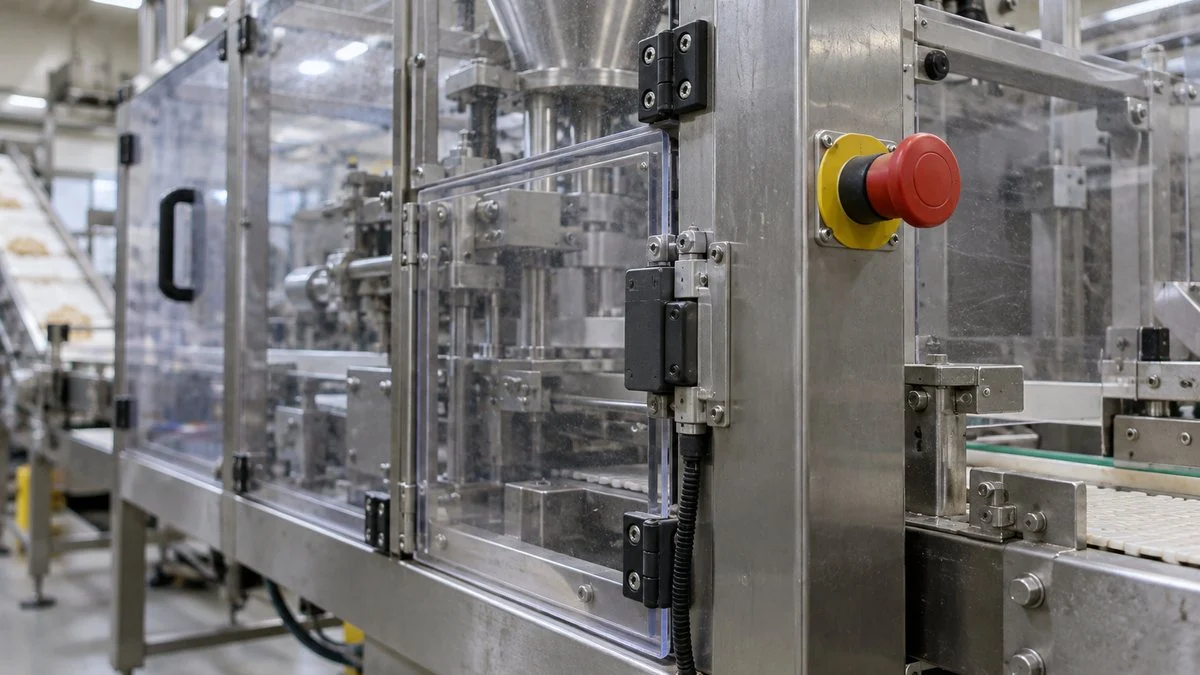
These cases from Japanese public agencies show near-miss reports leading to equipment changes or lasting participation.
From "Straightening Product" to a New Stop Button Location
Niigata Labour Bureau's material includes a sample filled-in report set in a food plant. Product on a packaging line had shifted out of position, and when the worker reached in to straighten it, a finger nearly got caught by the cutter.
The reporter noted that the machine's stop button was far from the work position and that machine faults had recently caused frequent misalignment. The report asked for an adjustment and for the button to be moved.
The safety manager's response was to have the machine maker check the fault. The response also proposed moving the emergency stop button and considering a clear guard with an interlock, which stops the machine when the guard is opened.
The same material includes another report: there was a rule to stop the machine for cleaning, but few people followed it because walking to the switch was a hassle. Here, too, the safety manager proposed adding a switch that can be operated from the work position, and changing the machine so it runs only while a button is held down.
The cleaning example is worth noting: a report that "people don't follow the rule" became a reason to change the equipment.
A Target of One Report per Person per Year, and 100% Participation
In the Omron Taiyo case published by JEED, report quality had dropped because of the focus on numbers. The company changed its annual target to one report per employee. For employees with intellectual disabilities, an assigned instructor reviews daily work with them and helps put it into a report.
Reports that should be shared company-wide are also discussed by the safety and health committee and posted on workplace walls. JEED reports that employees submitted an average of 1.4 reports each per year, every employee submitted at least one, and the company has stayed accident-free. Lowering the target turned reporting into something everyone took part in.
Models and Hazard Maps That Make Reports Visible
A collection of good safety practices in manufacturing from the Hikone Labour Standards Inspection Office (Shiga Labour Bureau) includes a plant with an on-site safety dojo (training hall), where every worker takes hands-on hazard training once a year. The dojo displays models of near-miss cases.
To prevent falls, the same material describes using near-miss data to build a hazard map of places where people are likely to fall and sharing it with everyone. Turning reports into something people can see shows that their reports have become a shared asset.
Near-Miss Report Template
Below is a one-page template you can adapt. It combines the six items above with type and follow-up fields like those on US near-miss forms. Keep the fields short, and mark everything except "what almost happened" as optional if that helps people report.
| Field | What to write | Example (fictional) |
|---|---|---|
| Type | Near miss / Imagined near miss (hazard noticed) / Safety idea | Near miss |
| When | Date and approximate time | Oct. 8, about 2:00 p.m. |
| Where | Line, machine, or aisle | Line 2, press |
| What you were doing | The task at the time | Trial hit after die change |
| What almost happened | Caught, fall, collision, etc., and what the result would have been | Hand nearly caught in the die |
| Likely cause | What in the procedure, equipment, or environment made it risky (no names) | No signal rule between adjuster and operator |
| Suggested fix | Optional | Disable foot switch during adjustment |
| Photo | Optional | Photo of the foot switch position |
| Reporter name | Per your plant's rule (named, anonymous, or names kept by the team leader only) | (Optional) |
| Received by / date | Filled in by the team leader or safety staff | Team leader, Oct. 8 |
| Reply to reporter / date | What will happen, or why it will take time | Oct. 15: reviewing at the safety committee |
| Fix decided / owner / deadline | Equipment or procedure change first | Foot switch lockout; maintenance; Oct. 31 |
| Closed / result checked | Was the fix done, and did the near miss stop recurring? | Nov. 30: no repeat reports |
Checklist: Is Your Reporting System Working?
- Does everyone know what counts as a near miss, including imagined near misses, with real examples?
- Can a worker report in under a few minutes, verbally or on a phone, without writing a long description?
- Is "no discipline and no effect on reviews" written into the procedure, and do supervisors respond with thanks?
- Has a rule been set for reporter names (named, anonymous, or names kept by the team leader only)?
- Does every reporter get a reply, with a target of about two weeks?
- Are serious-potential and repeated near misses analyzed in depth, with the rest simply counted?
- Do most fixes change equipment, layout, or procedures, rather than only reminders?
- Do near misses feed into your risk assessment or job hazard analysis?
- Do you track reach, reply time, and the share of real fixes, not only the count?
Questions to Ask the Japanese Side
If the program comes from a Japanese parent company or a Japanese plant manager, these questions help avoid confusion before rollout:
- Should hiyari hatto reports replace our existing near-miss form, feed into it, or run beside it?
- Does "hiyari hatto" here include imagined near misses (sotei hiyari) and safety ideas?
- Is there a report target per person? If so, is it a minimum for participation or a performance measure?
- Who reads the reports, and what reply time is expected?
- Which reports must be shared with Japan, and in what language?
- How should reporter names be handled when reports are shared with Japan or other plants?
- Will reports be used in individual evaluations in any way? (The guidance in this article says they should not be.)
Limits of This Guide
- The advice here comes from Japanese public guidance (MHLW labour bureaus and MLIT) and published cases. The MLIT guide was written for shipping companies; we have applied its ideas to factories. Your company's own rules come first.
- The press report and the template examples are fictional. They are not safe work procedures.
- Japanese guidelines and notices mentioned here apply in Japan. At plants in the US, India, or Southeast Asia, check local regulations and your company's EHS policy with your safety team.
- Heinrich's ratio is a historical rule of thumb. It does not predict injury rates at any specific plant.
- Near-miss reporting supports, but does not replace, risk assessment, machine guarding, and lockout/tagout.
- A plant with few near-miss reports usually does not have few hazards; it sees only a small part of them.
- Reporting stops at one of four layers: noticing, writing, what happens after reporting, or follow-through.
- Lower the barrier with imagined near misses, checkbox forms, and verbal reports.
- Write "no discipline, no effect on reviews" into the procedure, and reply within about two weeks.
- Put equipment, environment, and system fixes first, and feed near misses into risk assessment.
A near-miss program is not about collecting reports. It prevents accidents only when reports turn into fixes and the results make their way back to the people who reported them.
FAQ
What does hiyari hatto mean?
Hiyari hatto is Japanese for a near miss: an event at work that could have caused an injury but did not. The words describe the chill of a scare (hiyari) and a startled gasp (hatto). Japanese plants often also accept "imagined" near misses, hazards someone noticed before anything happened.
How is hiyari hatto related to Heinrich's law?
Heinrich's law says that for every major injury there are 29 minor injuries and 300 no-injury accidents. Hiyari hatto corresponds to the 300, and Japanese programs use the ratio to argue that fixing near misses prevents serious accidents. Treat the numbers as a rough illustration, not a forecast, and give extra attention to near misses that could have been serious.
Should near-miss reports be anonymous?
Anonymous reports are easier to get but harder to follow up, so important details are often missing. A common middle path is a named report with names removed when the case is shared. Whichever you choose, state in writing that reports will not lead to discipline or affect reviews.
Should we set a quota for near-miss reports?
Be careful with quotas. They often lead to reports written at the deadline just to hit the number, and quality drops. Track the share of people reporting, days to reply, and the share of fixes that changed equipment or procedures alongside the count.
How is hiyari hatto different from KY (hazard prediction)?
Hiyari hatto collects events that almost happened. KY, or kiken yochi training, is a team exercise in predicting the hazards of a task before starting it. KY builds the awareness that makes people notice near misses, including imagined ones, so the two programs support each other.
Sources
- Niigata Labour Bureau, introducing a near-miss and imagined near-miss reporting system (example) (Japanese)
- Hyogo Labour Bureau, risk assessment through near-miss activities (Japanese)
- Ministry of Land, Infrastructure, Transport and Tourism (MLIT), guide to collecting and using accident and near-miss information (maritime edition), 3rd edition, June 2023 (Japanese)
- Ministry of Health, Labour and Welfare (MHLW), guidelines on investigating danger or harm (risk assessment), with commentary (Japanese)
- MHLW Workplace Safety Site, near-miss case database (Japanese)
- Japan Organization for Employment of the Elderly, Persons with Disabilities and Job Seekers (JEED), Omron Taiyo case: every worker submits near-miss reports and joins safety activities (Japanese)
- Shiga Labour Bureau, Hikone Labour Standards Inspection Office, good safety practices in manufacturing (Japanese)
- Japan Management Association (JMA), safety and health column on making good use of near-miss activities (June 12, 2024, Japanese)
- US Occupational Safety and Health Administration (OSHA), Recommended Practices for Safety and Health Programs: Worker Participation and Hazard Identification and Assessment
- Near-Miss Incident Report Form (template), produced under OSHA grant SH-05031-SH8
- Safety+Health magazine (National Safety Council), "Examining the Foundation" (on Heinrich's work and its critics)
Original article in JapaneseThis guide is adapted from a MONOSCOPE article written for readers in Japan: ヒヤリハット報告が集まらない原因と対策|工場での書き方・記入例と事故を防ぐ仕組み
About the editor
 MONOSCOPE EditorFOUNDER & EDITOR
Spent about ten years at a plant equipment maker and a plant engineering company, proposing, designing, and commissioning equipment, then moved into web marketing. Now a web consultant for B2B manufacturers, helping them explain their products and technology. Licensed in Japan as an Energy Manager and a Third-Class Chief Electrical Engineer.
Has run an engineering blog since 2017 (500+ articles) and a Japanese YouTube channel with about 20,000 subscribers. Each English guide is written from the Japanese shop-floor point of view and checked against the cited standards.