Kiken Yochi (KY) Training: Japan’s Hazard Prediction Method
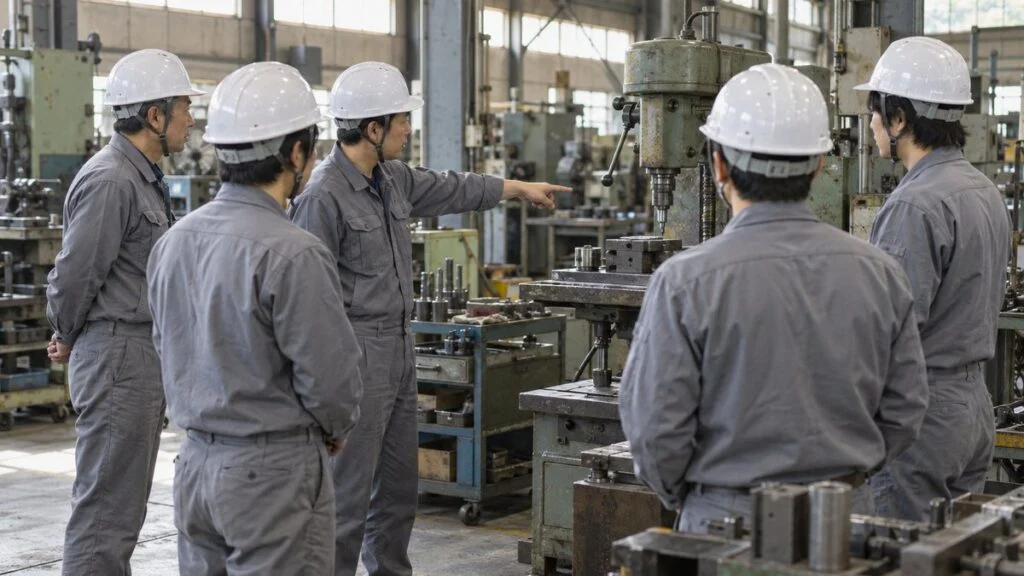
Your Japanese parent company has asked your plant to "start KY." Maybe a manual arrived with illustrated hazard sheets, a whiteboard went up next to the line, and supervisors were told to run a few minutes of KY after the morning meeting. A month later, the board says the same thing every day, and nobody is sure what it is for.
KY stands for kiken yochi (危険予知), Japanese for "hazard prediction." KY activity means spotting the hazards in a job and confirming them before the work starts. It has two layers: hazard prediction training (KYT), where small groups practice finding hazards, and a short daily KY session, where crews use the same pattern right before they begin a job. Skip the training layer, and the daily board quickly becomes a formality.
This guide explains the KYT Basic 4-Round Method as described by the Japan Industrial Safety & Health Association (JISHA) and Japan's Ministry of Health, Labour and Welfare (MHLW). It then walks through a fictional KYT sheet, shows how Japanese plants run short daily KY, and compares KY with risk assessment and the US Job Hazard Analysis (JHA). The last sections cover why KY loses its meaning, especially at plants outside Japan, and what to look at in your own plant.
Contents
What Is Kiken Yochi (KY)?
JISHA defines hazard prediction training (KYT, for kiken yochi training) as small-group discussion of the hazard factors hidden in a workplace or task, and of the accidents those factors could cause. The team agrees on the danger points and the priority actions, confirms them by pointing and calling, and deals with the hazards before anyone acts.
Teams work from an illustration of a work situation, or from a real task demonstrated on site. JISHA uses a broader term, hazard prediction activities, for the everyday program that combines KYT, pointing and calling, and related methods. Some plants call this KYK (kiken yochi katsudo). In this article, "KY" covers the whole program, from training to daily practice.
Teams learn the pattern in training, then use it before work every day and at key points in each job.
Source: compiled by MONOSCOPE from JISHA, MHLW, and Tokyo Labor Standards Association Federation materials. Names vary by industry and by plant.
Where KY Came From
According to MHLW's Workplace Safety Site, hazard prediction training began at Sumitomo Metal Industries. JISHA combined it with a 4-round problem-solving method and with pointing and calling, a safety check used by the former Japanese National Railways. The result, the KYT 4-Round Method, became the standard approach.
The Japanese safety journal Anzen Staff traces the start to 1973. A staff member from Sumitomo Metal's Wakayama Steel Works joined a JISHA safety study tour of Europe and the US, and saw a single hazard illustration at a Belgian chemical company. In 1974, Sumitomo Metal developed a two-round version ("What hazards are there?" and "What would you do?"), and the method spread through the steel industry. It later became a core method of JISHA's Zero-accident Total Participation Campaign, which JISHA had launched the year before.
Related: Hiyari Hatto Near-Miss Reports: Fixes, Examples, Template
How the KYT Basic 4-Round Method Works

Teams learn the KY pattern through the KYT Basic 4-Round Method. JISHA states that hands-on KYT practice is the starting point for any hazard prediction program, and that shorter methods such as one-point KY and individual KYT are built on the 4-Round Method.
JISHA names each round with a question or a statement that the leader uses to prompt the team:
- Round 1, spot the hazards (JISHA: understanding the actual situation): "What hazards are hidden here?"
- Round 2, pick the danger points (investigating the reality): "These are the danger points."
- Round 3, plan countermeasures (establishing countermeasures): "What would you do?"
- Round 4, set targets (setting targets): "This is what we will do."
The team generates ideas and then narrows them down twice: first for hazards, then for countermeasures.
Source: compiled by MONOSCOPE from MHLW Workplace Safety Site, "Hazard Prediction Training (KYT)."
Before You Start: Team and Roles
MHLW's Workplace Safety Site recommends teams of 5–6 people, small enough that everyone speaks up. The team picks a leader, who facilitates, and a recorder. If needed, the team can add roles such as a reporter, a presenter, or a commenter.
Before starting, the leader briefly explains the purpose of the session and asks everyone to contribute. The quality of the illustration matters less than whether people feel free to say what they really think.
Beginners can use published illustration sheets from commercial or public sources. Once the team is used to the method, photos of your own workplace and your own tasks make the discussion more concrete.
Round 1: Spot the Hazards
The leader describes the situation in the illustration and asks, "What hazards are hidden here?" Members call out what they notice, each in a cause-and-result form: "Because [hazard factor], [what happens], and [type of accident]." The recorder numbers each item and writes it on the large sheet.
This form keeps people from stopping at one word such as "dangerous" or "slippery." It forces them to name both the cause and the result. At this stage, nobody criticizes anyone else's idea; the goal is quantity.
JISHA defines hazard factors as unsafe acts or unsafe conditions that could lead to an injury or accident. Teams look at people's movements, but also at equipment, storage areas, and the condition of the floor.
Round 2: Pick the Danger Points
The leader asks which Round 1 hazards matter most to the team. Members call out item numbers, and the recorder circles them in red. From those, the team picks the hazards that could cause a serious injury or need action first.
The team agrees on 1–2 of these, marks them with a double circle and an underline, and calls them the "danger points." The leader then leads everyone in pointing and calling the danger point together ("Because…, … — Yoshi!") so the whole team shares the same picture. Yoshi means "OK" or "confirmed."
Round 3: Plan Countermeasures
For each danger point, the leader asks, "What would you do?" Members suggest concrete actions the team could carry out, such as "clamp the part," with about three per danger point.
The leader checks that the list is not just "be careful" or "pay attention." If nobody can tell whether a countermeasure was carried out, the team cannot turn it into an action target in Round 4.
Some ideas will be equipment or layout changes, such as "make a fixture" or "move the storage area." The recorder writes these down instead of dropping them, and the leader passes them to a supervisor afterward.
Round 4: Set Targets
From the Round 3 list, the team agrees on what it will commit to doing, marks those items in red with an asterisk and underline, and calls them priority actions. The team then writes a team action target that covers those actions, and confirms it by calling it out together while pointing.
A useful pattern is "When [situation], we will [action] — Yoshi!" It makes clear when to act and what to do. The more items there are, the harder they are to remember on the floor, so guides suggest one priority action per danger point.
After Round 4: Confirm with Pointing and Calling
To close, the team chooses the pointing and calling items that members will check on the actual job, tied to the priority actions. The leader leads the group in calling them together three times. The session ends with touch and call.
In touch and call, members make physical contact while they call out together. JISHA describes several styles, such as touching, stacking hands, or forming a ring. Touch and call is a form of group pointing and calling, and its aim is to build a sense of unity within the team.
Example KYT Sheet: Drilling Holes on a Bench Drill Press
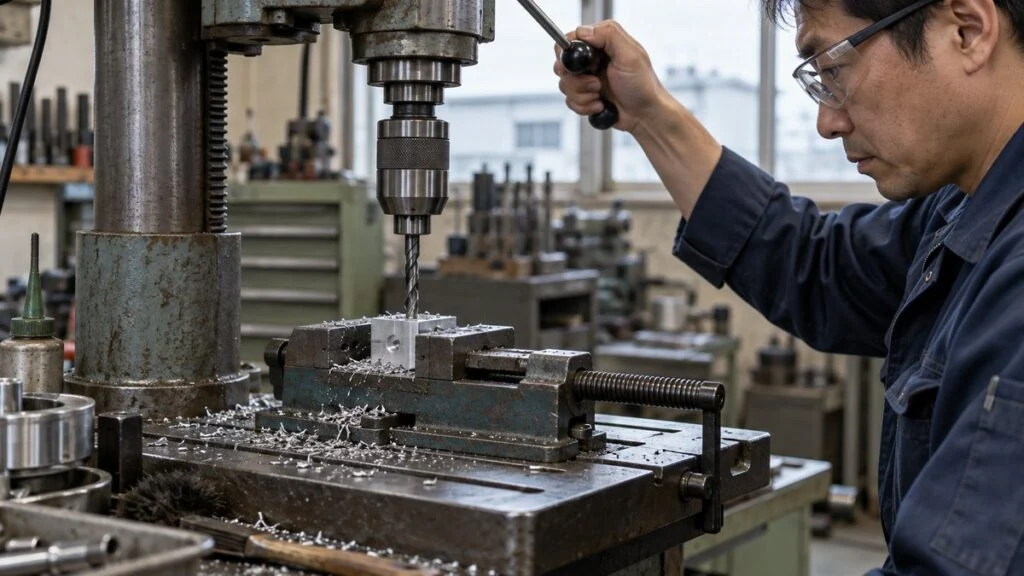
The example below shows how a team might fill in a KYT sheet. The task is fictional: drilling four holes in a small aluminum plate on a bench drill press. It does not describe any real workplace or accident, and it is not a work instruction for this task.
Fictional training example, not a work instruction. Round 1 pairs each cause with its result. From Round 3 on, every line is an action someone can check.
2. Because I wear cotton work gloves, the glove catches on the rotating drill and my fingers are injured
3. Because I brush chips away with my bare hand, a sharp chip cuts my hand
4. Because I am not wearing safety glasses, a flying chip gets in my eye
5. Because my cuffs are loose, a sleeve gets caught in the rotating parts
6. Because the parts bin sits on the floor by my feet, I trip and fall
Double circle: 1 "Because I hold the part by hand, it spins and hits my hand"
Double circle: 2 "The glove catches on the rotating drill and my fingers are injured"
Team ideas for 2: take gloves off before stepping up to the machine / keep gloves on a shelf away from the machine
* Take gloves off before working
Team action target: "When we use the drill press, we will clamp the part in the vise and take our gloves off before drilling — Yoshi!"
"No gloves — Yoshi!"
Fictional example. For real work, follow your plant's work standards, your local regulations, and the machine's instruction manual. Items 3–5 (removing chips with a brush after the spindle stops, wearing safety glasses, fastening cuffs) are assumed to be covered separately by the plant's work standard.
In Japan, the glove countermeasure in this example is backed by law. Article 111 of the Ordinance on Industrial Safety and Health prohibits employers from letting workers wear gloves on drill presses, chamfering machines, and similar machines with rotating cutting tools where a hand could be caught. Rules outside Japan may differ, so check with your EHS team and local regulations.
KY countermeasures often turn out to be rules already written in a regulation or work standard. Round 3 can also produce equipment ideas, such as "add a fixture to locate the part" or "keep the vise mounted permanently."
These ideas cannot become action targets on the spot. The plant needs a route for them, such as a note in the margin of the KYT sheet that the team leader passes to a manager or production engineering. With that route in place, KY becomes a starting point for equipment improvements.
Three mistakes are common. In Round 1, the team lists only an accident type, such as "watch out for entanglement." In Round 2, it marks three or four double circles. In Rounds 3 and 4, it writes only "do a safety check." In each case, the crew doing the same job the next day cannot tell what to check.
Blank KYT Sheet Template
You can copy this layout into a spreadsheet or print it for the line. The prompts in each row repeat the rules above, which helps new leaders keep the session on track.
| Field | What to write | Check before moving on |
|---|---|---|
| Date / team / leader / recorder | Basic session details | Team of about 5–6 people |
| Task or illustration | One short sentence describing the task and its conditions today | Does it include what is different today? |
| R1: What hazards are hidden here? | Numbered list: "Because [cause], [what happens], and [accident type]" | Both worker actions and workplace conditions (equipment, storage, floor)? No criticism? |
| R2: These are the danger points | Circle the important items; double-circle and underline 1–2 danger points | No more than two double circles? |
| R3: What would you do? | About three concrete actions per danger point | Could someone else see whether it was done? No "be careful"? |
| R4: This is what we will do | Priority actions (asterisk) and a team action target: "When…, we will… — Yoshi!" | One priority action per danger point? Short enough to remember? |
| Pointing and calling items | Short phrases, e.g. "[Object] [status] — Yoshi!" | Said while pointing at the real object? |
| Equipment or procedure ideas | Ideas that need a manager, engineering, or a procedure change | Who receives it, and by when? |
Running Short KY Before Work Every Day
Few plants have time to run the full 4-Round Method every morning before the shift, so Japanese plants use shorter methods that keep the same logic.
JISHA groups these methods by level. Teams use one-point KY or short-time KYT (SKYT). People who give work directions use work-direction STK training and KY by asking questions. Individuals use individual KYT or a self-questioning card.
Crews use one method as a team before the shift, another alone at the workstation, and pointing and calling at key points in the job.
Source: compiled by MONOSCOPE from JISHA, "Concept of Zero-accident Total Participation Campaign"; Tokyo Labor Standards Association Federation guide; Safety Technology Association for Construction and Cargo Handling Vehicles, "KY Activity Practice Guide."
KY in the Toolbox Meeting
The name toolbox meeting (TBM) comes from crews meeting by the toolbox to plan the job. A guide from the Tokyo Labor Standards Association Federation describes hazard prediction as the core of a TBM, and says crews typically hold it for about 5–10 minutes before work starts in the morning.
Crews can also hold a TBM after lunch or when they switch jobs. The team leader explains the day's work scope, setup, and assignments, and the whole crew confirms the safety points.
A guide from the Safety Technology Association for Construction and Cargo Handling Vehicles describes a focused 3–5 minute session at the work location. The crew uses a KY board with three fields: the work, the danger points, and "This is what we will do."
Line work in a factory looks the same every day, but something usually changes: a changeover, a helper from another line, a machine acting up, a new material lot. Starting TBM-KY with "What is different today?" gives the crew a new topic every day without extra effort.
One-Point KY and Individual KY
One-point KY is one of the basic applied methods that JISHA teaches alongside the KYT Basic 4-Round Method in its training courses. JISHA classifies it as a team-level method, and because it is short, it fits easily into a morning TBM.
Individual KY is hazard prediction that a worker does alone at the workstation before starting. A guide from a Japanese construction safety training association describes the flow: during the pre-start inspection, the worker points at a short list of check items, then turns an action target based on the expected hazards into a pointing and calling item and says it out loud.
Another approach is working through a self-questioning card out loud. It helps in situations where a team KY is hard to run, such as solo work and night shifts.
Shisa Kanko (Shisa Kosho): Pointing and Calling
Pointing and calling (shisa kosho or yubisashi kosho, 指差し呼称; Japanese railways also call it shisa kanko, 指差喚呼) is a routine in which workers point at an object, sign, signal, or gauge and say its name and status out loud. According to MHLW's Workplace Safety Site, it began with steam locomotive drivers at Japanese National Railways checking signals. Today, many industries in Japan use it, including manufacturing.
Look, point, check at the ear, and swing down: four motions that make each check more reliable.
Source: compiled by MONOSCOPE from MHLW Workplace Safety Site, "Pointing and Calling." The site recommends placing your left hand on your hip, standing straight, and moving briskly.
A frequently cited study is a 1994 experiment by the Railway Technical Research Institute. According to MHLW's Workplace Safety Site, the error rate for pressing the wrong button was 2.38% with neither pointing nor calling, 1.0% with calling only, and 0.75% with pointing only.
With both pointing and calling, the rate fell to 0.38%, about one-sixth of the rate with neither. This was a lab result for button-pressing errors. It does not show that a plant's injury rate will drop to one-sixth.
The Workplace Safety Site itself says pointing and calling alone cannot eliminate human error. It describes the method as an effective way to raise alertness and make each check more accurate.
Related: Standardized Work Instructions: Sagyo Hyojunsho Template
KY vs. Risk Assessment vs. JHA/JSA
KY is often compared with risk assessment. Both aim to find hazards in advance, but they differ in timing, scope, and the kind of countermeasures they produce. A guide from Japan's Land Transportation Industry Accident Prevention Association sets out the differences in a table.
KY helps the crew avoid hazards right before work. Risk assessment reduces the hazards themselves.
Source: compiled by MONOSCOPE from the comparison table in Land Transportation Industry Accident Prevention Association, "Introduction to Risk Assessment."
The two work together. The implementation notice for MHLW's risk assessment guideline lists materials to consult during an assessment. One of them is the results of hazard prediction activities (KYT). Hazards that keep appearing in KY can feed into decisions on equipment or procedure changes.
Related: Risk Assessment in Japanese Plants vs. JHA, HSE, ISO 12100
KY vs. Job Hazard Analysis (JHA)
US readers may know the Job Hazard Analysis (JHA), also called a Job Safety Analysis (JSA). OSHA's booklet Job Hazard Analysis (OSHA 3071) defines it as a technique that focuses on job tasks to identify hazards before they occur. It looks at the relationship between the worker, the task, the tools, and the work environment.
Both methods look for hazards before work and involve the people who do the job. The difference is depth and frequency. A JHA breaks a job into steps and produces a written analysis that is reviewed periodically. KY is a short spoken routine repeated every day for the conditions in front of the crew.
| KY (kiken yochi) | JHA / JSA (OSHA 3071) | |
|---|---|---|
| Unit of analysis | Today's task and today's conditions | A job, broken down into steps |
| Which jobs | Every job, every day | Priority goes to jobs with the highest injury or illness rates; jobs that could cause severe injury, or where one simple error could cause a severe accident; new or changed jobs; and jobs complex enough to need written instructions |
| Who | The crew and its leader, on site | Employers, foremen, and supervisors, with employees involved in every phase |
| Output | 1–2 danger points, a team action target, and pointing and calling items | A written analysis of hazards and controls for each step (OSHA provides a sample form) |
| Review | Repeated each shift or job | Reviewed periodically, and especially after an injury or illness on that job |
| Main purpose | Sharpen awareness and agree on behavior right before work | Find uncontrolled hazards and set proper job procedures and controls |
In our reading, a JHA sits closer to the risk assessment column in Figure 6 than to KY. A plant that already has JHAs does not have to choose between them. The JHA sets the procedure and controls for the job, and daily KY checks what is different today. Repeated KY findings can then trigger a JHA review.
KY and Equipment Safeguards
MHLW's risk assessment guideline sets an order of priority for risk reduction measures. First come inherent measures at the design and planning stage, such as eliminating or changing a hazardous task. Next come engineering controls, such as interlocks and local exhaust ventilation. Then come administrative controls, such as manuals and training, and last, personal protective equipment. Readers outside Japan will recognize this as the hierarchy of controls.
KY handles, day to day, the hazards that higher-level measures have not removed.
Source: compiled by MONOSCOPE from MHLW, "Guidelines for Investigation of Danger or Harm" and its implementation notice. Placing KY under administrative controls is MONOSCOPE's interpretation.
JISHA also says that preventing human-error accidents starts with safety measures on the hardware side: equipment, machinery, and the work environment. KYT and pointing and calling are the people-side measures that go with them.
Running KY every day on a machine with an entanglement hazard does not fix a missing guard or interlock. For maintenance work on stopped equipment, confirming hazards in KY is not enough either. Those jobs need an energy control system such as lockout/tagout, in which energy sources are isolated and secured with locks and tags.
Related: Lockout/Tagout in Japan: Japanese Law vs. OSHA 1910.147
KY and Japanese Law
Based on our review of Japan's Industrial Safety and Health Act and its Ordinance, no article requires KY activity by name. Not running KY is not, by itself, a violation of these laws. Japanese law also does not govern plants in other countries, so a parent company's request for KY is a matter of company safety practice.
Related rules do exist. The Act asks manufacturers and other employers to assess hazards and act on the results, but as an "effort" duty rather than a strict obligation (assessment of certain chemicals is mandatory under a separate article). It also requires safety and health training for new hires, for workers whose tasks change, and for newly appointed foremen in manufacturing and other designated industries. Article 40 of the Ordinance lists the content of foreman training, including hazard assessment and measures based on it, and ways to keep workers interested in accident prevention and draw out their own ideas. KY is best seen as one practical way to carry out this training and voluntary safety activity on the floor.
Why KY Turns Into a Formality, and What Helps
No public source we found lists all the reasons KY becomes a formality. The table below groups common symptoms and remedies, based on the methods described by JISHA, MHLW, and Japanese industry associations.
Teaching material from a Japanese construction safety training association warns that simply going through the motions of pointing and calling and KYT does not make a real Zero-accident Campaign. Unless each person treats safety as their own concern and takes part voluntarily, the activity soon runs out of steam. A formality is a problem of method, but also of how the people running the program approach it.
Each symptom is matched with a likely cause and what to try.
Symptom grouping is MONOSCOPE's. Remedies are based on methods described by MHLW, JISHA, the Tokyo Labor Standards Association Federation, the Safety Technology Association for Construction and Cargo Handling Vehicles, and a Japanese construction safety training association.
Change the Topic Every Day
Where entries repeat, the fix starts with the topic. The Safety Technology Association guide lists tips for successful KYT: choose familiar themes from daily work, keep the situation narrow, and look at problems from every angle instead of only unsafe behavior.
Near misses reported on your own floor are an easy source of topics. The Tokyo Labor Standards Association Federation guide recommends using accumulated near-miss reports in KYT. It also suggests using the near-miss and accident illustrations on MHLW's Workplace Safety Site as training material.
Turn "Be Careful" into Actions
MHLW's method asks teams to state Round 3 countermeasures as concrete, practical actions. Guidance on individual KY also stresses avoiding vague wording and setting specific, easy-to-understand action targets.
A simple test is whether a third person could look and say "done" or "not done." "Watch your step" fails that test. "Do not leave parts bins in the aisle" and "push carts, do not pull them" pass it.
A leader who asks, "Is that something we could see someone doing?" will get better targets.
Show Management Interest
In an interview published by the Anshin Foundation, the head of JISHA's Zero-accident Promotion Center describes the effect of leaders and managers asking questions such as "What's the hazard in today's job?" and "What pointing and calling did you choose this morning?" He says those questions give workers a sense of ownership and take away the feeling that KY is imposed on them.
Reading the KY board and saying something about it is the easiest support a manager can give. When the same hazard keeps appearing, it usually points to a cause left in equipment or procedures, not to a lack of attention by workers.
When action targets handle the immediate hazard and improvement ideas feed into equipment changes and work standard revisions, KY stops being a morning formality and starts changing the workplace.
Related: Why 5S Doesn’t Stick: Causes, Fixes, and the Japanese Terms
Adapt KY for Plants Outside Japan
For teams that include foreign workers or new hires, the terms "KY" and "TBM" are usually unfamiliar. The Tokyo Labor Standards Association Federation guide stresses explaining the purpose and methods of the activity in full, and making it easy for people to speak honestly. Japanese guidance says this for mixed teams inside Japan, and the same need applies when a whole plant is new to KY.
Illustrations, photos, and real objects that people can point at are easier to share across a language barrier. Before rolling out materials from Japan, check the following points with your team and with the Japanese side:
- Language: Are the KYT sheet and KY board in the language the crew actually speaks on the floor, not only in Japanese or English?
- Purpose: Has someone explained why the team says "Yoshi!" and points, rather than just asking them to copy the motions? Do you use "Yoshi" or a local word?
- Illustrations: Do the illustration sheets show your machines and your layout, or a Japanese plant your crew has never seen?
- Speaking up: Can workers name a hazard in front of their supervisor without it being taken as a complaint?
- Follow-up: Who receives equipment ideas from KY sheets, and how does the team hear back?
- Fit with existing systems: How should KY connect to your existing JHAs, risk assessments, permit-to-work, and lockout/tagout procedures?
Questions worth asking the Japanese parent company include: Which KY methods does it expect (full 4-round training, one-point KY, individual KY)? How often? What records does it want to see, and who reviews them? Is there a training course or trainer for team leaders?
How to Start or Restart KY
Whether you are launching KY or rebuilding a program that has become a formality, this order tends to make it stick better than starting with a daily KY board right away:
- Train with the 4-Round Method: Team leaders go through all four rounds with an illustration sheet and learn the flow and the phrasing.
- Add short KY every morning: Build one-point KY into the TBM and agree on the danger point and action target.
- Review the records: Once a week, look back over the KY board and pick out repeated hazards and equipment ideas.
- Connect to improvements: Pass repeated hazards into risk assessment or work standard reviews, and report the results back to the team.
In Japan, team leaders can attend courses run by JISHA and regional safety associations. JISHA's one-day course, for example, covers the philosophy of the Zero-accident Campaign and the KYT Basic 4-Round Method, with hands-on practice in applied methods such as one-point KYT.
Limits of This Guide
- The method described here follows JISHA and MHLW materials. Companies may adapt it, so check your parent company's KY manual for its own round names, sheet layout, and calls.
- The drill press sheet is a fictional training example. It is not a safe work procedure. Actual rules come from your plant's work standards, the machine manual, and local regulations.
- Japanese laws mentioned here apply in Japan. At plants in India, Southeast Asia, or the US, check local law with your EHS team.
- KY supports, but does not replace, engineering controls, lockout/tagout, risk assessment, or JHA.
- The 1994 pointing and calling result measured button-pressing errors in a lab. It does not predict a plant's injury rate.
- KY has two layers: training (KYT) that teaches the pattern, and short pre-work KY with pointing and calling.
- The KYT Basic 4-Round Method opens up and narrows down twice: spot the hazards, pick the danger points, plan countermeasures, set targets.
- Countermeasures and action targets work best as concrete actions someone can check.
- No Japanese law requires KY by name, and KY does not replace equipment or procedure measures.
- Hazards that keep coming up in KY can feed into risk assessment or JHA reviews.
- To keep KY alive, change the topic daily, have managers ask about it, and give improvement ideas a route upward.
FAQ
What does KY stand for in Japanese safety?
KY stands for kiken yochi, meaning "hazard prediction." KYT is kiken yochi training, the small-group exercise, and KYK (kiken yochi katsudo) is the broader daily program of hazard prediction activities.
What are the four rounds of KYT?
The four rounds are Round 1, "What hazards are hidden here?"; Round 2, "These are the danger points"; Round 3, "What would you do?"; and Round 4, "This is what we will do." The team lists hazards, narrows them to 1–2 danger points, suggests countermeasures, then agrees on priority actions and a team action target.
How long should daily KY take?
Japanese guides describe a TBM before the morning shift of about 5–10 minutes, and some describe focused 3–5 minute sessions at the work location. Full 4-round training takes longer, so plants usually run it separately from the daily routine.
Is KY the same as a Job Hazard Analysis?
No. A JHA breaks a job into steps and records hazards and controls in a written analysis that is reviewed periodically. KY is a short, spoken routine repeated each day for the current conditions. Many plants can use both: the JHA sets the procedure, and KY checks what is different today.
Does pointing and calling (shisa kanko) really reduce errors?
In a 1994 lab experiment by Japan's Railway Technical Research Institute, button-pressing errors fell from 2.38% with neither pointing nor calling to 0.38% with both, about one-sixth. MHLW notes that pointing and calling alone cannot eliminate human error.
Sources
- Japan Industrial Safety & Health Association (JISHA), "Concept of Zero-accident Total Participation Campaign" (English); Japanese version
- JISHA, "What Is KYT?" and "How to Run KYT" (Japanese)
- MHLW Workplace Safety Site, "Hazard Prediction Training (KYT)" and "Pointing and Calling" (Japanese)
- MHLW, Safety and health training manual for inexperienced workers in manufacturing (Japanese)
- Rodo Shimbun, Anzen Staff, feature on KY at Sumitomo Metal Industries Kashima Steel Works (July 1, 2012, Japanese)
- JISHA Kanto Safety and Health Service Center, one-day KYT course (Japanese)
- Tokyo Labor Standards Association Federation, "Chapter 5: Daily Safety and Health Activities" (Japanese)
- Safety Technology Association for Construction and Cargo Handling Vehicles, "KY Activity Practice Guide" (March 2011, Japanese)
- Japanese construction safety training association (Tokubetsu Kyoiku Kyokai), "Individual KY" and "What Is the Zero-accident Campaign?" (Japanese)
- Anshin Foundation, interview on KYT and the Zero-accident Campaign (March 2020, Japanese)
- Land Transportation Industry Accident Prevention Association, "Introduction to Risk Assessment" (Japanese)
- MHLW, guidelines on investigating danger or harm (risk assessment) and commentary (Japanese)
- e-Gov Laws, Industrial Safety and Health Act (Articles 28-2, 59, 60) and Ordinance on Industrial Safety and Health (Articles 40, 111) (Japanese)
- US Occupational Safety and Health Administration (OSHA), Job Hazard Analysis (OSHA 3071)
Original article in JapaneseThis guide is adapted from a MONOSCOPE article written for readers in Japan: KY活動(危険予知活動)のやり方|4ラウンド法と形骸化させない工夫
About the editor
 MONOSCOPE EditorFOUNDER & EDITOR
Spent about ten years at a plant equipment maker and a plant engineering company, proposing, designing, and commissioning equipment, then moved into web marketing. Now a web consultant for B2B manufacturers, helping them explain their products and technology. Licensed in Japan as an Energy Manager and a Third-Class Chief Electrical Engineer.
Has run an engineering blog since 2017 (500+ articles) and a Japanese YouTube channel with about 20,000 subscribers. Each English guide is written from the Japanese shop-floor point of view and checked against the cited standards.