Class 1 vs Class 2 Pressure Vessels in Japan: PV Value Chart
A Japanese customer's spec says the air receiver you are quoting must not be a dai-nishu atsuryoku yoki. A process engineer at your Japanese parent company asks whether a new steam-heated exchanger is "ichi-atsu." Or a vessel your shop built to ASME Section VIII is headed for a plant in Japan, and the buyer wants to know which inspections it needs there. In each case, the question is the same: which class of pressure vessel is this under Japanese law?
The short answer: Japan's Industrial Safety and Health Act splits pressure vessels into two main groups. Class 1 pressure vessels (dai-isshu atsuryoku yoki, 第一種圧力容器) heat, react, or evaporate something inside, or store liquid above its atmospheric boiling point. Class 2 pressure vessels (dai-nishu atsuryoku yoki, 第二種圧力容器) store gas at 0.2 MPa gauge (about 29 psig) or higher. A full Class 1 vessel needs a yearly statutory inspection plus a monthly self-inspection. A Class 2 vessel needs a self-inspection once a year.
Which class a vessel falls into depends on four things: what it holds and how it is used, its maximum allowable working pressure, its internal volume, and the inside diameter and length of its shell. This guide walks through each one, with a quick-reference chart, worked PV-value examples, the inspection flow, a decision flowchart, and a checklist you can send to the Japanese side.
Contents
- What Counts as a Pressure Vessel in Japan
- Class 1 vs. Class 2 Pressure Vessels
- Class 1 Sub-Classes and the PV Value
- Class 2 Sub-Classes and Size Rules
- Inspections and Paperwork by Class
- Operating Chief and Licensed Work
- How to Classify a Vessel: Decision Flowchart
- Checklist: What to Confirm with the Japanese Side
- Limits of This Guide
- FAQ
- Sources
What Counts as a Pressure Vessel in Japan
Under Japanese law, a pressure vessel is a vessel whose internal pressure exceeds atmospheric pressure, other than a boiler. Heat exchangers, autoclaves, distillation stills, and compressed-air tanks are typical examples.
Boilers are a separate category. A boiler heats water with fire or another heat source to make steam or hot water above atmospheric pressure and sends it somewhere else. Many pressure vessels sit on the receiving end of that steam.
Gas cylinders and other high-pressure gas containers fall under a different law, the High Pressure Gas Safety Act. Vessels regulated by that act, the Electricity Business Act, or the Gas Business Act are exempt from the Industrial Safety and Health Act's manufacturing-permit and inspection rules. Some duties still apply, though, such as appointing an operating chief for a Class 1 vessel.
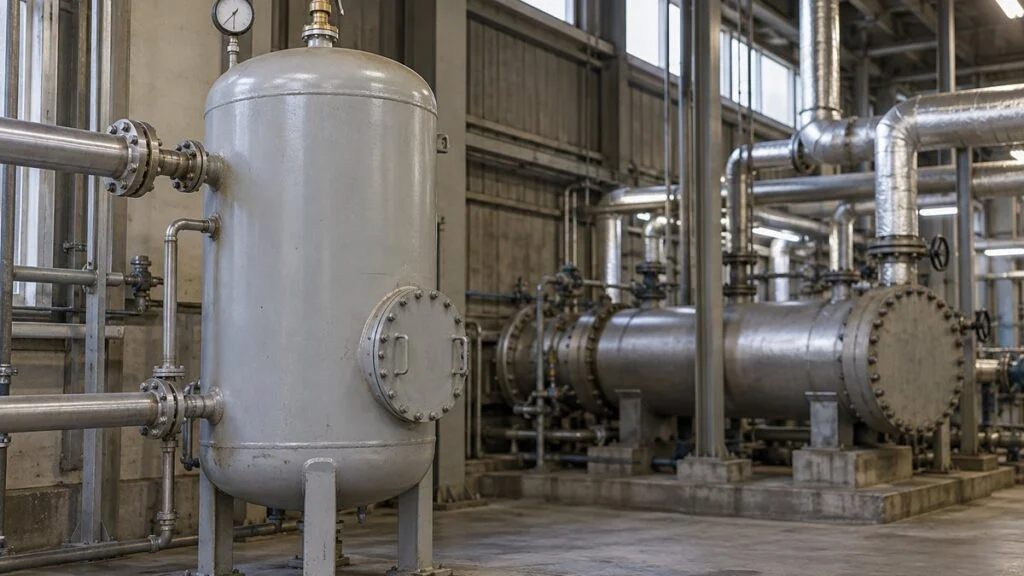
A steam-heated exchanger is often a Class 1 vessel. A compressor's air receiver is often a Class 2 vessel.
Typical examples only. The actual class depends on use (heating, reaction, evaporation, or gas storage), maximum allowable working pressure, internal volume, and shell inside diameter and length.
Because a vessel under internal pressure can do serious damage if it ruptures, the Industrial Safety and Health Act regulates it in three ways:
- Construction requirements are set by government codes, such as the Construction Code for Pressure Vessels.
- Statutory inspections apply at manufacture and installation (welding inspection, structural inspection, completion inspection, and others).
- After installation, the vessel stays under a cycle of performance inspections or periodic self-inspections.
The law divides pressure vessels into Class 1 and Class 2. Smaller Class 1-type vessels become small pressure vessels (kogata atsuryoku yoki), and vessels too small for either class are informally called simple vessels (kan'i yoki).
This classification is Japanese law and applies to vessels used in Japan. At a plant outside Japan, your local code and regulator still decide what is required. Outside Japan, you are most likely to meet these terms in specs and drawings written by Japanese engineers, or when a vessel is headed for Japan.
Class 1 vs. Class 2 Pressure Vessels
On the shop floor, Japanese engineers often shorten Class 1 to ichi-atsu (一圧) and Class 2 to ni-atsu (二圧). The table below shows how the two classes differ.
| Item | Class 1 (ichi-atsu) | Class 2 (ni-atsu) |
|---|---|---|
| Contents and use | Heating, reaction, or evaporation; liquid above its atmospheric boiling point | Stores gas at 0.2 MPa gauge (about 29 psig) or higher |
| How the class is decided | PV value, plus shell inside diameter and length | Internal volume, plus shell inside diameter and length (PV value not used) |
| At manufacture and installation | Manufacturing permit and structural inspection; installation notice and completion inspection | Must pass individual certification |
| After installation | Performance inspection, normally every year, plus monthly self-inspection | Self-inspection at least once a year |
| Operating chief | Required, with exemptions for smaller vessels | Not required |
| Typical equipment | Steam-heated heat exchangers, autoclaves | Compressor air receivers |
The real difference is what is inside the vessel and what happens to it:
- Class 1: vessels in which heating, reaction, or evaporation generates vapor, and vessels that store liquid above its boiling point at atmospheric pressure
- Class 2: vessels that store gas at 0.2 MPa gauge or higher, unless they already count as Class 1
Class 1 is sometimes described as "a vessel holding saturated liquid," but the law defines four types. The class turns on what the vessel does, not only on the state of its contents.
Heaters, reactors, and evaporators qualify when internal pressure exceeds atmospheric pressure. Accumulators qualify when they store liquid above its atmospheric boiling point (Enforcement Order, Article 1, item 5).
Example equipment is from a 2006 Ministry of Health, Labour and Welfare (MHLW) study group paper. Use and size decide the class, not the equipment name.
The two classes are separated because a rupture does far more damage in a Class 1 vessel. Hot liquid that was kept liquid only by pressure flashes to vapor the moment the pressure drops, and the sudden expansion makes the burst much more violent. That is why Class 1 rules are stricter. Each class also splits into smaller sub-classes, covered next. If you just want to classify a specific vessel, skip ahead to the decision flowchart.
Class 1 Sub-Classes and the PV Value
Vessels of the Class 1 type fall into three tiers by size and pressure. From strictest to lightest: Class 1 pressure vessel > small pressure vessel > simple vessel. "Simple vessel" is not a term defined in the law. It is an informal name for the vessels listed in Article 13, paragraph 3, item 26 of the Enforcement Order, which only have to be built to the Construction Code for Simple Boilers, etc.
Japanese law uses two tests: maximum allowable working pressure times internal volume (the PV value), and shell dimensions. If a vessel meets the condition for a lighter tier under either test, it goes into the lighter tier.
- Not Class 1: PV ≤ 0.004, or at 0.1 MPa or less, "volume ≤ 0.04 m³" or "inside diameter ≤ 200 mm and length ≤ 1,000 mm"
- Small pressure vessel: PV ≤ 0.02, or at 0.1 MPa or less, "volume ≤ 0.2 m³" or "inside diameter ≤ 500 mm and length ≤ 1,000 mm"
Classifying by PV Value
With P as the maximum allowable working pressure in MPa (gauge) and V as the internal volume in m³, the PV value sorts Class 1-type vessels as shown below. The thresholds work only in these units, so convert psi and gallons before you calculate.
A value exactly on a boundary goes into the lighter tier ("or less" is the lighter side).
P = maximum allowable working pressure in MPa (gauge); V = internal volume in m³. Rules get stricter toward the top. Use this scale only for Class 1-type vessels (heating, reaction, evaporation, or liquid above its boiling point), never for Class 2.
The pressure that counts is the maximum gauge pressure the vessel's construction allows, not the normal operating pressure (Ordinance on Safety of Boilers and Pressure Vessels, Article 1). In practice, take it from the vessel's specification sheet or drawing. Plugging in the operating pressure from a gauge reading can put the vessel in a lighter class than it really belongs to.
Safety valves are set to open at or below the maximum allowable working pressure (Article 65 of the same Ordinance). If a vessel has two or more safety valves, the second and later ones may be set up to 3% above it. Check the design pressure and the relief valve settings together when you classify a vessel.
Use gauge pressure, not absolute pressure, in the PV calculation. Absolute pressure inflates the PV value and can push a vessel into a stricter class than the law intends.
Fictional numbers to show how each tier is reached.
Example A is a Class 1 vessel, but because it is a heater with an internal volume of 5 m³ or less, it does not need an operating chief (Enforcement Order, Article 6, item 17). It still needs the performance inspection and the monthly self-inspection.
Classifying by Shell Diameter and Length
For vessels with a maximum allowable working pressure of 0.1 MPa gauge (about 14.5 psig) or less, the shell's inside diameter and length also decide the tier.
If either dimension exceeds the box for a lighter tier, the size test alone does not move the vessel down.
200 mm ≈ 7.9 in, 500 mm ≈ 19.7 in, 1,000 mm ≈ 39.4 in. A volume or PV test that gives a lighter tier still wins.
- Inside diameter ≤ 200 mm and length ≤ 1,000 mm: not Class 1 (simple vessel or not covered)
- Inside diameter ≤ 500 mm and length ≤ 1,000 mm: small pressure vessel
- Inside diameter > 500 mm or length > 1,000 mm: Class 1 by the size test (a lighter tier by volume or PV value still applies)
Vessels at 0.1 MPa or less also have volume conditions (0.04 m³ or less is excluded; 0.2 m³ or less is a small pressure vessel). At that pressure, though, those volumes always give PV ≤ 0.004 and PV ≤ 0.02 anyway. So for low-pressure vessels, the shell-dimension test is the one that adds something beyond the PV value. Watch long, slender vessels with a large volume: once the shell is longer than 1,000 mm, the size test no longer helps.
For borderline details, such as how shell length is measured, check with the manufacturer or the local Labour Standards Inspection Office. Closed expansion tanks on hot-water systems are one familiar case that can fall into Class 1 or Class 2, depending on water temperature and pressure.
Class 2 Sub-Classes and Size Rules
The Class 2 side has only two tiers: Class 2 pressure vessel and simple vessel, with Class 2 the stricter. Class 2 does not use the PV value. A vessel that stores gas at 0.2 MPa gauge or higher and meets either size condition is Class 2. One condition is based on internal volume and the other on shell dimensions.
Classifying by Pressure and Volume
- 0.2 MPa or higher and volume 0.04 m³ (40 L, about 10.6 US gal) or more: Class 2 pressure vessel (Enforcement Order, Article 1, item 7(a))
- Above atmospheric pressure but below 0.2 MPa, and volume over 0.1 m³ (100 L): simple vessel (Article 13, paragraph 3, item 27)
- Anything else (for example, below 0.2 MPa and 0.1 m³ or less): not covered
Take a 0.5 m³ (500 L, about 132 US gal) air receiver at a compressor outlet, used at 0.93 MPa (about 135 psig). It is above 0.2 MPa and over 0.04 m³, so it is a Class 2 pressure vessel. The same 0.5 m³ tank used only up to 0.15 MPa is not Class 2. Because it exceeds 0.1 m³, it is a simple vessel and must be built to the applicable construction code.
Classifying by Shell Diameter and Length
This test applies to gas vessels at 0.2 MPa or higher.
An inside diameter of 200 mm or more and a length of 1,000 mm or more make a Class 2 vessel even below 0.04 m³.
Enforcement Order, Article 1, item 7(b). A gas vessel at 0.2 MPa or higher, under 0.04 m³ and outside the size box, is not covered. It cannot be a simple vessel either, since that tier requires more than 0.1 m³.
A slender shell can make a small vessel Class 2. A cylinder with a 200 mm inside diameter and 1,000 mm length holds about 0.031 m³, short of 0.04 m³, yet it is Class 2 by the size test. On the other hand, a 0.03 m³ tank used at 0.9 MPa with a 250 mm by 600 mm shell meets neither condition and is not covered. Only gas vessels below 0.2 MPa can be simple vessels.
Inspections and Paperwork by Class
Each tier has its own procedures at manufacture and installation, plus recurring inspections afterward:
- Class 1 pressure vessel: performance inspection (seino kensa) by a registered inspection body such as the Japan Boiler Association, normally every year, to renew the inspection certificate, plus a periodic self-inspection at least once a month
- Small pressure vessel: periodic self-inspection at least once a year
- Class 2 pressure vessel: periodic self-inspection at least once a year
- Simple vessel: no periodic inspection or self-inspection rule (the vessel must meet the construction code)
Small pressure vessels, Class 2 vessels, and simple vessels need no installation notice and no inspection at installation.
Periodic self-inspections cover damage to the vessel body, wear of cover bolts, and damage to piping and valves. Results must be recorded and kept for three years (Ordinance, Articles 67, 88, and 94). Class 1 vessels have inspections at every stage from manufacture to use, split between the manufacturer and the user.
Steps split between the manufacturer and the company that installs and uses the vessel.
Ordinance on Safety of Boilers and Pressure Vessels, Articles 49–75; Industrial Safety and Health Act, Article 88. Depending on the performance inspection result, the certificate may be renewed for less than one year or for more than one year up to two years.
A performance inspection requires preparation such as cooling and cleaning the vessel (Ordinance, Article 75), so the equipment has to stop each time. That production impact is why Japanese engineers designing plant tanks try to keep them out of Class 1 where they can. When that is not possible, a common approach is to schedule the performance inspection inside a planned shutdown so the plant stops only once.
For how Japanese plants plan those shutdowns, see Teishu (Plant Turnaround) in Japan.
Procedures continue after installation. Modifying the shell or heads requires a modification notice and a modification inspection. Restarting a vessel after a suspension requires a re-use inspection, and taking it out of service means returning the inspection certificate.
Vessels Built Outside Japan
If you fabricate or supply a vessel that will be used in Japan, the Japanese class still applies. According to the Japan Boiler Association, Class 1 vessels are inspected at each stage, including manufacture, import, and installation. Small pressure vessels and Class 2 vessels must pass individual certification (kobetsu kentei) at manufacture or import. Imported Class 1 vessels go through the use inspection shown in Figure 7.
Some inspection organizations outside Japan are recognized by Japan's Ministry of Health, Labour and Welfare (MHLW) to inspect pressure equipment for the Japanese market. Apave, LRQA, and TÜV Rheinland all describe services of this kind. MHLW has also issued guidance on how use inspections and individual certifications are handled when an application includes a conformity certificate from a designated foreign inspection agency. Which route applies to your vessel, and what the Japanese inspection body will still check, is a question to settle with the importer and the inspection body before fabrication starts.
An ASME code stamp does not, by itself, show compliance with Japan's Construction Code for Pressure Vessels. In a 1998 government report, Japan's then Ministry of Labour said vessels built to ASME standards can be recognized as conforming, with equivalence documents reviewed case by case. Practice may have changed since then, so confirm the current requirements before you assume an ASME design will be accepted as-is.
Operating Chief and Licensed Work
Work handling a Class 1 vessel requires the employer to appoint a Class 1 pressure vessel operating chief (sagyo shunin-sha, Enforcement Order, Article 6, item 17). Some vessels in the Class 1 range are exempt:
- Small pressure vessels
- Heaters (Article 1, item 5(a)) with an internal volume of 5 m³ or less
- Reactors, evaporators, and accumulators (items 5(b)–(d)) with an internal volume of 1 m³ or less
The operating chief must hold a Japanese qualification, and which one depends on whether the vessel is part of chemical equipment (Ordinance, Article 62):
- Class 1 vessels in chemical equipment: a person who has completed the skill training course for Class 1 pressure vessel operating chiefs (chemical equipment)
- Other Class 1 vessels: a licensed boiler engineer (special, first, or second grade), or a person who has completed either the chemical-equipment or the general Class 1 pressure vessel operating chief course
- Class 1 vessels also regulated by the High Pressure Gas Safety Act or similar laws: holders of the specified Class 1 pressure vessel operating chief license are also eligible
The chief's duties include keeping pressure from exceeding the maximum allowable working pressure and keeping the safety valves working. When the vessel is first used or its contents change, the chief explains the work method and directly supervises the work. The chief also checks temperature and pressure inside the vessel as needed, acts at once on any abnormality, records operating conditions, and hands them over at shift change (Article 63). The chief's name must be posted where it is easy to see at the vessel's location (Article 66).
Some other work on Class 1 vessels in Japan also needs licensed personnel. Welding requires a licensed special boiler welder (an ordinary boiler welder may weld parts 25 mm thick or less, among other cases). Maintenance of Class 1 vessels large enough to need an operating chief is reserved for licensed boiler maintenance workers (Enforcement Order, Article 20; Ordinance, Articles 55 and 70). Class 2 vessels, small pressure vessels, and simple vessels have no operating-chief requirement.
How to Classify a Vessel: Decision Flowchart
Work through the questions in order: contents and use first, then pressure, then size. Treat the result as a screening answer. When the classification is unclear, consult the manufacturer, the local Labour Standards Inspection Office, or the Japan Boiler Association.
Start at the top. P = maximum allowable working pressure (MPa, gauge); V = internal volume (m³).
- YesThat law applies (exempt from the Industrial Safety and Health Act's permit and inspection rules; the Class 1 operating-chief duty remains)
- NoGo to Q2
- YesClass 1 side. Go to Q3
- NoIf it stores only gas, go to Q5
- YesNot Class 1. Simple vessel if PV > 0.001; not covered if PV ≤ 0.001 (or at 0.1 MPa or less with V ≤ 0.01)
- NoGo to Q4
- YesSmall pressure vessel
- NoClass 1 pressure vessel (check volume to see whether an operating chief is needed)
- YesClass 2 pressure vessel
- NoSimple vessel if below 0.2 MPa with V > 0.1; otherwise not covered
Vessels for ships under the Ship Safety Act and vehicle fuel systems, among others, are also excluded. When in doubt, check with the local Labour Standards Inspection Office or the Japan Boiler Association.
Example A's heat exchanger answers "yes" at Q2 and "no" at Q3 and Q4, so it is a Class 1 vessel. The 0.93 MPa, 0.5 m³ air receiver goes from Q2 to Q5 as a gas vessel and ends up Class 2.
Do not classify by equipment name alone. Two heat exchangers can fall under different provisions depending on whether one heats a liquid with steam and the other only cools with cooling water.
Checklist: What to Confirm with the Japanese Side
Whether you are buying, specifying, or supplying the vessel, confirm these items with the manufacturer before design or purchase, so that no required procedure is missed later.
- Maximum allowable working pressure (gauge, MPa) and safety valve set pressures, taken from the spec or drawing, not the operating pressure
- Internal volume (m³), and shell inside diameter and length (mm)
- Contents and use: heating, reaction, evaporation, liquid above its atmospheric boiling point, or gas storage only
- Which law applies: the Industrial Safety and Health Act, or the High Pressure Gas Safety Act or another law
- The class the Japanese side expects (Class 1, small pressure vessel, Class 2, simple vessel, or not covered), and who confirmed it
- Required documents: individual certification, structural inspection stamp, inspection certificate, and similar records
- For imported vessels: which inspection body handles the use inspection or individual certification, and whether a foreign inspection agency will be involved
- For Class 1: who files the installation notice (at least 30 days before work starts) and how the yearly performance inspection fits the shutdown schedule
You can carry these items into the purchase specification. See Equipment Purchase Specification: Items, Checks, Template.
Sample Email to a Japanese Customer or Supplier
Edit the bracketed parts to fit your case:
Subject: Pressure vessel class for [tag no. / equipment name]
Hello [name],
To confirm the pressure vessel class under the Industrial Safety and Health Act, could you check the values below?
1. Maximum allowable working pressure (MPa, gauge): [value]
2. Internal volume (m³): [value]
3. Shell inside diameter and length (mm): [value]
4. Contents and use (heating / reaction / evaporation / liquid above boiling point / gas storage): [value]
5. Applicable law (Industrial Safety and Health Act or High Pressure Gas Safety Act): [value]Based on these values, we understand the vessel to be a [Class 1 / small pressure vessel / Class 2 / simple vessel]. Please let us know if your understanding differs, and which inspections and documents you will need from us.
Best regards,
[your name]
Limits of This Guide
- This guide explains the classification rules in Japan's Industrial Safety and Health Act. It is not a substitute for the law itself or for a ruling from the authorities.
- Borderline cases (shell length measurement, cooling-only heat exchangers, vessels that switch between pressure and vacuum) need to be confirmed with the manufacturer, the local Labour Standards Inspection Office, or the inspection body.
- Vessels under the High Pressure Gas Safety Act and other laws follow different rules not covered here.
- Outside Japan, your local pressure equipment code and regulator apply, whatever class a Japanese document assigns.
- Rules for imported vessels and foreign inspection agencies change over time. Confirm the current route with the importer and inspection body.
FAQ
What Do Ichi-Atsu and Ni-Atsu Mean?
They are shop-floor shorthand: ichi-atsu is a Class 1 pressure vessel and ni-atsu is a Class 2 pressure vessel. Ichi-atsu covers vessels that heat, react, or evaporate, or that hold liquid above its boiling point. Ni-atsu covers vessels that store gas at 0.2 MPa or higher. Ichi-atsu carries the heavier rules: a yearly performance inspection and monthly self-inspections. Ni-atsu vessels must pass individual certification and get a self-inspection once a year.
Is a Compressor Air Receiver a Class 2 Pressure Vessel?
It is if the maximum allowable working pressure is 0.2 MPa or higher and the volume is 0.04 m³ (40 L) or more, or the shell is at least 200 mm in inside diameter and 1,000 mm long. A Class 2 receiver needs a self-inspection at least once a year, with records kept for three years. A slender shell can make even a small tank Class 2, so check both the volume and the shell dimensions.
Is a Heat Exchanger a Class 1 Pressure Vessel?
A heat exchanger that takes in steam or thermal oil to heat a liquid or solid is a heater and falls in the Class 1 range. Depending on size, it may be a small pressure vessel or a simple vessel instead. Cooling-only exchangers are harder to call. Check whether the liquid inside is above its atmospheric boiling point or whether gas is stored at 0.2 MPa or higher, and confirm with the manufacturer or the local Labour Standards Inspection Office.
What Is the Difference Between a Small Pressure Vessel and a Simple Vessel?
A small pressure vessel is a category defined in the law: a smaller vessel of the Class 1 type. It must pass individual certification and get a self-inspection at least once a year. "Simple vessel" is an informal name for small vessels that fall below the small pressure vessel tier, among others. They must be built to the Construction Code for Simple Boilers, etc., but no authority or registered body inspects them.
Is a Vacuum Vessel a Pressure Vessel?
Not if it only runs under vacuum. Class 1 heaters, reactors, and evaporators, and all Class 2 vessels, require internal pressure above atmospheric. A vessel that switches between pressure and vacuum is classified on its pressurized condition.
For details, see Is a Vacuum Vessel a Pressure Vessel? Japan’s Legal Classes.
How Is a Class 1 Pressure Vessel Different from a Boiler?
A boiler heats water with fire or another heat source to make steam or hot water above atmospheric pressure and sends it elsewhere. A Class 1 heater uses steam received from a boiler or another source to heat its contents. The law treats boilers and pressure vessels as separate categories, but their permit and performance-inspection systems are similar, and a licensed boiler engineer can serve as operating chief for Class 1 vessels outside chemical equipment.
Sources
- Class definitions, operating chief, simple vessels: e-Gov, Order for Enforcement of the Industrial Safety and Health Act (Articles 1, 6, 12, 13, 14, 20) (Japanese)
- Inspections, self-inspections, operating chief qualifications and duties: e-Gov, Ordinance on Safety of Boilers and Pressure Vessels (Articles 1, 49–95, 125) (Japanese)
- Manufacturing permit, inspections at manufacture, installation notice: e-Gov, Industrial Safety and Health Act (Articles 37, 38, 88) (Japanese)
- Boilers vs. pressure vessels and example equipment: MHLW, "Boilers and Pressure Vessels," study group paper No. 4, August 2006 (Japanese)
- Classification and duties: Japan Boiler Association, Class 1 (small) pressure vessel classification (Japanese); Class 2 pressure vessel classification (Japanese)
- Operating chief scope: Japan Boiler Association, handling of Class 1 pressure vessels (Japanese)
- Performance inspection: Japan Boiler Association, what a performance inspection is (Japanese)
- Foreign inspection agencies for the Japanese market: Apave, MHLW approval; LRQA, MHLW inspection services; TÜV Rheinland, exporting pressure equipment to Japan
- ASME-built vessels and imports (1998): Cabinet Office, Market Access Ombudsman Council report, item 3-(14)
Original article in JapaneseThis guide is adapted from a MONOSCOPE article written for readers in Japan: 第一種圧力容器とは?第二種との違い(一圧・二圧)・PV値の区分早見表と必要な検査
About the editor
 MONOSCOPE EditorFOUNDER & EDITOR
Spent about ten years at a plant equipment maker and a plant engineering company, proposing, designing, and commissioning equipment, then moved into web marketing. Now a web consultant for B2B manufacturers, helping them explain their products and technology. Licensed in Japan as an Energy Manager and a Third-Class Chief Electrical Engineer.
Has run an engineering blog since 2017 (500+ articles) and a Japanese YouTube channel with about 20,000 subscribers. Each English guide is written from the Japanese shop-floor point of view and checked against the cited standards.