Equipment Purchase Specification: Items, Checks, Template
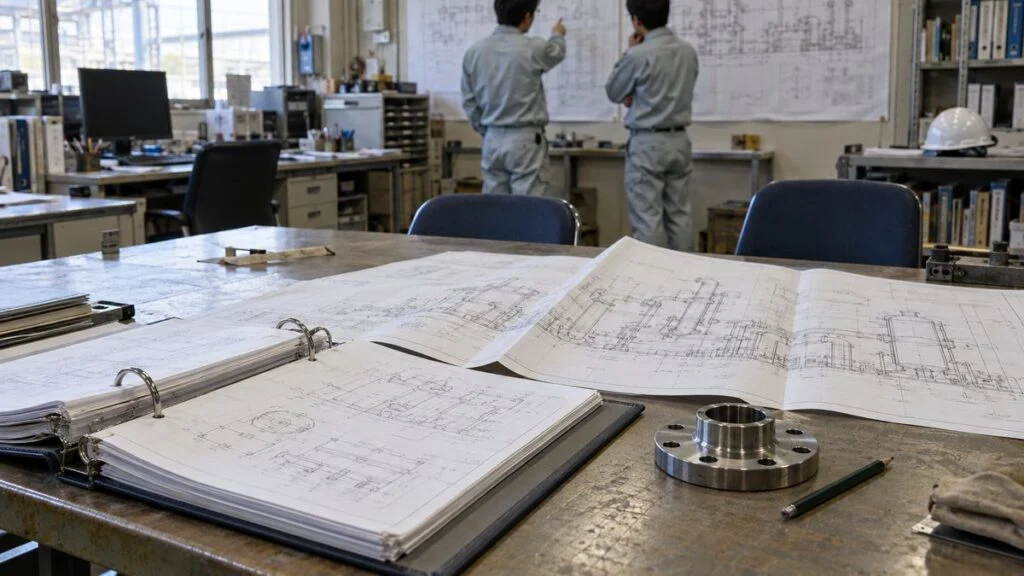
A Japanese EPC contractor sends your company a request for quotation. Attached is a 40-page document titled 購買仕様書 (kobai shiyosho), a common specification with its own revision number, and a list of reference drawings. Or you work at a Japanese-owned plant in Thailand or India, and head office asks you to issue a purchase specification to local pump vendors using the company template. Either way, you need to know what the document is supposed to do and what each side has to check.
A purchase specification (kobai shiyosho, also called konyu shiyosho) is the buyer's statement of what the equipment must do and include: performance, construction, scope of supply, inspection, and the documents the supplier must submit. Suppliers quote against it, and after the order it becomes the basis for design and fabrication. A good one lets the buyer do more than pick a model. It lets the buyer compare quotes on equal terms and decide, at delivery, whether the equipment passes.
This guide walks through the purpose of the document, the items it should cover, and the checks on both sides, using a fictional circulating pump, P-101. It ends with a requirement register, a deviation list format, and questions you can send to the Japanese side.
Contents
- What Is a Purchase Specification (Kobai Shiyosho)?
- What a Purchase Specification Is For
- What to Include: Purchase Specification Checklist
- When You Receive a Purchase Specification (Supplier Side)
- When You Write a Purchase Specification (Buyer Side)
- From Requirement to Inspection and Change Control
- Templates: Requirement Register, Deviation List, and Questions
- Where This Guide Does Not Apply
- FAQ
- Sources
What Is a Purchase Specification (Kobai Shiyosho)?
Beyond the basic duty (flow, temperature, pressure), a purchase specification describes how the equipment will be used. Add materials, applicable standards, installation environment, painting, insulation, accessories, spare parts, inspection, and warranty, and the supplier has the basis it needs for its own technical judgment.
A request for "one pump for cooling water" is not enough. It does not say the required flow, head, liquid temperature, power supply, or connection sizes. When the buyer states the service and operating conditions as numbers and drawings, the supplier can select a model and the accessories it needs.
In many Japanese companies, the design department writes the specification and the procurement department sends it out with the request for quotation. The split varies by organization, and operations, maintenance, quality, and safety staff usually add their own requirements before it goes out.
Requirements shared by many pieces of equipment often sit in a common specification, while conditions for each item go in an individual specification. The main document should list every referenced drawing and standard with its number and revision, so the supplier knows exactly which documents it is expected to read. Japan's Ministry of Land, Infrastructure, Transport and Tourism (MLIT) uses the same idea in its common specification for mechanical works, which separates common requirements, project-specific requirements, and contract drawings. Public-works specifications do not apply to private contracts automatically; the contract has to adopt them.
When the supplier cannot meet a requirement as written, it states the item, the reason, and an alternative. These exceptions go into a deviation list (sometimes called debikura in Japan), which makes every departure from the specification visible before the order is placed.
Purchase vs. Quotation vs. Delivery Specification
The purchase specification is the buyer's requirement. The quotation specification (mitsumori shiyosho) is the supplier's proposal: the specifications of the equipment it offers. The quotation states price and commercial terms; the quotation specification explains what the supplier will deliver for that price.
After the order, the delivery specification (nonyu shiyosho) and the approval drawings pin down dimensions, interfaces, and construction, and fabrication, inspection, and delivery follow once the required approvals are in. Document names and submission timing vary by company, so a document submission list should state which documents are due and at which approval stage. For the post-order side, see our guide to the delivery specification (nonyu shiyosho) and to approval drawings (shonin-zu).
Figure 1: Tracking One Requirement Through Three Specifications
For pump P-101, the duty point, scope of supply, and interfaces are checked separately at each stage until the specification is agreed.
20 m³/h and 30 m are assumed values used to show how the documents are cross-checked. Schedule details and the conditions for starting fabrication are set by each project's contract and approval procedure.
Sending every supplier the same purchase specification does not mean every quote is on the same basis. Read each supplier's standard scope and exclusions, and keep three things separate when you compare: what you required, what they proposed, and what was finally agreed.
What a Purchase Specification Is For
The purchase specification carries the equipment requirements into every stage that follows, so quotation, design, fabrication, operation, and maintenance all work from the same requirements. It does five jobs.
Comparing Quotes on the Same Basis
When you collect quotes from several suppliers, the conditions you compare must match. A low base price can still cost more overall if required instruments or tests are quoted as extras.
Send every supplier the same specification at the same revision and ask for a quote that covers the full required scope. Then check technical compliance first, and compare accessories, transport, witnessed testing, installation supervision, and similar costs line by line in the same columns.
Figure 2: Compare the Same Scope, Not the Base Price
Once the costs needed to meet the requirements are added, the ranking can flip.
| Fictional example, excl. tax | Supplier A | Supplier B |
|---|---|---|
| Base equipment | ¥900,000 | ¥1,000,000 |
| Required accessories (extra) | ¥150,000 | Included in base price |
| Delivery to site | ¥50,000 | ¥50,000 |
| Total for the same scope | ¥1,100,000 | ¥1,050,000 |
Not market prices or real products. Running costs, performance, track record, service support, and lead time are evaluated separately from the total.
If you change a condition partway through the comparison, send the change to every bidder in the same form. If only one supplier has quoted the new condition, nobody can tell what its extra cost covers or what the compared prices assume. Keep the work of leveling the technical scope separate from price negotiation.
Related: Japanese Procurement: QCD Negotiation and Supplier Ratings
Standardizing Across Equipment
A plant connects equipment from many suppliers through piping and wiring. If connection standards and operating methods differ from one unit to the next, site hookup, operation, and maintenance all take extra work.
Standardizing items such as the paint system, instrument signals, and the spare parts policy makes the whole plant easier to manage. That does not mean forcing every unit onto the same lubricant or material. Each unit still needs the performance it requires and must stay within what its manufacturer allows.
Separate the items you want standardized from the items chosen to suit each model, and the requirements become easier to follow. Instead of writing only "per our company standard," send the standard itself so the supplier can read it.
Building In Lessons From Past Problems
Turning past failures and missed items into requirements reduces repeat problems. If a replacement part once could not be pulled out, for example, that experience becomes a requirement for an inspection opening, withdrawal space, and working room around the unit.
A line like "design for easy maintenance" gives the supplier nothing concrete to design to. State what is removed, from where, and in which direction, and carry the same point into the checklist for drawing review.
The earlier you state a requirement, the easier it is to avoid rework after fabrication. Still, the materials, design changes, and inspection a fix needs are quoted as costs. Do not assume a supplier will do it for free just because you asked early.
Defining Scope and Responsibilities (Shosho)
Shosho (所掌) is the scope of responsibility: who designs, makes, procures, and installs each item. Define the connection points for the equipment itself and for piping, wiring, foundations, and accessories, and duplicate orders or missing items become much easier to catch.
For the pump, state the suction and discharge flange faces, the motor terminal box, and the boundary between the baseplate and the foundation as separate items. Assign small items too: companion flanges, gaskets, bolts, and anchor bolts. Our guide to companion flanges and who supplies them covers that part in detail.
Figure 3: Split P-101's Scope at Each Connection Point
Piping, power, and foundation are separate interfaces. Drawing a box around the equipment does not decide who supplies the accessories.
Example in which the pump, motor, and baseplate are in the supplier's scope. Dotted lines mark the scope boundary at each interface; companion flanges, fasteners, wiring, and foundations are agreed in the scope-of-supply table.
Whether two parts fit at an interface depends on more than nominal size and pressure class. The facing and the bolt-hole pattern matter too; see JIS vs. ASME (ANSI) vs. JPI flanges for how those differ. Any split of responsibility agreed in a meeting should also go into the scope table or the drawings. Do not leave an item listed on only one side's responsibility list; people on both sides of each boundary should be able to see the same point.
Preventing Misunderstandings
The buyer may see an item as a standard accessory while the supplier treats it as an option. Name every required item specifically in the specification, and check item by item whether the quotation's scope of supply includes it.
Phrases like "standard items, complete" or "including everything necessary" mean different things to different people, because each side has its own idea of standard. Write the quantity, model, what it connects to, and who does the site work, and you can sort out missing items and added conditions before the order.
Copying the same requirement into several documents also invites update errors. Use matching equipment numbers and requirement numbers so you can trace each requirement across the specification, the scope table, the drawings, and the answers to queries.
For example, assign requirement number P-101-07 to a single item: scope of supply for the companion flanges. Put the same number on the supplier's answer, the decision on any deviation, and the matching field on the final drawing, and the path to agreement can be traced. Even if the answer says "included," confirm the quantity, the material, and which fasteners are covered. If the answer column and the itemized quote disagree, settle which one governs before you finalize the order terms.
What to Include: Purchase Specification Checklist
Which items you include depends on the equipment and how it will be used. Start from the categories below, and decide at the same time which documents or tests will show that each requirement is met. That cuts down on queries after the specification is issued.
Figure 4: Pair Each Requirement With the Evidence You Will Check
A checklist of what to write, next to what you will look at to decide whether it complies.
| Category | What to write | Evidence to check (examples) |
|---|---|---|
| Scope and responsibilities | Equipment number, quantity, accessories, site work, and boundaries | Scope-of-supply table, interface drawing |
| Design and operating conditions | Fluid, temperature, pressure, flow, environment, power supply | Datasheet, performance curve |
| Regulations and standards | What they apply to, standard number and edition, who files applications | Applicability list, submission plan |
| Materials and construction | Wetted parts, joints, wall thickness, corrosion allowance | Material certificates, construction drawing |
| Accessories and spare parts | Item name, purpose, quantity, when supplied | Itemized supply list |
| Painting and insulation | Paint system, color, insulation material, thickness, extent | Procedure, application records |
| Inspection and testing | Items, methods, acceptance criteria, witnessing, records | Inspection procedure, test reports |
| Documents to submit | Type, deadline, format, number of copies, approval category | Document list, submission log |
| Delivery and support | Packing, transport, installation, commissioning support, warranty | Plans, contract terms |
Examples to adapt to each project. Do not copy unnecessary inspections or standards from another unit's template.
For temperature and pressure, give normal operating, maximum and minimum, and design conditions as separate values. State whether pressure is gauge or absolute, whether a temperature is ambient or the process fluid, and which operating case a flow rate refers to. Those definitions make the selection basis clear.
The name of the fluid is not enough. Concentration, density, viscosity, solids or other constituents, and corrosiveness all affect model selection. If equipment designed for water will handle another liquid, review materials, required power, and seal and bearing suitability as separate questions.
For equipment installed in Japan, Japanese law can apply depending on what the equipment is: for example, the Industrial Safety and Health Act and the Ordinance on Safety of Boilers and Pressure Vessels, the High Pressure Gas Safety Act, and the Electricity Business Act. Determine how the equipment and the facility are classified, assign each application, inspection, and required document to the party responsible for it, and record the result in the specification.
Keep legal requirements separate from standards (JIS or others) that the contract adopts. Do not stop at "comply with all applicable laws and standards." List each one with what it applies to, the edition, and the points to be checked.
Spare parts written only as "one year's supply" leave the operating hours and replacement intervals undefined. Separate commissioning spares, routine replacement parts, and critical spares for breakdowns, and check each by item name, quantity, storage conditions, and delivery timing.
Also state which document governs when the common specification and the individual specification conflict. MLIT's published specification sets an order of precedence and a procedure for checking inconsistencies. Stating your own document hierarchy works in private projects too. Attach reference drawings that show how the equipment connects and is controlled, and use the right drawing for the purpose so piping boundaries and signals are not misread.
Related: PFD vs P&ID on Japanese Projects: Contents and Drawing Order
When You Receive a Purchase Specification (Supplier Side)
As the supplier, you check the requirements against your products and your manufacturing capability. Review technical compliance, price impact, delivery, and deliverables as separate questions, and your answer is less likely to miss something.
Find What Applies to Your Equipment
First, confirm that you have the full set: the specification and every attachment. The common specification alone may not give the temperatures or quantities for your unit, so check document numbers, revisions, page counts, and the attachment list.
Next, mark each clause as applicable, not applicable, or under query. A common specification written for a whole plant will contain clauses that do not apply to your equipment. Do not leave them blank; state why you marked them not applicable.
Do not let the sales contact decide alone. Route the requirements to design, manufacturing, inspection, and service. Material certificates, witnessed tests, and site support each need the responsible department to confirm how it will be done and how many hours it takes.
If the buyer's schedule differs from your standard schedule, check how waiting for approvals will affect fabrication. Ask early for the input data you need and the deadline for answers, and you can state the assumptions behind your quote clearly. For how Japanese buyers run the inquiry stage itself, see RFQ to a Japanese manufacturer: the hikiai process.
Decide What You Can Meet
For every applicable requirement, classify your answer: met as standard, met at extra cost, alternative proposed, or cannot be met. Meeting the performance is one check; being able to build with the specified materials and inspection methods is another.
If meeting a requirement adds cost or lead time, show that in the quote. When you propose a different design or a different test that serves the requirement's purpose, explain why you consider it equivalent and what differences remain.
Not every clause has to be met exactly as written, as long as each difference is stated and agreed. What you should not do is quietly leave out a requirement on the assumption that the buyer will accept the deviation. Legal and safety requirements are not bargaining items to trade for a discount. Either offer a configuration that meets them or decide whether you can take the job.
If the buyer accepts a change to your standard specification, update both the quotation specification and the deviation list. If you revise only the price and leave the technical answer as it was, the two sides will again have different understandings at the time of order.
List Deviations and Settle Them With the Buyer
For each deviation, cite the clause number and the requirement, then give the reason you cannot meet it and what you propose instead. Include the effect on performance, cost, delivery, and surrounding equipment so the buyer has what it needs to decide.
"Because it is our standard" does not tell the buyer whether the limit is technical or a cost choice. Explain separately whether you can do it outside your standard, under what conditions, and how the alternative differs.
In the answer column, record a status (accepted, original requirement stands, accepted with conditions, or under discussion) along with who decided and when. Submitting the list is not the same as having the deviations approved. Give every open item an owner and a decision deadline, and carry each agreement into the quotation specification, the order terms, and the delivery documents so nothing contradicts the list.
When You Write a Purchase Specification (Buyer Side)
As the buyer, check that each requirement is correct, that the supplier will understand it, and that it can be verified. Do not let the designer finish it alone. Bring in operations, maintenance, and procurement to find gaps before the specification is issued.
Check Numbers and Interfaces
Check flow, temperature, pressure, and similar values against the calculation sheets and the equipment list behind them. The same number means something else if the unit or the basis differs, so match the definitions, not just the figures you copy.
Equipment numbers, quantities, the standby philosophy, and power supply conditions shape the whole plant design. Mix up one pump and two, and you change not only the price but also the layout, piping, controls, and how the plant runs during maintenance.
For interfaces, check coordinates and orientation on the drawings, connection sizes, pressure classes, and foundation locations with every party involved. Link the supplier's equipment drawings with the piping, electrical, and civil drawings so one side is never more current than the other.
If a value is not final yet, mark it as provisional and give the date it will be fixed. Decide how far selection or fabrication may proceed before then and what a change will affect. That keeps a provisional value from being treated as final.
Carry Over Lessons Learned
Templates hold years of experience, but they do not always include the latest problems. Look at operating logs and failure reports and ask whether the same cause could occur in this service.
Write the fix in terms of the cause and the function needed, not just the symptom. If water collected somewhere, for example, do not just write "no water shall collect." Specify the drain path and how it will be inspected.
Adding every fix from other models can bring in structures and tests you do not need. Record why each one applies to this fluid, environment, and operating method, and have both maintenance and the supplier confirm it makes sense.
For important requirements, link the incident number and the reason the requirement exists in your internal records. Information that cannot leave the company can be summarized; the supplier needs the design conditions and how compliance will be checked.
Include the End Customer's Requirements
When you have agreed to a request from your own customer (the plant owner, for example), trace it from the requirement list to a clause in the purchase specification. A request recorded only in meeting minutes will not reach the equipment unless it is passed on to the supplier.
Customer requests mix must-haves and nice-to-haves, so sort them by priority and name who decides. Agree before the order on alternatives if a request proves hard to meet, and on the effect on cost and delivery.
A specified color, the orientation of an inspection opening, or common replacement parts all affect the design of an individual unit. Do not just list the customer's requests; check that they do not conflict with interfaces or safety requirements. Keep a record of which requests were adopted, which were not, and which are still open, so it is clear which agreements the final specification reflects and nobody has to reopen the same discussion later.
From Requirement to Inspection and Change Control
Everything above becomes useful once each requirement is written so it can be verified. For P-101, that means replacing "adequate performance" and "standard accessories" with a duty point, a scope, and the document that will prove each one.
If the rated point is 20 m³/h at 30 m total head, performance is checked at that combination. It does not mean meeting the maximum flow and the maximum head separately; state both as conditions of one operating point. Add the fluid properties, temperature range, suction conditions, and whether the pump runs continuously. Pick a model without those conditions and it may have the catalog capacity but still not suit the actual service.
For performance acceptance, agree in advance on the test method, the points to be measured, tolerances, and the applicable standard and grade. Writing a number in the requirement column is not enough; agree on which test report, under which conditions, will confirm it.
Figure 5: Link Dimensional Requirements to Drawings and Inspection Records
A flange does not pass on outside diameter alone. Check the holes and the facing as specified, too.
A conceptual diagram of dimensional checks, not the dimensions of any specific JIS flange. Specify the facing, dimensions, tolerances, and inspection method on each project's drawings.
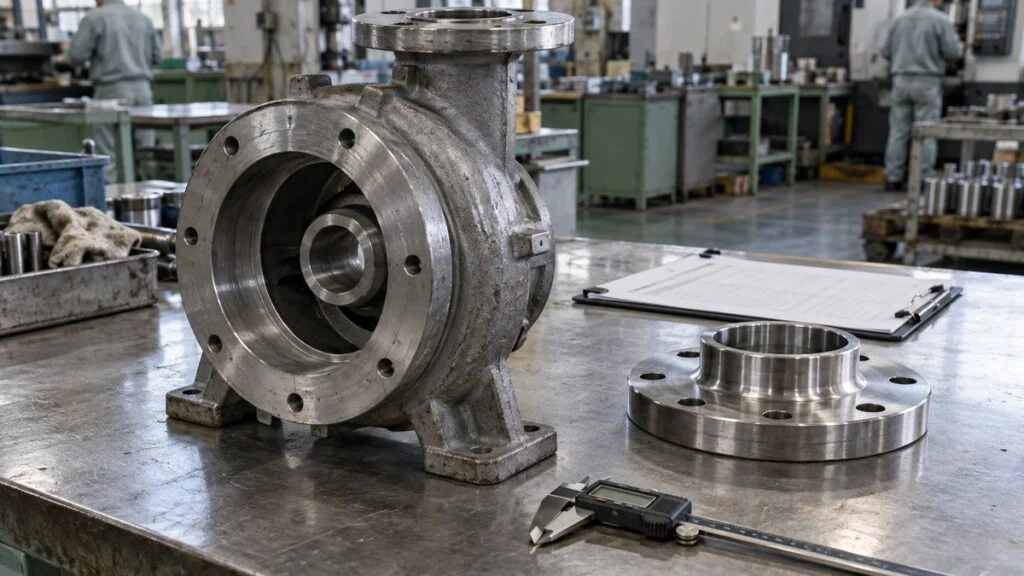
For factory witness testing, agree on which items will be witnessed, the notice period, the procedure to be submitted, and how results are recorded. A yes/no on witnessing is not an inspection plan; decide in advance what happens if the buyer cannot attend. Keep conditions that can only be checked on site separate from those checked at the factory. An integrated run with site piping and power is not the same thing as a performance test of the unit alone. Our FAT and SAT checklist covers this step.
At delivery, check the equipment number and model on the actual unit, accessory quantities, document revisions, and test reports. Log any missing documents or open corrections, with an owner and a completion date. In the receiving record, note each requirement number checked, the result, and the number of the test report that proves it. When the reason for acceptance is traceable, the record helps later with maintenance queries and with ordering the same unit again.
If you find a nonconformity, decide the disposition (repair, replace, re-inspect) and who confirms it is closed. If an open item will remain after handover, agree on how it will be handled and record that too.
For any specification change, record the reason, before and after, what it affects, cost, delivery, and the decision date. Sending one new number by email does not finish the job; follow through on every drawing and list it touches.
Figure 6: Trace a Specification Change Back to Four Deliverables
Even a change of connection size is not finished when the equipment drawing is replaced.
Once the change is decided, revise the affected documents, track their current revisions, and send them to everyone on the distribution list, so nobody keeps working from a superseded copy.
When the specification, quotes, agreement list, and revision history are linked, decisions survive a change of staff.
Templates: Requirement Register, Deviation List, and Questions
The formats below put the points above into a form you can copy. The rows are fictional examples for P-101; adjust the columns to your company's documents.
Requirement Register (Buyer)
| Req. no. | Requirement | Spec clause / rev. | Supplier answer | Evidence | Status |
|---|---|---|---|---|---|
| P-101-01 | Rated point 20 m³/h at 30 m total head, same operating point | Individual spec 3.1 / Rev. B | Met as standard | Performance curve; shop test report | Open until test |
| P-101-07 | Companion flanges, gaskets, and bolts for suction and discharge: supplier scope | Individual spec 5.2 / Rev. B | Included (qty and material to confirm) | Itemized supply list | Query sent |
| P-101-12 | Casing material as specified | Individual spec 4.1 / Rev. B | Alternative proposed (Deviation D-03) | Material certificate | Under discussion |
Deviation List (Supplier)
| Column | What to fill in |
|---|---|
| Deviation no. | D-01, D-02, … (keep numbers fixed across revisions) |
| Spec document, clause, revision | Exactly where the requirement is written |
| Requirement as written | Quote or summarize the clause |
| Supplier's proposal | What you will supply instead |
| Reason | Technical limit or cost choice, stated plainly (not just "our standard") |
| Effect | Performance, cost, delivery, surrounding equipment |
| Buyer decision | Accepted / original requirement stands / accepted with conditions / under discussion |
| Decided by, date | Name and date of the decision |
| Reflected in | Quotation spec rev., order terms, delivery spec rev. |
Questions to Send to the Japanese Buyer (Supplier Side)
- Please confirm the complete document set for this inquiry: specification numbers, revisions, and attachments.
- Which document governs if the common specification and the individual specification conflict?
- Are the pressures in gauge or absolute, and which operating case do the flow values refer to?
- Which values are provisional, and when will they be fixed?
- Who supplies the companion flanges, gaskets, bolts, and anchor bolts at each interface?
- Which Japanese regulations apply to this equipment, and which applications and documents are in our scope?
- Which tests will you witness, how much notice do you need, and what happens if you cannot attend?
- Please confirm the document submission list: deadlines, format, copies, and which documents need approval.
- How and by when will you answer our deviation list?
Pre-Issue Checklist (Buyer Side)
- All values checked against calculation sheets and the equipment list, with units and basis defined
- Equipment numbers, quantities, standby philosophy, and power supply confirmed
- Interfaces checked against piping, electrical, and civil drawings
- Provisional values marked, with a date for fixing them
- Every required accessory named with quantity and scope, no "standard items, complete"
- Referenced standards and drawings listed with number and revision
- Legal requirements listed separately from contract standards
- Acceptance method (test, procedure, record) defined for each key requirement
- Lessons learned and end-customer requests traced to clauses
- Clauses copied from another unit's template removed if they do not apply
Where This Guide Does Not Apply
- Names and order vary. Some companies say konyu shiyosho instead of kobai shiyosho, and the names and timing of the later documents differ by company and industry. Follow the document list in your contract.
- Who writes it varies. The design-writes, procurement-sends split is common, not universal.
- Public-works specifications are examples only. MLIT's common specification applies to public works. A private contract follows it only where the contract says so.
- Japanese law depends on the equipment and the site. The laws named above are examples for equipment installed in Japan. Whether they apply, and who files what, has to be determined for each project with the parties responsible for permits.
- The specification is not the whole contract. In Japan, the Fair Transactions Act (the amended Subcontract Act, in force since January 1, 2026) covers transactions based on the type of transaction and the capital or headcount of the parties. For covered transactions, the buyer has a separate duty to state order terms and keep records. A purchase specification alone does not satisfy every item.
FAQ
Which comes first, the purchase specification or the quotation specification?
Usually the purchase specification. The buyer states its requirements first, and the supplier answers with the model it selected in a quotation specification. Even when informal technical discussions start earlier, the conditions for the order should be written down and agreed.
Can I use a purchase specification template as-is?
No. Use the template as a starting list of items, then adapt it to the equipment and this project's operating conditions. Clauses that do not apply and outdated drawings left in the document cause misunderstandings, so check the latest revisions and the scope of each clause.
Will switching to the supplier's standard design lower the price?
It can improve cost or lead time, but whether it meets the requirement comes first. Show the effect on performance, materials, scope, and inspection, get the buyer's agreement, and then update the quotation terms.
Is a deviation approved once it is submitted?
No. Submitting a deviation only presents the difference. Record the decision, any conditions, who decided, and the date, and then carry the agreement into the specification and the order terms.
Once the delivery specification is checked, is the purchase specification finished?
No. Track each requirement through drawing review, fabrication, inspection, and delivery. Keep open items and change history traceable until the final agreement matches the actual equipment and the completion documents.
Sources
- Common and project-specific specifications, documents submitted for the owner's acceptance (shodaku tosho), document inconsistencies, inspection and deliverables: Ministry of Land, Infrastructure, Transport and Tourism (MLIT), Common Specification for Mechanical Works (draft), March 2026 (Japanese)
- Duty to state and record order terms for covered transactions: Japan Fair Trade Commission (JFTC), points for businesses under the Fair Transactions Act (Japanese) and JFTC leaflet: the Subcontract Act becomes the Fair Transactions Act in January 2026 (Japanese)
- Effective date of the amended act: JFTC press release, May 16, 2025
- Safety requirements by equipment category: Industrial Safety and Health Act (e-Gov, Japanese) and Ordinance on Safety of Boilers and Pressure Vessels (e-Gov, Japanese)
- Applicability by facility and handling: High Pressure Gas Safety Act (e-Gov, Japanese) and Electricity Business Act (e-Gov, Japanese)
Original article in JapaneseThis guide is adapted from a MONOSCOPE article written for readers in Japan: 購買仕様書とは?書く項目と記載例・見積仕様書との違い、受注側と発注側の確認点
About the editor
 MONOSCOPE EditorFOUNDER & EDITOR
Spent about ten years at a plant equipment maker and a plant engineering company, proposing, designing, and commissioning equipment, then moved into web marketing. Now a web consultant for B2B manufacturers, helping them explain their products and technology. Licensed in Japan as an Energy Manager and a Third-Class Chief Electrical Engineer.
Has run an engineering blog since 2017 (500+ articles) and a Japanese YouTube channel with about 20,000 subscribers. Each English guide is written from the Japanese shop-floor point of view and checked against the cited standards.