FAT and SAT with Japanese Suppliers: Steps & Free Checklist

Your plant has ordered a production machine from a Japanese equipment supplier. Before shipment, the supplier invites you to a tachiai kensa (立会検査, witnessed inspection) at their factory and emails a kensa yoryo-sho (検査要領書, inspection procedure) for your approval. Most of what you can verify on inspection day is settled earlier, when you agree on the specification and acceptance terms.
If the specification is vague, nobody can say on the day whether the machine passed. The dispute then follows the machine through installation, kenshu (検収, formal acceptance of the delivered equipment), and finally payment. This guide explains the difference between the factory acceptance test (FAT) and the site acceptance test (SAT), walks through the factory acceptance test procedure and what follows it, in six steps from specification to acceptance, and ends with a free FAT and SAT checklist you can download.
- FAT takes place at the supplier's factory before shipment. SAT takes place at your plant after the equipment is installed.
- FAT asks "Was it built to spec?" SAT asks "Does it work to spec where it is installed?" Shipping damage, utilities, and signal exchange with upstream and downstream equipment can only be checked on site.
- Two documents agreed before the order determine what you can verify: your user requirements specification (URS) and the inspection procedure. Write each requirement with a number, a measurement method, and test conditions so the result is a clear pass or fail.
- At FAT, check fault behavior, safety functions, residual-risk information (the hazards the supplier could not design out), and documents, as well as normal running. Record every finding with a priority and carry it into the punch list.
- Put the acceptance conditions and payment milestones in writing at the time of order, and confirm which country's law governs the contract.
Contents
- FAT vs. SAT: What Each Test Proves
- How Japanese Suppliers Handle Tachiai and Kenshu
- FAT and SAT Procedure: 6 Steps from Specification to Acceptance
- Steps 1–2: Before You Place the Order
- Step 3: FAT at the Supplier's Factory
- Steps 4–5: Installation and SAT at Your Plant
- Step 6: Kenshu (Acceptance) and Open Items
- Common FAT and SAT Mistakes
- Questions to Settle with Your Japanese Supplier
- Free FAT and SAT Checklist
- Limits of This Guide
- FAQ
FAT vs. SAT: What Each Test Proves
A factory acceptance test (FAT) is the inspection carried out at the equipment supplier's factory before the machine ships. In Japanese it is called kojo tachiai kensa (工場立会検査, witnessed factory inspection). A site acceptance test (SAT) is carried out after the equipment has been delivered and installed at your plant; in Japanese it is genchi ukeire kensa (現地受入検査, on-site acceptance inspection).
IEC 62381, the international standard for FAT and SAT of automation systems in the process industry, defines FAT as inspection and testing that demonstrates the system or component meets its specification, typically conducted at the vendor's facility. It defines SAT as inspection and testing at the installation site that demonstrates the installation complies with the applicable standards, codes, specifications, and installation instructions.
Put simply, FAT checks whether the machine was built to spec, and SAT checks whether it works to spec once installed.
Both are witnessed inspections, but they happen at different places and times, so they check different things.
Note: IEC 62381 covers automation systems in the process industry. The terms FAT and SAT are also widely used with the same meaning for assembly machines and machine tools.
The table below adds where to spend your time and what happens after each test, the points you will write into the inspection procedure.
| Point | FAT (at the supplier) | SAT (at your plant) |
|---|---|---|
| Place and timing | Supplier's factory, before shipment | Your plant, after installation and hookup |
| Question it answers | Was it built to spec? | Does it work to spec as installed? |
| Where to spend time | Fault behavior, safety functions, documents | Condition after shipping, utilities, links to other equipment |
| Typical findings | Design or build defects, misread specifications | Shipping damage, insufficient utilities |
| Rework | Designers and assemblers are on hand | Parts and people take time to arrange |
| What happens next | Findings recorded with priority, owner, and due date | Punch list closed, then acceptance |
Why Test Twice?
If the machine passed FAT, it is tempting to think SAT only needs a power-on check. But between the two tests the equipment is disassembled, crated, shipped, reassembled, and installed in a different building. Floor levelness, supply voltage, compressed air pressure, room temperature and humidity, and signal exchange with neighboring equipment cannot be fully reproduced at the supplier's factory. For an overseas buyer, the journey also includes international freight.
Annex 15 of the EU GMP guidelines (good manufacturing practice for medicinal products) makes the same point: FAT may be supplemented by SAT after the equipment arrives at the manufacturing site. It also says that, where justified, some FAT tests need not be repeated on site, provided you can show that transport and installation do not affect the function.
As a rule, the later a defect is found, the more time and effort it takes to fix. So the basic split is this: resolve everything you can at FAT, and reserve SAT for what only the site can show.
How Japanese Suppliers Handle Tachiai and Kenshu
Two Japanese words will come up again and again. Tachiai (立会) means "being present as a witness." A tachiai kensa is an inspection the buyer attends in person, usually following a written procedure the supplier has prepared. Kenshu, as noted above, is the formal act of checking the delivered goods against the contract and accepting them. The contract decides how kenshu relates to payment and to the start of the warranty, so it matters to your finance and purchasing teams as much as to engineering.
Expect a stack of documents. Names and contents vary by company and industry, but these are ones an overseas buyer may see:
| Japanese name | What it is | What to check |
|---|---|---|
| 仕様書 (shiyosho) | Specification. Your requirements (URS) or the supplier's equipment specification | Every requirement has a number, a measurement method, and conditions |
| 検査要領書 (kensa yoryo-sho) | Inspection procedure: test items, methods, acceptance criteria | Each item traces back to a line in the specification; FAT or SAT is stated |
| 試運転要領書 (shiunten yoryo-sho) | Procedure for the trial run (commissioning) of the machine | Run length, parts used, and how stops are counted |
| 検査成績書 (kensa seiseki-sho) | Inspection report: the measured results, often signed by both sides | Actual measured values, not just "OK"; the instruments used |
| 図面・回路図・部品表 (zumen, kairo-zu, buhin-hyo) | Drawings, electrical schematics, bill of materials | Revision matches the machine as built |
| 取扱説明書 (toriatsukai setsumei-sho) | Instruction manual, including residual-risk information | Language and format you need for your operators |
| 残件リスト (zanken list; 残件 = open items) | List of open items, the equivalent of a punch list | Owner, due date, and how closure will be confirmed |
FAT and SAT Procedure: 6 Steps from Specification to Acceptance
FAT and SAT are not just two days of testing. Treat everything from writing the specification to closing the last open item as one continuous process, and it becomes clear what has to be decided at each point.
Steps 1 and 2, before anyone visits the supplier, decide the outcome.
Note: For small equipment, FAT is sometimes skipped and only SAT is done. Steps 1 and 2 still apply.
Supplier relationships often turn tense from Step 3 onward, when you start hearing "That's not in the specification" or "That will be an extra charge." The root cause is often a specification or procedure left vague in Steps 1 and 2. The sections below follow the steps in order.
Related: Purchasing Process at Japanese Manufacturers: 8 Steps
Steps 1–2: Before You Place the Order

What gets checked during FAT and SAT is set by two documents: the user requirements specification (URS) that you write, and the inspection procedure you agree with the supplier. The first says what you want; the second says how you will prove you got it.
EU GMP Annex 15 says the URS should be a point of reference throughout the validation life cycle. That holds in any industry, not just pharmaceuticals: the standard you will judge the machine by is whatever the pre-order documents say.
Write Requirements That Can Pass or Fail
Specifications often say things like "high speed," "sufficient accuracy," or "stable operation." Nobody can make a pass/fail call on those at FAT, so the supplier and the buyer each read them the way that suits them.
To make a requirement testable, give it three things: a number, a measurement method, and conditions. For cycle time (the time to produce one part), "X seconds or less" is not enough. State which part, how many consecutive parts the average is taken over, and whether changeover is included. A hypothetical example: "Part A, 200 consecutive parts, average cycle time 12.0 s or less, changeover excluded." With that level of detail there is nothing left to argue about on the day.
With a number, a method, and conditions, pass or fail is decided on the spot.
Note: The "__" values depend on the equipment and product. Set them based on your quality standards and production plan.
When you put numbers on stability, also define what counts as a stop and how stop time is measured. Overall equipment effectiveness (OEE), which splits losses into availability, performance, and quality, is a useful model for defining stops.
Related: OEE and the 7 Big Losses vs. Six Big Losses in TPM
Cover These Points in the Inspection Procedure
Often the supplier drafts the inspection procedure and sends it to you for review and approval. When it arrives, check that it covers at least these six points:
- Test items, each tied to a line in the specification
- Test methods and the measuring instruments to be used
- Acceptance criteria (values and tolerances)
- Test parts: production parts or substitutes, and how many
- Whether each item is checked at FAT or at SAT
- Who witnesses, and the record format (signature fields, photos, how measurement data is kept)
The point most often missed is the number and type of test parts. If your production materials and components have not reached the supplier's factory, the machine can run only on substitutes, so you cannot see how it behaves under real conditions. For an overseas buyer that means international shipping to Japan, so agree on when and how the parts will be sent at the time of order.
Write the Acceptance Conditions into the Contract
For equipment, the purchase order or contract needs to say what counts as acceptance: passing FAT, passing SAT, or a later check with production parts.
Agree at the same time on the payment schedule, how open items affect acceptance, and when the warranty period starts. Equipment orders are high-value and the path to acceptance is long, so engineering and purchasing should agree on these terms early.
Related: Japanese Procurement: QCD Negotiation and Supplier Ratings
Step 3: FAT at the Supplier's Factory
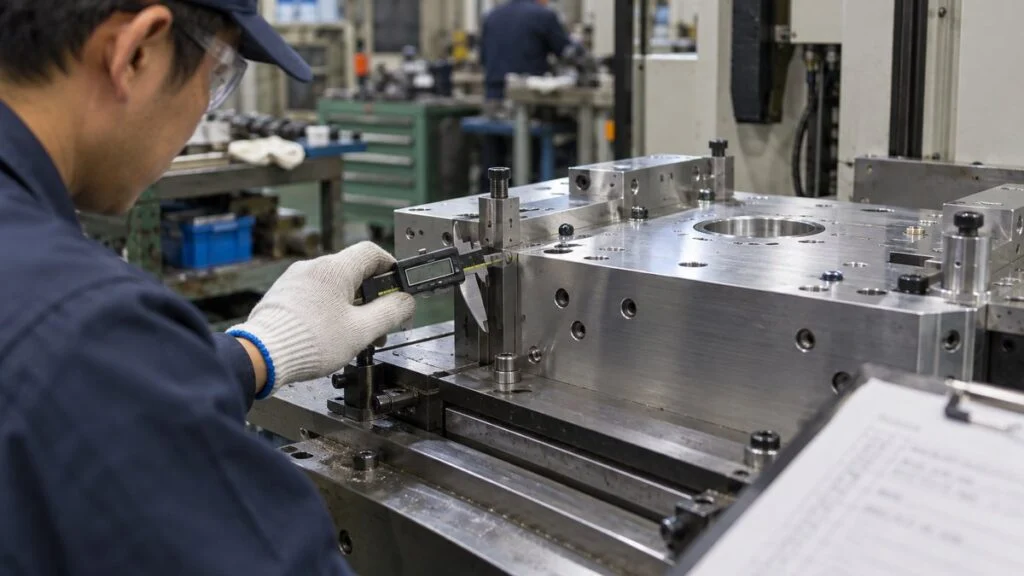
On FAT day, you work through the inspection procedure item by item. The supplier's designers and assemblers are in the building, which is the big advantage of FAT: you can ask about a cause on the spot and agree on the fix before you leave.
FAT covers how the machine stops and what documents come with it, not only whether it runs.
Note: Also agree how control program changes made after FAT will be handled (change history and what gets retested).
Test Fault Conditions, Not Just Normal Running
In the supplier's demo, the machine runs flawlessly. Production trouble comes from abnormal conditions: a part out of position, material running out, a dirty sensor. Trigger those faults on purpose and check that the screen shows the cause and that an operator can recover safely.
It also pays to bring the production and maintenance staff who will actually run the machine. They catch what a manufacturing engineer alone tends to miss: awkward controls, badly placed inspection doors, and consumables that are hard to change.
Collect the Residual-Risk Information
Japan's Ministry of Health, Labour and Welfare (MHLW) sets out its recommended approach in its Guidelines for the Comprehensive Safety Standards of Machinery, which were developed with reference to ISO 12100. The machine builder carries out a risk assessment at the design stage and passes the hazards it could not eliminate (residual risks) to the user as information for use.
Since April 2012, Article 24-13 of Japan's Ordinance on Industrial Safety and Health has also required anyone who transfers or lends machinery to make an effort to inform the recipient of its hazards. This is an "effort obligation" rather than a strict requirement, but a Japanese supplier should still be ready to provide this information.
At FAT, go beyond confirming that the safety functions work. Ask for the residual-risk list and an explanation of which hazards remain in which tasks. It is the starting point for the risk assessment you will do at your own plant. If the equipment includes robots, also check the robot safety requirements. What your plant must do with this information is set by your local regulations and your safety team, not by this guide.
Related: Risk Assessment in Japanese Plants vs. JHA, HSE, ISO 12100
Record Findings with a Priority
FAT produces findings of every size. If you insist on fixing every finding before shipment, you miss the delivery date; if you defer them all, you inherit the problems on site. Sort each finding into one of three groups, and record an owner and a due date for each:
- Fix before shipment: anything affecting safety, quality, or legal compliance
- Fix by SAT: items that on-site adjustment can resolve
- Fix later: items that can wait until after production starts
This record becomes the basis of the punch list described in Step 6. When someone says "We'll fix that," write it down and have both sides confirm it.
Steps 4–5: Installation and SAT at Your Plant
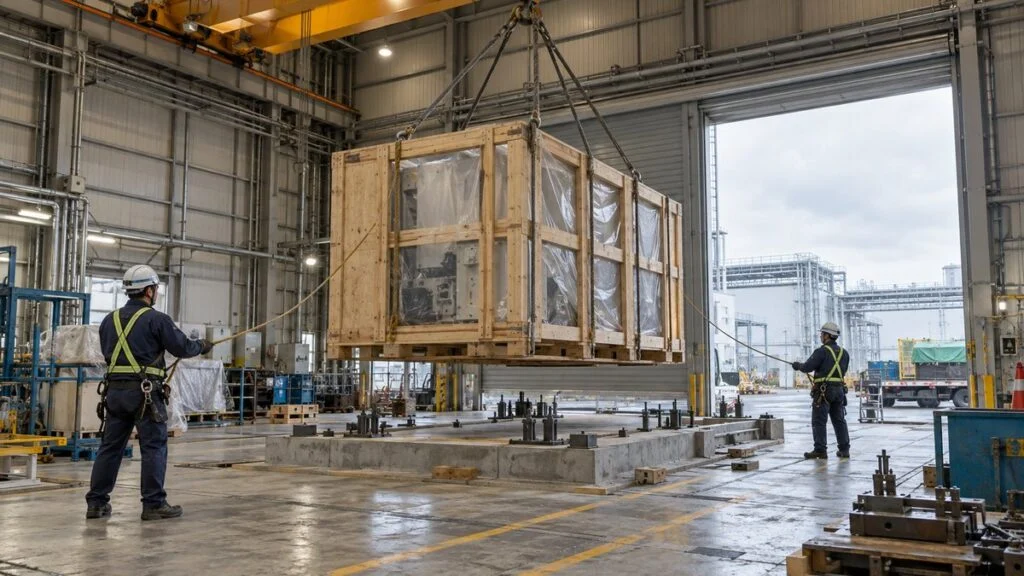
Once you have confirmed that the FAT findings due before shipment are fixed, the equipment ships and is installed at your plant. Installation covers foundation and anchor positions, leveling, utility hookups (power, compressed air, cooling water, and so on), and signal wiring to neighboring equipment.
For SAT, split the items into those already verified at FAT and those that can only be checked on site. Limit the first group to a quick recheck and spend your time on the second; that keeps SAT short.
Recheck on site only what shipping and installation can change.
Check for Shipping Damage and Test the Utilities
Vibration and shock in transit can loosen bolts, shift locating parts, and break wires. Photograph the equipment as you uncrate it, and remeasure at least a few representative accuracy items from FAT. That way you avoid a later dispute over whether something broke in transit or was wrong from the start.
Utilities are your plant's responsibility. Compressed air pressure that drops when other machines run, or a power supply without enough capacity, is often a plant problem rather than an equipment problem. Define the responsibility boundary (toriai, 取り合い, in Japanese) in the specification before the order.
Run with Production Parts and Your Own Operators
SAT ends with the machine running on the same materials, operators, and changeovers as in production. It is common for a machine to run smoothly when the supplier's engineer is at the controls, yet take much longer to change over when your own operators run it for the first time.
Use this time to get operator training and to have the supplier walk your maintenance team through inspection and parts replacement. Use what you learn to build your maintenance plan.
Related: Maintenance Workflow at Japanese Plants: 8 Steps in 3 Phases
Step 6: Kenshu (Acceptance) and Open Items
Passing SAT leads to acceptance. In practice, though, equipment is rarely accepted with nothing left open. Whether to accept with minor open items is where many disputes start.
There are several ways to tie acceptance to payment, and the more expensive the equipment, the more often payment is split into stages. Whichever you choose, agree in writing at the time of order which test triggers which payment.
Choose the split based on the size of the equipment and your relationship with the supplier.
Note: Payment percentages and the number of installments are set contract by contract.
Close the Punch List
If you accept with minor open items, list each one with a description, owner, due date, and how closure will be confirmed, and have both sides sign. In plant and construction work this is called a punch list; Japanese suppliers may call it a zanken list.
Anything affecting safety or quality must be fixed before acceptance. Track the rest against their due dates, and agree whether the warranty starts on the acceptance date or when the last item is closed. Settling that up front prevents misunderstandings later.
Check Which Law Governs the Contract
Most acceptance terms can be set freely by contract, but the governing law can add deadlines of its own. Contracts with Japanese suppliers may name Japanese law, so check the governing-law clause with your legal or purchasing team. If Japanese law applies to a sale between businesses (merchants), Article 526 of the Commercial Code requires the buyer to inspect the goods without delay after receipt and to notify the seller immediately of any nonconformity. For defects that cannot be found right away, the same rule applies if the buyer discovers them within six months of receipt. The article can be overridden by contract, and equipment contracts often set their own inspection period. Delaying inspection can cost you the right to claim. Article 566 of the Civil Code also sets a one-year notice period from when the buyer learns of a nonconformity in type or quality, with no time limit if the seller knew of it or was grossly negligent. Read these rules together with the warranty clause.
Common FAT and SAT Mistakes
Each of the mistakes below comes from skipping part of the steps above.
Most of these are prevented during preparation, not on the day.
The supplier sees the same problems from the other side. Clearing up vague points at the quotation stage and agreeing on the inspection procedure early is the surest way to avoid rework and arguments over extra charges. FAT and SAT exist so that buyer and supplier judge the machine by the same standard. Approach them as a joint effort toward a smooth production start, not as a test of the other side, and the conversations on the day stay constructive.
Questions to Settle with Your Japanese Supplier
Before the purchase order is final, get written answers to these questions:
- What exactly counts as kenshu (acceptance): FAT, SAT, or a run with production parts?
- Which payment is due at which milestone, and when does the warranty start?
- Who drafts the inspection procedure, and when will we receive it for approval?
- Which items are tested at FAT, and which at SAT?
- What test parts will be used, how many, and when must we ship them to Japan?
- Which documents will we receive (inspection report, trial-run procedure, drawings, manual, spare parts list), and in which language?
- Where is the responsibility boundary (toriai) for utilities and signal interfaces?
- How will control program changes after FAT be documented and retested?
- How will open items be recorded, signed, and closed?
- Which law governs the contract, and what inspection period does it set?
Free FAT and SAT Checklist
We turned the steps in this guide into a FAT and SAT checklist you can reuse on your next project. It has 44 items in six sections:
- Before FAT: testable requirements, acceptance terms, the inspection procedure, test parts, documents, and attendees
- During FAT: build vs. spec, capacity and accuracy, continuous run, fault recovery, safety functions, and residual risks
- FAT sign-off: prioritized findings, signed inspection report, program version, and release to ship
- Before SAT: uncrating photos, foundation and leveling, utilities, interfaces, and production parts
- During SAT: remeasurement after shipping, utility checks, interlocks, production runs, and training
- Final acceptance: punch list, signed acceptance record, payment milestone, and warranty start
Download the FAT and SAT checklist (Excel, 44 items)
Edit the items to fit your equipment and contract. The checklist is a starting point, not a substitute for the inspection procedure you agree with your supplier.
Limits of This Guide
- Practices vary. Document names, how detailed the inspection procedure is, and how acceptance links to payment differ between Japanese suppliers, industries, and projects. Confirm the details with your supplier.
- Regulated industries have their own rules. Pharmaceutical manufacturing equipment under EU GMP Annex 15 goes through formal qualification (installation, operational, and performance qualification, or IQ, OQ, and PQ), with FAT and SAT as part of that process.
- Safety and legal decisions are not covered here. This guide lists what to check. What your plant must do for machine safety, and how your contract is interpreted, are decided by your safety team, your legal team, and the laws that apply to you.
- Small equipment may skip FAT. Even then, the preparation in Steps 1 and 2 still applies.
FAQ
What Is the Difference Between FAT and SAT?
FAT is done at the supplier's factory before shipment to confirm the machine was built to spec. SAT is done at your plant after installation to confirm it works to spec in place, including utilities, the condition after shipping, and links to other equipment.
Can We Skip FAT and Do Only SAT?
Yes, for small equipment this is sometimes done. You still need to set the requirements and acceptance terms and agree on the inspection procedure before ordering. Keep in mind that defects found on site take longer to fix, especially when the supplier's engineers have to travel from Japan.
Who Should Attend a Factory Acceptance Test?
Bring the production, maintenance, and quality staff who will use the machine, not just the manufacturing engineer. They notice usability and maintenance problems that a manufacturing engineer working alone tends to miss.
What Is a Punch List in FAT and SAT?
A punch list is the list of minor open items left when equipment is accepted before everything is finished. Each item has a description, owner, due date, and how closure will be confirmed, and both sides sign it. It grows out of the findings recorded at FAT. Japanese suppliers may call it a zanken (open items) list.
What Does Kenshu Mean in Japanese Equipment Contracts?
Kenshu (検収) is formal acceptance: checking the delivered equipment against the contract and taking it over. Payment and the warranty start are often linked to it, so the contract should state exactly which test or condition counts as kenshu and how it relates to payment and the warranty.
Sources
- FAT and SAT definitions: IEC 62381:2024 Automation systems in the process industry – Factory acceptance test (FAT), site acceptance test (SAT), and site integration test (SIT) (sample pages)
- URS, FAT/SAT, IQ/OQ/PQ: European Commission, EU GMP Annex 15: Qualification and Validation (2015)
- Notification of machinery hazards: MHLW, notice on Article 24-13 of the Ordinance on Industrial Safety and Health (Japanese)
- Machinery safety guidelines: MHLW, Guidelines for the Comprehensive Safety Standards of Machinery (2007 revision, Japanese)
- Commercial Code Article 526: Zeiken, Commercial Code (excerpt) Article 526 (Japanese)
Original article in JapaneseThis guide is adapted from a MONOSCOPE article written for readers in Japan: FAT・SATとは|工場立会検査・現地受入検査の違いと検収で揉めない進め方6ステップ
About the editor
 MONOSCOPE EditorFOUNDER & EDITOR
Spent about ten years at a plant equipment maker and a plant engineering company, proposing, designing, and commissioning equipment, then moved into web marketing. Now a web consultant for B2B manufacturers, helping them explain their products and technology. Licensed in Japan as an Energy Manager and a Third-Class Chief Electrical Engineer.
Has run an engineering blog since 2017 (500+ articles) and a Japanese YouTube channel with about 20,000 subscribers. Each English guide is written from the Japanese shop-floor point of view and checked against the cited standards.