Pointing and Calling (Shisa Kanko): Japan’s Safety Ritual
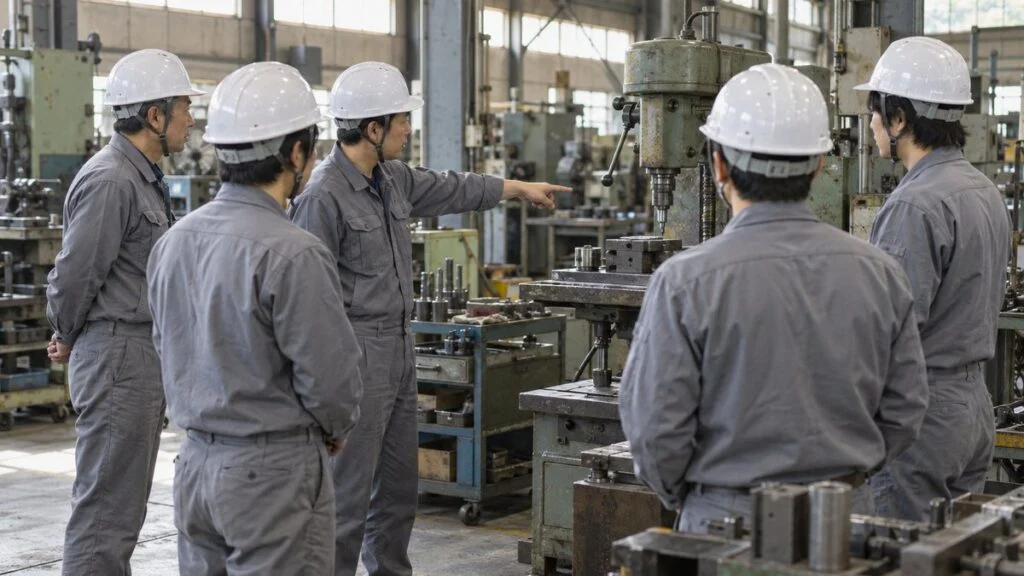
Stand on a platform in Tokyo and watch the crew. As the train pulls in, the conductor points down the platform and says something out loud, then points again before the doors close. Visit a factory in Japan and you may see the same gesture: an operator points at a valve or a gauge, names it, and finishes with a sharp "Yoshi!" ("OK!").
This is pointing and calling, known in Japan as shisa kanko (指差喚呼) or shisa kosho (指差呼称). This article explains where it came from, what the research behind it actually measured, and how it fits with kiken yochi (hazard prediction) training and morning meetings. It ends with how teams outside Japan can use it without it turning into an empty ritual.
Key numbers
Sources: MHLW Workplace Safety Site, "Pointing and Calling" (Railway Technical Research Institute experiment, 1994); Nippon.com, "Pointing and Calling: Japan's Railway Safety Technique" (February 9, 2026); MTA, "Subway Conductors Point the Way to Safety" (November 12, 2013).
Contents
- What Pointing and Calling Looks Like
- From Steam Locomotives to Factory Floors
- What the Research Actually Shows
- How It Fits With KY (Kiken Yochi) Training
- Morning Meetings: Chorei and the Toolbox Meeting
- Pointing and Calling Outside Japan
- How to Adopt It Without Empty Ritual
- Why It Matters if You Work With Japanese Plants
- Limits of This Article
- FAQ
- Sources
What Pointing and Calling Looks Like
Japan's Ministry of Health, Labour and Welfare (MHLW) defines pointing and calling as pointing at a work object, sign, signal or gauge and saying its name and status out loud to confirm it. Names vary by industry and company. Railways often say shisa kanko, while many factories say shisa kosho or yubisashi kosho.
The ministry's Workplace Safety Site describes a standard sequence of four motions. Not every workplace does all four, but this is the textbook version.
The textbook form from Japanese guidance. Each step adds a check: eyes, arm, voice, and a pause to think. Adapt the gestures to the task and the space; never use one that creates a new hazard.
Source: MHLW Workplace Safety Site, "Pointing and Calling"; JISHA, "Concept of Zero-accident Total Participation Campaign." Both describe a left hand on the hip, a straight back and brisk movements. The example call is ours.
When several people point and call together, the Japan Industrial Safety and Health Association (JISHA) calls it "pointing and saying out loud together." Its aim is different: JISHA says it builds a sense of unity in the team. A variant called "touch and call," in which members touch hands or form a ring while calling, is also part of JISHA's guidance.
From Steam Locomotives to Factory Floors
The practice started on the railways. According to MHLW, it began as a safety habit of steam locomotive drivers on Japan's state railways, later Japanese National Railways (JNR), who used it to confirm signals. A 2026 Nippon.com article by a former train crew member adds that calling out signals appeared in crew manuals in the 1910s, and pointing was added from the late 1920s.
Industry picked it up later. JISHA launched its Zero-accident Total Participation Campaign in 1973, with support from the former Ministry of Labour. That campaign made pointing and calling one of its core methods, alongside hazard prediction training.
A railway habit became a factory routine, then crossed back to railways abroad.
Sources: Nippon.com (February 9, 2026); MHLW Workplace Safety Site; JISHA, "Concept of Zero-accident Total Participation Campaign"; Rodo Shimbun, Anzen Staff (July 1, 2012); MTA (2013); Metrolinx (March 15, 2021).
MHLW's glossary lists aviation, transport, construction and manufacturing among the industries that use it. How often factories use it, and at which steps, varies by company; we found no public data on how common it is.
What the Research Actually Shows
Articles about pointing and calling often say it "cuts errors by 85%." That figure comes from one lab experiment, and the details matter. In 1994, Japan's Railway Technical Research Institute (RTRI) had participants press operation buttons under four conditions, and counted how often they pressed the wrong one.
Reported rates were lower with pointing, calling, or both than with neither. Doing both gave the lowest rate.
Source: MHLW Workplace Safety Site, "Pointing and Calling," citing a 1994 experiment by the Railway Technical Research Institute. Lab task only; it does not measure injury rates.
The rate fell from 2.38% to 0.38%, a drop of 2 percentage points. In relative terms that is about 84% lower, or roughly one-sixth of the original rate, which is how MHLW and JISHA describe it. The public summaries do not give the number of participants, the task design or any measure of statistical uncertainty. Treat the figure as one controlled result, not a general law.
A related journal article also exists. S. Haga, H. Akatsuka and H. Shiroto published laboratory experiments on the error-prevention effect of pointing and calling in 1996, in a Japanese industrial and organizational psychology journal (vol. 9, pp. 107–114). We found only the reference, so we cannot say whether it reports the 1994 experiment or a separate study.
Later lab studies measured different things. Shinohara and colleagues (International Journal of Industrial Ergonomics, 2013) used a task-switching test with 20 participants and concluded that pointing and calling supports the mental control people need to avoid operating errors. That is a reaction-task result, not a wrong-button rate and not an injury rate.
None of this shows that a plant's injury rate will fall by 84%. MHLW itself says pointing and calling alone cannot eliminate human error. It calls the method an effective way to raise alertness and make each check more accurate.
How It Fits With KY (Kiken Yochi) Training
In JISHA's framework, pointing and calling is part of a wider routine called KY, short for kiken yochi (危険予知, hazard prediction). JISHA describes KY training (KYT) as small-group discussion of the hazards hidden in a work scene, ending with pointing and calling to confirm what the team agreed.
According to MHLW, hazard prediction training began at Sumitomo Metal Industries. JISHA then combined it with a four-round problem-solving method and with JNR's pointing and calling. The result, the KYT Basic 4-Round Method, runs like this:
A team of about 5–6 looks at an illustration or a real task and works through four rounds.
Source: JISHA, "Concept of Zero-accident Total Participation Campaign"; MHLW Workplace Safety Site, "Hazard Prediction Training (KYT)." Rounds 1–3 use JISHA's English wording; Round 4 is our translation of MHLW's Japanese.
The full four rounds take time, so JISHA also teaches shorter versions, such as one-point KY. A crew can run one in a few minutes before work, then use pointing and calling at the key points it agreed on. For the full method with a worked example sheet, see our guide to Kiken Yochi (KY) training and the 4-round method.
Morning Meetings: Chorei and the Toolbox Meeting
Many Japanese workplaces start the day with a chorei (朝礼, morning assembly). As Pen magazine describes it, staff may do radio calisthenics first, the manager greets everyone, staff recite the company motto, and department heads go over the day's schedule. Format and length vary by company, and some workplaces skip it.
On the shop floor, much of the safety work happens in the toolbox meeting (TBM), named after crews gathering by the toolbox. A guide from the Tokyo Labor Standards Association Federation says a TBM usually takes 5–10 minutes before morning work starts. The foreman explains the day's scope and assignments, and the whole crew confirms the safety points.
The same guide says the core of a TBM is hazard prediction. It notes that TBMs are common in construction and shipbuilding, where the site and the work change every day. Where a plant holds both meetings, the chorei speaks to the whole site, and the TBM speaks to one crew about one job.
Pointing and Calling Outside Japan
New York City Transit is the best-known example. Its zebra boards, black-and-white boards that mark where the conductor's car should stop, date back about a century. The MTA says conductors were first required to point at them before opening the doors in September 1996, and that "there is absolutely no argument over where it originated – Japan."
In Toronto, a March 2021 Metrolinx article described pointing and calling coming to GO trains. Customer service ambassadors point and call "good spot," then "clear right, clear left," before opening and closing the doors. The article quoted an Alstom manager as saying some ambassadors handle 60–70 stops a day, and that the routine helps break the automatic habits staff can fall into.
The Nippon.com article reports that France's national railway operator and China's high-speed railways have built pointing into their training. It also says East Japan Railway Company (JR East) trains rail staff in Indonesia and other Southeast Asian countries in Japanese-style pointing and checking.
For factories, there is less public data. Japanese safety guidance does say something useful about workers new to these methods.
The Tokyo Labor Standards Association Federation guide, written for Japanese workplaces that employ foreign workers, notes that KYT and 5S developed in Japan and are new to many of those workers. It says people need a full explanation of why and how before they join in. That advice fits anyone new to the methods.
How to Adopt It Without Empty Ritual
Metrolinx's own article admits the gesture "may seem a little silly, or a tad dramatic." One risk when a plant adopts it is that teams repeat the gestures without actually checking anything. The ideas below draw on the sources in this article; how far you take each one depends on your plant.
Compiled by MONOSCOPE from JISHA, MHLW, Metrolinx and the Tokyo Labor Standards Association Federation guide. The choice of example check points is ours.
The table below lists signs that help tell a working check from an empty ritual when you walk the shop floor. It is our own checklist, not a published standard.
Signs to look for when you walk the floor.
MONOSCOPE's own checklist, based on the definitions from MHLW and JISHA. Not a published standard.
Before you expand the routine, pilot it at a few defined checks. For each one, write down the expected status, the call, and what to do if the status is wrong. Review mismatches and operator feedback after a few weeks.
Near-miss reports help show where controls failed. Review the cause first, because the right fix may be a guard or a procedure change, not a new check point. Our article on hiyari hatto near-miss reports covers how Japanese plants collect them. For energy isolation during maintenance, see lockout/tagout in Japan vs. OSHA.
Why It Matters if You Work With Japanese Plants
If your plant has a Japanese parent company or customer, you may be asked to "do KY" or "do shisa kosho." Knowing the background helps you ask better questions. Ask which methods they expect, at which steps, and what records they want, before you design anything.
Expect it to look different by company and site. Practices also vary by company and site inside Japan, so one visit to one plant is not the whole picture. For how Japanese plants structure safety reviews more broadly, see risk assessment in Japanese plants vs. JHA and ISO 12100.
Limits of This Article
- We did not interview anyone or visit any plant. Everything here comes from the public sources listed below.
- The 1994 figures come from MHLW and JISHA summaries. We could not access the original RTRI report or the full 1996 paper.
- Lab results on button-pressing errors do not predict injury rates at a real plant.
- We found no public data on how many Japanese factories use pointing and calling, or how often.
- Local law and your company's safety system come first. Pointing and calling supports them; it does not replace them.
FAQ
What Is Shisa Kanko?
It is the Japanese name for pointing and calling: you point at an object, such as a signal or gauge, and say its name and status out loud. Railways often use the term shisa kanko, while many factories say shisa kosho. It began with steam locomotive drivers on Japan's state railways, the forerunner of today's JR companies.
Does Pointing and Calling Really Reduce Errors by 85%?
In one 1994 lab experiment by Japan's Railway Technical Research Institute, the wrong-button rate fell from 2.38% to 0.38% when participants both pointed and called. That is about 84%, or roughly one-sixth. It was a button-pressing task, not a measure of workplace injuries.
What Does "Yoshi" Mean?
It means "OK" or "good," and it confirms that the check is done. Teams outside Japan can use a word in their own language, as long as the call also names the object and its status.
Is Pointing and Calling Required by Law in Japan?
In the sources we checked, we found no general legal requirement for factories; JISHA and MHLW present it as a safety method, not a legal duty. Check task- or site-specific rules separately. Railway operators set their own rules, and JNR wrote pointing into its regulations in 1970.
Sources
- MHLW Workplace Safety Site, Pointing and Calling (指差呼称) (Japanese)
- MHLW Workplace Safety Site, Hazard Prediction Training (KYT) (Japanese)
- Japan Industrial Safety and Health Association (JISHA), Concept of Zero-accident Total Participation Campaign
- Rodo Shimbun, Anzen Staff feature on KY at Sumitomo Metal Industries (July 1, 2012, Japanese)
- Nippon.com, Pointing and Calling: Japan's Railway Safety Technique (February 9, 2026)
- Haga, S., Akatsuka, H. and Shiroto, H. (1996), laboratory experiments on the error-prevention effect of pointing and calling, Japanese Association of Industrial/Organizational Psychology Journal, 9, 107–114 (Japanese; reference only)
- Shinohara, K., Naito, H., Matsui, Y. and Hikono, M. (2013), The effects of "finger pointing and calling" on cognitive control processes in the task-switching paradigm, International Journal of Industrial Ergonomics, 43(2), 129–136
- MTA, Subway Conductors Point the Way to Safety (November 12, 2013)
- Metrolinx, Japanese safety technique Shisa Kanko coming to GO Trains (March 15, 2021)
- Tokyo Labor Standards Association Federation, Chapter 5: Daily Safety and Health Activities (Japanese)
- Pen, Chorei, an Essential Ritual for Group Cohesion (2018)
About the editor
 MONOSCOPE EditorFOUNDER & EDITOR
Spent about ten years at a plant equipment maker and a plant engineering company, proposing, designing, and commissioning equipment, then moved into web marketing. Now a web consultant for B2B manufacturers, helping them explain their products and technology. Licensed in Japan as an Energy Manager and a Third-Class Chief Electrical Engineer.
Has run an engineering blog since 2017 (500+ articles) and a Japanese YouTube channel with about 20,000 subscribers. Each English guide is written from the Japanese shop-floor point of view and checked against the cited standards.