Mating Flange (Companion Flange): Who Supplies It?
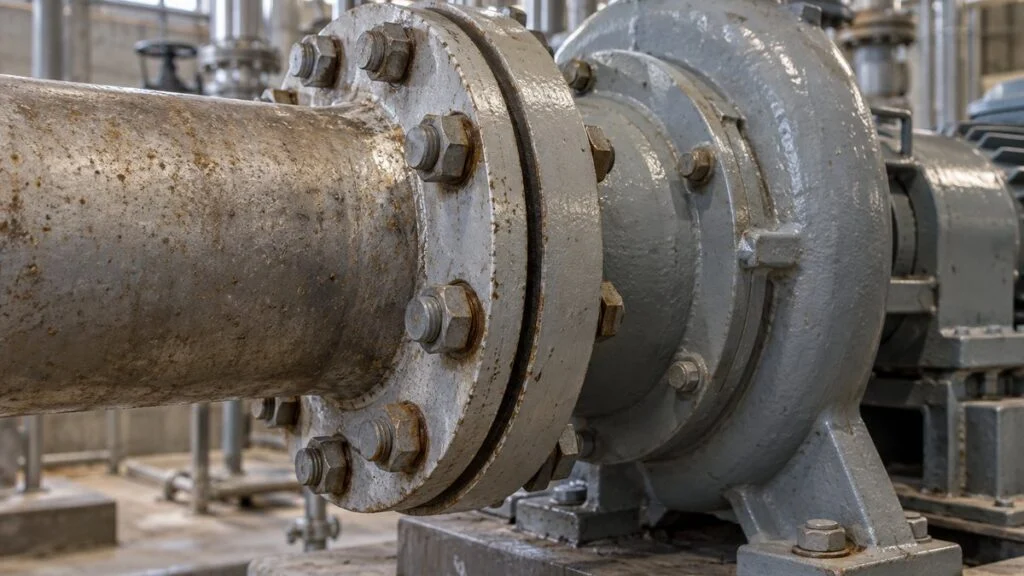
Here is a fictional but typical case. A pump package from Japan arrives on site. The purchase order said "companion flanges included," and the crate does hold two flanges, but no bolts and no gaskets. The flanges are also threaded, while your piping spec calls for welded joints. Nobody ordered the wrong part. The buyer and the supplier just meant different things by the same words.
The short answer: in Japanese specifications, ai-furanji (相フランジ) is the mating flange that the equipment supplier provides so the piping can connect to a dedicated, maker-specific nozzle, as on many pumps, safety valves, and fans. English documents usually call it a companion flange. Who supplies the mating flange is a scope-of-supply decision: for common standard flanges, the piping side usually provides it; for dedicated flanges, the equipment supplier usually ships it. Japanese documents may also say kumi-furanji (組フランジ), meaning the flange plus bolts, nuts, and gasket as a set.
This guide explains those terms, shows the two common ways the scope is split, and gives you a checklist, a set of questions, and sample purchase-order wording so the right parts arrive in the same crate.
Contents
- Japanese Terms You Will See on the Spec
- Who Supplies the Mating Flange? Two Common Scope Splits
- What Japanese Catalogs Actually Include
- Ai-Furanji vs. Kumi-Furanji
- The English Term Trap: Companion, Mating, and Counter Flanges
- What to Decide Before You Order
- Checklist and Sample Wording
- Where This Guide Does Not Apply
- FAQ
- Sources
Japanese Terms You Will See on the Spec
These words usually appear where the equipment meets the piping. Japanese specifications call that boundary the toriai-ten (取合点, interface or terminal point), and the split of who supplies what is the shosho (所掌, scope of supply).
Terms you may find in a purchase specification, quotation, or accessory list.
| Written as | Reading | Meaning |
|---|---|---|
| 相フランジ / 合フランジ / 合せフランジ | ai-furanji (合せ: awase-furanji) | Mating (companion) flange that bolts to the equipment nozzle, typically supplied with equipment that has a dedicated flange. All spellings are used. |
| 組フランジ / 組みフランジ | kumi-furanji | Mating flange supplied as a set with bolts, nuts, and gasket. Not a universal term. |
| 所掌 | shosho | Scope of supply (or scope of work): which party provides each item |
| 取合点 | toriai-ten | Interface or terminal point between equipment and piping |
| パッキン | pakkin | Gasket (literally "packing") |
| BNP | — | Shop shorthand for bolts, nuts, and packing (gasket) |
| 外形図 | gaikei-zu | Outline drawing (the maker's general arrangement drawing) |
| 標準付属品 | hyojun fuzokuhin | Standard accessories (the catalog line that says what ships with the unit) |
You may also see the reading written in katakana or romaji (アイフランジ, "ai flange," "i flange"). These are most likely just other spellings of ai-furanji. They have nothing to do with the flanges of an I-beam.
A flanged joint has three groups of parts: the two flanges, the gasket between them, and the bolts and nuts that clamp them together. The figure below shows which flange is which.
The nozzle flange belongs to the equipment. The mating flange is the one on the pipe.
Schematic only. The mating flange may be welded or threaded to the pipe.
Flanged joints cost more than threaded ones, but they seal well, last, and can be taken apart for maintenance. That is why flanged joints are the most common connection method in plant piping.
Related: JIS Bolt Grades 8.8 vs 10.9 vs 12.9: Strength and Torque
Related: Socket Weld vs Butt Weld: SW/BW on Japanese Piping Specs
Who Supplies the Mating Flange? Two Common Scope Splits
Japanese projects tend to split the scope in one of two ways, depending on what kind of flange the equipment has.
Standard Flanges: The Piping Side Supplies It
When the nozzle is a common standard flange, such as JIS 10K FF or JPI Class 150 RF, the equipment supplier tells the piping side the flange standard, pressure class, nominal size, and facing. The piping contractor then provides the mating flange, bolts, nuts, and gasket along with the rest of the piping material. If the nozzle standard differs from your site piping, see JIS vs ASME (ANSI) vs JPI flanges, and for facing and gasket choice, see flat face vs raised face flanges.
Related: Flat Face vs Raised Face Flange: JIS FF/RF and ASME Guide
Dedicated Flanges: The Equipment Supplier Ships It
Some equipment uses a flange shape set by the maker, not by a general piping standard. Pumps, safety valves, and fans are common examples. The piping side would find such flanges hard and costly to make, so the equipment supplier usually ships the mating flange, often with bolts, nuts, and gasket. The piping contractor then only has to weld (or, in small sizes, thread) the supplied flange to the pipe. That welding is normally part of the piping work.
Blue shows what the equipment supplier provides. Orange shows what the piping contractor provides.
Schematic only. The dashed line in B marks the joint the piping contractor makes between the supplied mating flange and the pipe.
The table below puts the two splits side by side, including what information has to change hands.
When the nozzle is maker-specific, the mating flange usually comes with the equipment.
The flange standard alone does not decide the scope. Confirm it in the purchase specification, the maker's accessory list, and the outline drawing. Practice also varies with the designer and the project.
What Japanese Catalogs Actually Include
Many Japanese equipment catalogs list mating flanges as standard accessories, but the details change by model and size. A few published examples show how much they vary.
"Flanged" on a data sheet does not tell you whether a mating flange ships with the unit. Check the accessory line.
Examples from each maker's published catalog or FAQ. Scope varies by model, size, and specification and does not apply to every product in these lines. Always check the current catalog and quotation.
For safety valves, the product standard in Japan is JIS B 8210 (safety valves), revised in February 2025 to replace the 2017 edition. Inlet and outlet connections still vary by model, so check the maker's specification for each valve.
Related: Full-Bore vs Lift-Type Safety Valves: JIS Terms Explained
Ai-Furanji vs. Kumi-Furanji
Kumi-furanji (組フランジ, also written 組みフランジ) means a mating flange together with its bolts, nuts, and gasket. A simple way to remember it: ai-furanji is the flange alone; kumi-furanji is the set.
The difference is whether the fasteners and gasket are included.
With either term, the parts included can differ by company and maker.
Because kumi-furanji is not a term every supplier uses, do not rely on it. If you want the full set, name the parts, for example "mating flanges, including bolts, nuts, and gaskets." Even the word ai-furanji can mean a different set of parts depending on the maker and size, so write part names and quantities in both the quotation and the purchase specification.
The English Term Trap: Companion, Mating, and Counter Flanges
Translating ai-furanji as "companion flange" is common, but the English word carries its own meaning. A US flange distributor, Texas Flange, notes that in supply catalogs the term "companion flange" almost always means a threaded flange that screws onto threaded pipe. Order "companion flanges" from a US stockist and you may get threaded flanges when you wanted weld necks.
European pump makers often use "counter flange" instead. Wilo, for example, sells counter flange kits as pump accessories, and the contents differ by kit: some include bolts, nuts, and flat gaskets, while others say to order seals separately. "Mating flange" is the most neutral of the three terms. Whichever word your documents use, state the flange type and the pipe-side end (weld neck, slip-on, socket weld, or threaded) so nobody has to guess.
What to Decide Before You Order
Mismatches tend to look like "the bolts we expected were not in the box" or "the flange is threaded but our line is welded." Working through the steps below in order catches most of them.
Start from the equipment nozzle and finish by writing parts and quantities into the order.
What one "set" contains differs by equipment. Counting by nozzle ("suction and discharge, one set each") reduces mismatches.
Steps 2 and 4 are where flange standards and gaskets come in. The articles on JIS, ASME, and JPI flange dimensions and FF vs. RF facings cover those checks in detail. It also helps to trace each nozzle on the P&ID (piping and instrumentation diagram), where the equipment-to-piping boundary is easy to see.
Related: How to Read P&ID Instrument Symbols: ISA-5.1 vs JIS
Checklist and Sample Wording
Scope Checklist for Each Nozzle
Fill in one row per nozzle and agree on it with the supplier before the order is placed.
| Item | What to confirm | Where to find it |
|---|---|---|
| Nozzle flange | Standard or maker-specific; standard, class, size, facing | Outline drawing, nozzle schedule |
| Mating flange supplied by | Equipment supplier or piping contractor | Purchase specification, quotation |
| Pipe-side end | Weld neck, slip-on, socket weld, or threaded; pipe size and wall | Supplier data sheet, your piping class |
| Material | Flange, bolts and nuts, gasket | Supplier data sheet, your piping class |
| Bolts, nuts, gasket | Included or not, and whether this changes with size | Catalog accessory list, quotation line items |
| Quantity | Number of nozzles covered (e.g., suction and discharge, one set each) | Quotation, purchase order |
| Packing and marking | Shipped with the unit, and tagged to the nozzle | Packing list |
Questions for the Japanese Supplier
- Are any nozzles on this unit maker-specific flanges rather than JIS, JPI, or ASME standard flanges?
- Do you supply mating flanges (相フランジ) as standard? For which nozzles and sizes?
- Do they include bolts, nuts, and gaskets? Does that change at larger sizes?
- What is the pipe-side end of each mating flange: weld neck, slip-on, socket weld, or threaded? For what pipe size and schedule?
- What are the materials of the mating flanges, bolts, nuts, and gaskets?
- Will the mating flanges ship with the unit and be tagged by nozzle?
Sample Purchase Specification Line
Mating flanges (相フランジ), including bolts, nuts, and gaskets, for suction and discharge nozzles: 1 set each (2 sets total). Pipe-side end: [weld neck / slip-on / threaded] for [pipe size and wall]. Materials: flange [ ], bolts and nuts [ ], gasket [ ]. To be shipped with the pump and tagged by nozzle.
Sample Inquiry Email
Subject: Mating flange scope for [equipment tag]
Your quotation lists "companion flanges" as an accessory for this pump. Please confirm (1) which nozzles they cover, (2) whether bolts, nuts, and gaskets are included, (3) the pipe-side end of each flange (weld neck, slip-on, or threaded) and the pipe size it fits, and (4) the materials of the flanges, bolts, and gaskets. Please show these as separate line items with quantities in your revised quotation.
Where This Guide Does Not Apply
- Project specifications override habit. Your project's piping specification or contract may split the scope differently from the patterns shown here. Follow the contract documents.
- Practice varies by company and designer. The two splits shown here are common in Japan, not a rule. Some designers draw the line differently.
- Catalog examples change. The accessory lists cited above are examples from specific models and editions. Check the current catalog and the quotation for your unit.
- Pressure-relief and pressure-equipment connections may be governed by codes and inspection rules at your site. The piping designer and the responsible engineer decide those connections; this guide only covers who supplies which parts.
Related: RFQ to a Japanese Manufacturer: The 7-Step Hikiai Process
FAQ
Is a Mating Flange the Same as a Companion Flange?
In many specifications, yes: both mean the flange that bolts to the equipment's flange. In US supply catalogs, though, "companion flange" usually means a threaded flange, so state the flange type when you order.
Do Japanese Pumps Come with Mating Flanges?
Not always. Some makers include them as standard accessories, others sell them separately, and within one maker, bolts and gaskets may be dropped at larger sizes. Check the standard accessory line in the catalog and the line items in the quotation.
What Is the Difference Between 相フランジ and 合フランジ?
None in practice. Both are read ai-furanji and mean the flange that mates with the equipment flange; a third spelling, 合せフランジ (awase-furanji), means the same. Saginomiya's safety valve catalog, for example, uses 合フランジ. Agree on the parts and quantities rather than on the spelling.
What Is a Counter Flange?
Another name for a mating flange, common with European pump makers. Kits may or may not include bolts, nuts, and gaskets, so read the kit contents.
Who Welds the Mating Flange to the Pipe?
Usually the piping contractor, as part of the piping work, even when the equipment supplier provides the flange. Confirm this in the scope split for your project.
Sources
- Submersible pump dedicated flange and standard accessory (one set of mating flanges with gasket and bolts): Kawamoto Pump, general-purpose pump handbook, WUO(4) series (Japanese)
- Foot valves with and without threaded mating flanges; suction unit without gaskets and bolts at 125A and above: Kawamoto Pump, general-purpose pump handbook, accessories (Japanese)
- Fan standard accessories (mating flanges with bolts) and duct connection: Ebara, LFU4 in-line fan with silencer box (Japanese)
- Safety valve mating flange option and JIS B 8602 flanges: Saginomiya, refrigeration safety valve type RSV (Japanese)
- Flanges and seals ordered separately: Grundfos FAQ, flanges and scope of delivery for circulator pumps
- JIS B 8210:2025 (safety valves), replacing the 2017 edition: Japanese Standards Association, JIS B 8210:2025 preview (Japanese)
- Meaning of "companion flange" in US supply catalogs: Texas Flange, "Companion Flanges"
- Counter flange kits and their contents: Wilo, steel counter flange set; Wilo, stainless steel counter flanges
Original article in JapaneseThis guide is adapted from a MONOSCOPE article written for readers in Japan: 相フランジとは?組フランジとの違いと所掌・発注の注意点
About the editor
 MONOSCOPE EditorFOUNDER & EDITOR
Spent about ten years at a plant equipment maker and a plant engineering company, proposing, designing, and commissioning equipment, then moved into web marketing. Now a web consultant for B2B manufacturers, helping them explain their products and technology. Licensed in Japan as an Energy Manager and a Third-Class Chief Electrical Engineer.
Has run an engineering blog since 2017 (500+ articles) and a Japanese YouTube channel with about 20,000 subscribers. Each English guide is written from the Japanese shop-floor point of view and checked against the cited standards.