Full-Bore vs Lift-Type Safety Valves: JIS Terms Explained
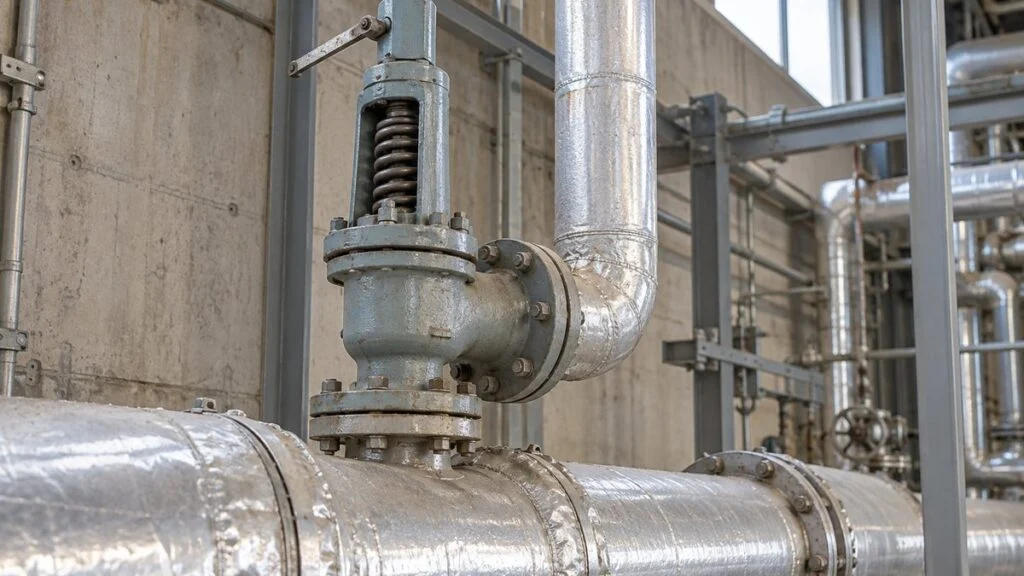
A boiler package from Japan comes with a datasheet that lists its safety valves as 全量式 (zenryo-shiki). A few years later, the Japanese distributor quotes a replacement marked 揚程式 (yotei-shiki) in the same connection size, and it costs noticeably less. (This is a fictional example.) The size matches, the set pressure matches, and the flange bolts up. Can you swap it in?
Not without checking. The two terms describe how far the disc lifts and which part of the valve limits the flow. In a lift-type valve (揚程式, yotei-shiki), the narrow gap between the disc and the seat sets the flow. In a full-bore valve (全量式, zenryo-shiki), the disc lifts high enough that the narrowest part of the inlet nozzle, the throat, sets the flow. According to one Japanese valve maker, a full-bore valve is rated for about 4–5 times the capacity of a lift-type valve of the same nominal size.
This guide explains the English names used by Japanese makers, the definitions in JIS B 8210, why the disc lift matters, how a spring-loaded safety valve opens and closes, and how Japan's boiler rules treat the two types. It ends with a checklist for comparing valves, questions to send to the Japanese supplier, and an FAQ.
Contents
Lift-Type vs. Full-Bore: The Japanese Terms and Their English Names
JIS B 8210, and the Japanese datasheets that follow it, sort spring-loaded safety valves (安全弁, anzen-ben) into two lift classes. Japanese manufacturers that publish English material, such as Yoshitake, translate them as follows:
| Japanese | Romaji | English used by Japanese makers | What limits the flow |
|---|---|---|---|
| 揚程式 | yotei-shiki | Lift type | The gap between disc and seat (curtain area) |
| 全量式 | zenryo-shiki | Full bore type | The nozzle throat |
European and British references use a different set of lift classes. Spirax Sarco, for example, describes low-lift, high-lift, and full-lift valves, and calls a valve "full lift" when the disc rises at least a quarter of the bore diameter so that the curtain area no longer affects the discharge area. A Japanese full-bore valve works on the same principle, but the two systems do not map one to one. When a datasheet uses either set of terms, go by the definition behind it, not just the label.
How JIS B 8210 Defines Them
JIS B 8210 (Safety valves) defines both types. The current edition was revised on February 25, 2025, and replaces the 2017 edition. It is based on ISO 4126-1:2013 and ISO 4126-7:2013 (with their 2016 amendments), modified for Japan. The 2025 edition covers valves with a set pressure of 0.1 MPa (about 14.5 psi) gauge or higher: full-bore valves with a throat diameter of 7 mm or more, and lift-type valves with a seat bore of 15 mm or more. Pilot-operated valves and valves for refrigeration pressure vessels are excluded.
The wording of the definitions in the 2025 edition is not visible in the public preview. The definitions below are from the 2017 edition, as quoted in a Japanese manufacturer's technical guide.
Lift type (揚程式): A safety valve whose lift is at least 1/40 but less than 1/4 of the seat bore diameter, and in which the seat flow area (curtain area) is the smallest flow area when the disc is open.
Full bore type (全量式): A safety valve that lifts far enough for the seat flow area to become sufficiently larger than the throat area.
Figure 1 shows the difference. Lift type is on the left and full bore type is on the right.
In a lift-type valve, the gap between disc and seat is the narrowest flow path. In a full-bore valve, the nozzle throat is.
Simplified diagrams. Adjusting rings and disc shapes differ by manufacturer and model.
In a lift-type valve, the disc rises only a little even after pressure passes the set point, so the gap between seat and disc is the smallest flow area, and that gap sets the flow. A full-bore valve lifts high in one quick motion, so the gap no longer restricts the flow. The throat area of the nozzle below the seat sets it instead.
Why the 1/4 Lift Is the Dividing Line
You can treat the gap (curtain area) as the side of a cylinder standing on the seat bore. A Japanese Ministry of Health, Labour and Welfare (MHLW) notice that interprets the boiler rules uses the same formula for the effective discharge area of a lift-type valve:
Put the JIS limits into this ratio and you get Figure 2. When the lift reaches 1/4 of the seat bore diameter, the curtain area equals the seat bore area.
Curtain area as a percentage of the seat bore area.
Ratio = 4ℓ/D. D/40 and D/4 are the lower and upper lift limits for a lift-type valve (JIS B 8210:2017). D/15 is the lift at or above which Article 64 of Japan's Boiler Structure Standards requires lift-type valves on steam boilers to meet JIS B 8210 (see below).
While the lift is below 1/4 of the bore, the gap is smaller than the seat bore, so the gap controls the flow. That is the lift-type range. Spirax Sarco draws the same line: once the disc lifts at least a quarter of the bore diameter, the curtain area no longer influences the discharge area (full lift).
A full-bore valve lifts until the gap is "sufficiently larger" than the throat area, so the throat, not the gap, sets the flow. That is why the same nominal size can carry such different capacities. The Japanese maker Venn states that, for the same nominal size, the nominal capacity (公称吹出し量, kosho fukidashi-ryo: the discharge capacity the valve is rated for) of a full-bore valve is 4–5 times that of a lift-type valve. Treat that as a rough guide and compare the rated capacities on the actual datasheets. Safety Valve Set Pressure vs. MAWP on Japanese Equipment explains why connection size alone never tells you the capacity.
How a Spring-Loaded Safety Valve Opens and Closes
Both types open the same way. Inlet pressure pushes the disc up, and the spring pushes it down. The upward force is the inlet pressure multiplied by the seat area. When that force exceeds the spring force, the disc lifts and fluid escapes. The tighter the spring is set, the higher the opening pressure (set pressure).
The spring holds the disc against the seat. Above the set pressure, the disc lifts.
Simplified diagram. Some full-bore valves have two adjusting rings, and part names and shapes differ by manufacturer.
Each part helps the valve open, pop fully open, or close:
- Spring and adjusting screw (ばね・調整ねじ): Create the force that holds the disc down. Turning the screw changes the spring compression and sets the set pressure.
- Disc and seat (弁体・弁座): The sealing faces that stop the fluid when the valve is closed. Dirt or scratches here cause leaks.
- Stem (弁棒): Transfers the spring force to the disc and guides it straight up and down.
- Adjusting ring (加減輪, kagen-wa): A ring around the seat used to tune the popping action and the closing pressure (blowdown).
- Test lever and cap (試験レバー・キャップ): The lever lifts the disc by hand to check that it is not stuck. The cap covers the adjusting parts.
Safety valves for steam and gas snap fully open soon after they start to open (pop action). Fluid that leaks past the seat collects in the space formed by the disc's outer lip and the adjusting ring (the huddling chamber), so pressure now acts on a larger area. Once the valve opens, the force of the flow changing direction lifts the disc further. When pressure falls, the spring pushes the disc back onto the seat. Figure 4 shows the four stages and the Japanese names for each pressure.
Four stages as pressure rises, the valve opens, and pressure falls again.
Terms follow the technical guide of Japanese maker Venn. For valves in liquid or gas service, the set pressure is the pressure at which a small flow first appears (start-to-discharge pressure, 吹始め圧力).
How the set pressure relates to the equipment's maximum allowable working pressure (MAWP) is covered in Safety Valve Set Pressure vs. MAWP on Japanese Equipment, so this guide does not repeat it.
When to Use Each Type
The table summarizes the differences. Even at the same nominal size, the two types differ in capacity, and therefore in size and price.
Same nominal size, different capacity, size, and price.
The capacity ratio is from Venn's technical guide. Price differences vary with size, material, and maker. Confirm the final choice with the valve manufacturer, using the fluid, set pressure, and required capacity.
No rule says which type to use. JIS B 8210 itself states that it is a product standard and does not govern how safety valves are applied.
In practice, full-bore valves are used on boilers and other equipment that must release a large volume of steam in a short time. Because they pass more flow for the same size, you can use smaller valves, or fewer of them.
Lift-type valves are common on liquid systems such as pump discharge lines, and many valves called relief valves (逃がし弁, nigashi-ben) are lift type. A liquid relief valve also opens differently: instead of popping open, it opens gradually as pressure rises. Liquids barely compress, so releasing a small amount is enough to bring the pressure down. Lift-type valves can be used on gases too. Gases, however, take up far more volume per unit mass than liquids and take longer to depressurize, so a full-bore valve is the safer default for gas service.
What Japan's Boiler Rules Require
Where a valve may be used is set by the regulations for each type of equipment, not by JIS. For boilers in Japan, the Boiler Structure Standards (ボイラー構造規格, an MHLW notice) set the number of safety valves and how they are installed. If you operate a Japanese-built boiler outside Japan, your local boiler code applies instead. These rules still explain why the original valves were specified the way they were.
Requirements differ by boiler type and by part of the boiler.
Summary of Articles 62–65 of MHLW Notice No. 197 of 2003 (partly amended by MHLW Notice No. 291 of 2025, effective April 1, 2026). Check the full text and the related notices for details.
Article 64 lists lift-type valves with a lift of at least 1/15 of the seat bore alongside full-bore valves, so lift-type valves are not banned from boilers.
An MHLW notice issued on November 7, 2025 (Kihatsu 1107 No. 5) also requires the safety valve capacity on a steam boiler to be at least the boiler's maximum evaporation rate. If the capacity falls short, the valve has to be larger, or more valves are added.
Related: Boilers in Japan: Legal Classes, Operator Licenses, Fuels
Safety valves are not the only overpressure device. For a non-reclosing alternative, and for how a rupture disc is combined with a relief valve, see Rupture Disc vs Relief Valve: Differences and Combined Use.
Related: Safety Valve Sizing in Japan: JIS B 8210 vs API 520
Checklist: Comparing Two Safety Valves
Use this before you accept a replacement or an alternative valve, especially when the datasheet is in Japanese.
- Lift class: 揚程式 (lift type) or 全量式 (full bore type)? Check the model series as well, since some makers use different series for each type.
- Rated capacity: The nominal capacity (公称吹出し量) in kg/h or another unit, and the fluid, set pressure, and pressure condition it was rated at.
- Required capacity: The flow the valve must discharge. For a steam boiler, this is at least the maximum evaporation rate.
- Size data: Throat diameter (のど部の径) for a full-bore valve, seat bore diameter (弁座口の径) for a lift-type valve, and the lift.
- Fluid and condition: Saturated steam, superheated steam, air, gas, or liquid, plus temperature.
- Set pressure, blowdown, and operating pressure: Is normal operating pressure far enough below the set pressure?
- Outlet conditions: Discharge to atmosphere or to a closed system, and the back pressure.
- Standard and regulations: The JIS B 8210 edition the valve complies with, and the boiler or pressure-vessel code that applies at your site.
- Nameplate: Nominal size, set pressure, and capacity match the documents.
- Cap and lever: Lever or no lever, open or enclosed (gas-tight) bonnet, to suit the fluid.
Questions to Ask the Japanese Supplier
When you contact the valve maker or the equipment supplier, these questions get you a clear answer faster:
- Is this valve lift type (揚程式) or full bore type (全量式) as defined in JIS B 8210?
- What is the rated capacity, and under what fluid, set pressure, and pressure condition?
- Does the replacement have at least the same capacity as the original valve under the same conditions?
- Which edition of JIS B 8210 does it comply with, and can you provide the certificate or test record?
- What is the throat or seat bore diameter, and what is the lift?
- What blowdown is the valve set to, and what operating pressure do you recommend relative to the set pressure?
- Is it suitable for our fluid and outlet conditions, including back pressure?
A short inquiry you can adapt:
Subject: Safety valve replacement for [equipment name / serial number]
The original safety valve on this unit is listed as full bore type (全量式), model [model], size [size], set pressure [value] MPa. Your quotation offers a lift type (揚程式) valve in the same size. Please confirm the rated capacity of both valves for [fluid] at this set pressure, and whether the proposed valve meets or exceeds the required capacity of [value] kg/h. Please also tell us which edition of JIS B 8210 the valve complies with.
Limits of This Guide
- The JIS definitions quoted here are from the 2017 edition. The 2025 edition, based on ISO 4126-1 and -7, may word them differently.
- The 4–5 times capacity ratio is a general figure from one Japanese manufacturer. Compare the rated capacities on the actual datasheets.
- The boiler rules summarized here are Japanese regulations. Equipment installed outside Japan must meet the local code, such as the ASME Boiler and Pressure Vessel Code in the US.
- This guide explains what to check and who decides. It is not a sizing method or a procedure for setting, testing, or replacing safety valves. Leave those to the valve manufacturer and qualified personnel under the applicable code.
FAQ
What Is the Difference Between a Safety Valve and a Relief Valve on a Japanese Boiler?
Japan's Boiler Structure Standards decide by boiler type and water temperature. Steam boilers get safety valves, and hot-water boilers at 120°C (248°F) or below get relief valves. A hot-water boiler at 120°C or below can omit the relief valve if it has a relief pipe in an easy-to-inspect position. Hot-water boilers above 120°C need a safety valve.
Related: Small Once-Through Boilers in Japan: Multi-Unit Control
Why Must a Safety Valve Be Installed Vertically?
The spring and disc are designed to move straight up and down. Japan's Boiler Structure Standards require safety valves to be mounted directly on the boiler body with the valve stem vertical. Venn's guide likewise says safety valves are, in principle, for vertical installation only; mounting them on their side or at an angle can cause malfunction.
Why Does a Safety Valve Leak Below Its Set Pressure?
A common cause is damage to the seating faces. When dirt or scale gets caught between the disc and seat and scratches them, the valve leaks even below the set pressure. Operating too close to the set pressure also causes leakage: a Baker Hughes technical article says operating pressure should typically be 95% of set pressure or less to keep the seat tight. If a leak persists, the valve is usually overhauled and its setting checked during a scheduled shutdown.
Related: TBM vs CBM: Time-Based vs Condition-Based Maintenance
Related: Teishu (Plant Turnaround) in Japan: Cycles, Laws, Prep
What Is the Lever on a Safety Valve For?
It lifts the disc by hand to check that the valve can operate and is not stuck. Venn's guide says to use it only when inlet pressure is at least 75% of the set pressure. The allowed pressure and frequency vary by product, so check the instruction manual for your valve.
Is a Full-Lift Valve the Same as a Full-Bore Valve?
They rest on the same idea: the disc lifts far enough that the curtain area no longer limits the flow. But "full lift" comes from European and British lift classes (low, high, and full lift), while "full bore type" is how Japanese makers translate 全量式 under JIS B 8210. Check the definition and rated capacity on the datasheet rather than assuming the labels are interchangeable.
Sources
- Japanese Standards Association: JIS B 8210:2025 Safety valves, preview (revision date, scope, corresponding ISO standards, product-standard statement; Japanese)
- Venn Co., Ltd.: Safety valve technical guide (JIS B 8210:2017 definitions, capacity ratio, terms, lever, mounting direction; Japanese)
- Yoshitake: Safety valve FAQ (English names "lift type" and "full bore type")
- MHLW: Boiler Structure Standards (Notice No. 197 of 2003) (number, position, and JIS compliance of safety valves; Japanese)
- MHLW: Notice on partial amendment of the Boiler Structure Standards (November 7, 2025) (capacity vs. maximum evaporation rate, effective discharge area πDℓ; Japanese)
- Spirax Sarco: Types of safety valve (low, high, and full lift; full lift at 1/4 of the bore diameter)
- Baker Hughes: Operational Basics of Safety Valves (Valve Magazine, May 2024) (force balance, pop action, operating pressure vs. set pressure)
Original article in JapaneseThis guide is adapted from a MONOSCOPE article written for readers in Japan: 安全弁の揚程式と全量式の違い|仕組み・構造と使い分け
About the editor
 MONOSCOPE EditorFOUNDER & EDITOR
Spent about ten years at a plant equipment maker and a plant engineering company, proposing, designing, and commissioning equipment, then moved into web marketing. Now a web consultant for B2B manufacturers, helping them explain their products and technology. Licensed in Japan as an Energy Manager and a Third-Class Chief Electrical Engineer.
Has run an engineering blog since 2017 (500+ articles) and a Japanese YouTube channel with about 20,000 subscribers. Each English guide is written from the Japanese shop-floor point of view and checked against the cited standards.