NFB Breaker vs. MCCB vs. ELB: Japanese Circuit Breaker Terms
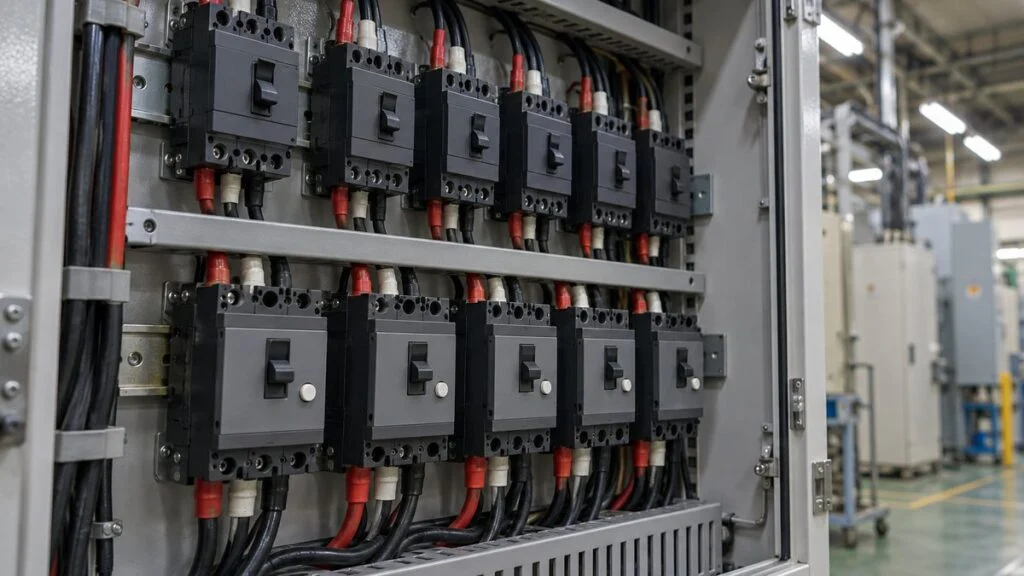
Open the electrical drawings or parts list of a machine built in Japan and you will often find breakers labeled NFB or ELB, with ratings such as "3P 225AF/150AT" or "30mA." Other drawings for similar panels use MCCB and ELCB instead. These are not four different devices. They are two device types, each known by two labels: NFB or MCCB for one, and ELB or ELCB for the other.
An NFB (no-fuse breaker) is a molded case circuit breaker (MCCB). It opens the circuit on overcurrent, meaning an overload or a short circuit, to protect cables and equipment. An ELB (earth leakage breaker), also written ELCB, opens the circuit when it detects current leaking to earth, to protect people from electric shock and to prevent fires caused by leakage. Some ELBs provide overcurrent protection as well.
This guide explains how each one works, how to read the notation on Japanese drawings, why Japanese panels put ELBs where they do, and what to check before you source a replacement outside Japan.
- NFB = MCCB. In Japanese standards it is a haisen-yo shadanki (配線用遮断器, "wiring breaker"). It trips on overload and short-circuit current to protect cables and equipment
- On overload, a bimetal bends with heat and trips the breaker after a delay. On a short circuit, an electromagnet trips it instantly
- ELB = ELCB, a roden shadanki (漏電遮断器, earth leakage breaker). A zero-phase current transformer (ZCT) compares outgoing and returning current to detect leakage. For shock protection, Japanese practice calls for a high-sensitivity, high-speed type (30 mA or less, 0.1 s or less)
- On drawings, "AF" is the ampere frame (frame size) and "AT" is the ampere trip (rated trip current)
- An ELB with overcurrent protection covers both jobs in one device. A leakage-only ELB needs an NFB or fuse upstream
- Before replacing a Japanese breaker, check its function, rated voltage, frequency, breaking capacity at your voltage, and the standard it is listed to (JIS/IEC vs. UL 489)
Contents
- Quick Reference: Japanese Breaker Terms
- What Is an NFB (No-Fuse Breaker)?
- What Is an ELB (Earth Leakage Breaker)?
- NFB vs. ELB: Side-by-Side Comparison
- Reading Breaker Notation on Japanese Drawings
- Why Japanese Panels Use ELBs Where They Do
- Replacing a Japanese Breaker Outside Japan: What to Check
- Limits of This Guide
- Summary
- FAQ
- Sources
Quick Reference: Japanese Breaker Terms
Use this table to match the label on a Japanese drawing or parts list with the device it refers to. The Japanese terms are shown with their romanized reading.
| Label you may see | What it is | Protects against | Japanese standard | Closest international term |
|---|---|---|---|---|
| NFB, ノーヒューズブレーカー (no-fuse breaker) | Molded case circuit breaker. "NFB" started as Mitsubishi Electric's name for it | Overload, short circuit | JIS C 8201-2-1 | MCCB (IEC 60947-2) |
| MCCB, 配線用遮断器 (haisen-yo shadanki) | The same device as an NFB, under its general name (MCCB) and its formal Japanese name | Overload, short circuit | JIS C 8201-2-1 | MCCB (IEC 60947-2) |
| ELB, ELCB, 漏電遮断器 (roden shadanki), 漏電ブレーカー (roden breaker) | Earth leakage circuit breaker. Many models also provide overcurrent protection | Earth leakage (ground fault); overcurrent too on many models | JIS C 8201-2-2 (industrial) | Residual current device (RCD); with overcurrent protection, a circuit-breaker with residual current protection (IEC 60947-2, Annex B) |
| RCCB | Residential leakage breaker without overcurrent protection | Earth leakage only | JIS C 8221 | RCCB (IEC 61008-1) |
| RCBO | Residential leakage breaker with overcurrent protection | Earth leakage, overload, short circuit | JIS C 8222 | RCBO (IEC 61009-1) |
| AF | Ampere frame: the frame size of the breaker body | – | – | Frame size / frame rating |
| AT | Ampere trip: the rated current at which the breaker is set to trip | – | – | Rated current (In), trip rating |
What Is an NFB (No-Fuse Breaker)?
NFB stands for No-Fuse Breaker, originally Mitsubishi Electric's name for its molded case circuit breakers (ノーヒューズ遮断器). The general term is MCCB (molded case circuit breaker), and the Japanese standard calls it a haisen-yo shadanki (wiring breaker). In other words, "NFB vs. MCCB" is not a comparison of two devices: both labels describe the same type of breaker.
An NFB does the same job as the breaker that trips at home when too many appliances run at once: it protects cables and equipment when an abnormal overcurrent flows, for example during a short circuit.
Most NFBs combine two ways of sensing overcurrent: a thermal element based on a bimetal strip and an electromagnetic element.
An NFB trips after a delay on moderate overcurrent and instantly on very large current.
Example of a thermal-magnetic MCCB. The current and time at which a breaker trips depend on each product's trip characteristics.
By trip mechanism, Mitsubishi Electric divides its NFBs into three types.
The types differ in how they sense overcurrent and trip.
Based on the classification on Mitsubishi Electric's no-fuse breaker product page.
Designs vary by manufacturer, but on many breakers the handle stops between ON and OFF after an overcurrent trip. That middle position tells you the breaker tripped rather than being switched off. On these breakers, the handle has to go to OFF (the reset position) before it can be switched ON again. Resetting while the cause is still there will trip the breaker again or damage the cables, so the cause must be found first. Follow the manufacturer's manual and your site's procedures for resetting.
Unlike a breaker, a fuse must be replaced once it blows. The thermal overload relay often used on pump motors also senses heat with a bimetal.
Related: Thermal Trip: Why Thermal Relays Trip and How to Reset
Related: Circuit Protector (CP) vs. Circuit Breaker (NFB) and Fuse
What Is an ELB (Earth Leakage Breaker)?
ELB stands for Earth Leakage Breaker and ELCB for Earth Leakage Circuit Breaker. In Japan, both mean the same thing: a breaker that detects leakage current and opens the circuit automatically.
An NFB (MCCB) protects cables and equipment from overcurrent. An ELB opens the circuit when it detects leakage, to prevent electric shock and fires caused by leakage.
Many ELBs also work as an MCCB, so you usually do not need both on the same circuit. Some models detect leakage only, though; how to tell them apart is covered below.
The ELB compares the current going out to the equipment with the current coming back.
Simplified example. Leakage from the equipment to earth means less current returns through the ELB than went out.
An ELB detects leakage by comparing outgoing and returning current. If the returning current falls short of the outgoing current by more than a set amount, current must be leaking somewhere, and the ELB cuts the power.
The comparison happens in a zero-phase current transformer (ZCT) inside the breaker. The outgoing and returning conductors pass through it together. While the two currents balance, the ZCT produces no output. When they differ, it sends a signal to an electronic circuit, which operates the trip mechanism.
ELB types are defined by two values: the leakage current that trips them (rated sensitivity current) and how fast they trip (operating time). For protecting people from electric shock, Japanese practice calls for a high-sensitivity, high-speed type.
The sensitivity and trip time depend on what the ELB is meant to protect.
Example classes from Panasonic's guide to earth leakage breakers (Japanese). Check each product's catalog for its actual values.
An ELB has a test button on the front. Pressing it checks that the breaker detects leakage and trips correctly; each model's manual says how and how often to test. Many models also have a leakage indicator, such as a button that pops out or a window, that shows the breaker tripped on leakage.
Outside Japan, "ELCB" can be ambiguous. Older voltage-operated earth leakage breakers, now generally obsolete, were also called ELCBs, and IEC terminology uses residual current device (RCD) for the current-operated type described here. If a supplier outside Japan offers an "ELCB," confirm that it is a current-operated RCD and check the standard it is listed to.
NFB vs. ELB: Side-by-Side Comparison
The two look alike from the front, but they respond to different faults and protect against different risks.
Similar housings, different jobs.
Trip indication varies by model. Check the manual for the breaker in front of you.
Reading Breaker Notation on Japanese Drawings
Japanese single-line diagrams, panel layouts, and parts lists usually describe a breaker with a short string of type, poles, and ratings. The legend on the drawing (凡例, hanrei) shows which symbol stands for an MCCB and which for an ELCB, and the same drawing may use NFB/ELB in one place and MCCB/ELCB in another.
Split the label into device type, poles, frame, and trip rating.
The trip rating (AT) is always at or below the frame size (AF). One frame size comes in several trip ratings.
Illustrative labels. Real drawings, such as those published for Japanese public facilities, use strings like "ELCB 3P 225AF 150AT."
Manufacturer model numbers carry the same information. In Mitsubishi Electric's numbering, "NF" marks an MCCB and "NV" an earth leakage breaker. A part number such as NF125-SV 3P 40A is a 125 A frame, 3-pole MCCB with a 40 A rated current; the letters after the frame number (SV, CV, and so on) identify the product series. Some Japanese catalogs also add an element code: Panasonic, for example, marks leakage-only breakers (no overcurrent protection) with codes such as 2P0E and 3P0E.
The fictional parts-list excerpt below shows how these labels come together.
| Ref. | Written on the parts list | How to read it |
|---|---|---|
| MCCB1 | NFB 3P 225AF/150AT | Main breaker. 3-pole MCCB, 225 A frame, 150 A trip |
| ELB1 | ELB 3P 100AF/75AT 30mA | 3-pole earth leakage breaker, 100 A frame, 75 A trip, 30 mA sensitivity. Check the catalog to confirm it has overcurrent protection |
| ELB2 | ELB 3P0E 30mA (upstream NFB2) | Leakage-only ELB with 30 mA sensitivity. Overcurrent protection comes from NFB2 upstream |
To tell whether an ELB also protects against overcurrent, check the protection function in the catalog or spec sheet. Wording such as "overload and short-circuit protection" or "with overcurrent protection" (過電流保護付き) means it does both. "Leakage only" (漏電専用) or "without overcurrent protection" means it detects leakage alone.
Why Japanese Panels Use ELBs Where They Do
Japanese regulations decide which circuits get an ELB, so knowing the logic helps when you read a panel built for Japan. At your own site, the local electrical code applies.
The main rule is Article 36 of Japan's Interpretation of the Technical Standards for Electrical Equipment (電気設備の技術基準の解釈, issued by the Ministry of Economy, Trade and Industry). As a rule, it requires an automatic ground-fault interrupting device, usually an ELB, on circuits feeding low-voltage equipment with a metal enclosure and an operating voltage above 60 V. The main exceptions are equipment installed in dry locations (or, at 150 V or less to earth, in locations that are not wet); double-insulated equipment under Japan's Electrical Appliances and Materials Safety Act, or equipment covered with insulating material; equipment whose Class C or Class D earthing has a resistance of 3 Ω or less; equipment fed through an isolating transformer (300 V or less line-to-line on the equipment side) with the equipment side unearthed; equipment with a built-in leakage breaker certified under that Act, installed so that its power lead is protected from damage; and equipment with simple contact-prevention measures (other than metal guards electrically connected to it). Further exceptions cover places such as power stations and substations, discharge-lamp circuits, and photovoltaic DC circuits; whether an exception applies depends on the text of the article and the installation. A separate paragraph of the same article also requires ground-fault interrupting devices on low-voltage circuits above 300 V that are connected by transformer to high-voltage or extra-high-voltage circuits.
For power tools in factories, Article 333 of Japan's Ordinance on Industrial Safety and Health requires a shock-protection leakage breaker on portable and movable electric equipment with a voltage to earth above 150 V. The requirement also covers such equipment at 150 V or less when it is used in wet locations or on steel plates and frames that conduct electricity easily. When a leakage breaker is hard to connect, the metal parts must be earthed instead, and circuits made unearthed by an insulating transformer, as well as double-insulated tools, are exempt (Article 334).
The sensitivity guideline comes from the Japanese wiring code (内線規程, Naisen Kitei, section 1375-2), a private-sector standard. According to Panasonic's guide, an ELB for shock protection should be a high-sensitivity, high-speed type (30 mA or less, 0.1 s or less).
In practice, Japanese designers fit ELBs on circuits feeding equipment people may touch and equipment in wet or humid locations, and NFBs elsewhere. For critical loads that must not stop because of a leakage trip, a designer may choose an NFB. Japan allows this only in narrow cases: Article 36 lets equipment whose shutdown would endanger public safety, such as emergency lighting and exit signs, use an alarm that reports a ground fault to a location staffed by technical personnel instead of an interrupting device. That exception does not automatically apply to ordinary production equipment, so even for circuits that should not stop, the designer first checks whether one of the general exceptions above applies.
With a leakage-only ELB, the protection is split: the ELB trips on leakage, and an upstream NFB (or fuse) trips on overload or short circuit.
Related: Japanese Machine Control Panels: UL 508A, NFPA 79, and CE
Replacing a Japanese Breaker Outside Japan: What to Check
When a breaker in a Japanese machine fails, an identical part from the original manufacturer avoids most of the questions below. If you need a local substitute, the nameplate and catalog of the original breaker are the starting point. The checklist below lists what to compare. The decision belongs to a qualified electrical engineer responsible for the installation, together with the machine builder and the local authority where required.
- Function: Overcurrent only (NFB/MCCB), leakage only, or leakage with overcurrent protection. Look for "0E" codes or "leakage only" in the catalog
- Poles, frame, and trip rating: Number of poles, AF, and AT. For electronic-trip models, record the actual setting as well
- Rated voltage: Japanese factories commonly use 200 V three-phase, and 400 V-class supplies are also used. Confirm the replacement is rated for your supply voltage (for example, 208, 380, 415, or 480 V), not just the voltage in Japan
- Frequency: Eastern Japan runs at 50 Hz and western Japan at 60 Hz. Check the frequency on the nameplate (50 Hz, 60 Hz, or 50/60 Hz), especially for electronic-trip breakers and ELBs
- Breaking capacity: The rated short-circuit breaking capacity changes with voltage and with the standard. In one Mitsubishi NF-SV series rating table, for example, a model rated 15 kA at 230 V drops to 7.5 kA at 400 V under IEC 60947-2. Compare the value at your voltage with the prospective fault current at the panel
- Standard and listing: Breakers for the Japanese market are typically rated to JIS and IEC 60947-2. In North America, branch-circuit protection in a UL 508A panel calls for a UL 489 breaker (or suitable fuses); a UL 1077 supplementary protector cannot take its place. Some Japanese manufacturers offer separate UL-listed lines for North America, such as Mitsubishi Electric's NF-U (UL 489) and NV-U (with ground-fault protection)
- ELB sensitivity and time: Sensitivity current (for example, 30 mA), operating time, and whether it is a time-delay type coordinated with other ELBs
- US ground-fault terms: A 30 mA Japanese ELB is not a US GFCI. Class A GFCIs for personnel protection (UL 943) trip at about 4–6 mA, so do not assume a 30 mA ELB meets a US GFCI requirement
- Physical fit: Mounting, terminal type and size, handle position, and any accessories on the original, such as auxiliary contacts or a shunt trip
If any item cannot be confirmed from the nameplate, ask the machine builder for the breaker's catalog page and the reason it was selected, especially for ELB sensitivity and breaking capacity.
Limits of This Guide
- This guide explains terms and what to check. It is not a procedure for inspecting, resetting, or replacing breakers. That work should be done by qualified personnel following the manufacturer's manual and your site's lockout/tagout procedures.
- The Japanese rules summarized here (the Interpretation of the Technical Standards for Electrical Equipment, the Ordinance on Industrial Safety and Health, and the Japanese wiring code) apply to installations in Japan. Outside Japan, your local code decides where leakage protection is required, such as the NEC in the US or IEC 60364-based codes in many other countries.
- Trip characteristics, breaking capacities, trip indications, and model codes vary by manufacturer and series. Use the catalog for the exact model, not the examples in this guide.
- The JIS standards named here are based on IEC standards but may include Japanese modifications, and editions change. Treat the mappings as closest equivalents and confirm against the current edition.
Summary
- An NFB is an MCCB: it protects cables and equipment from overcurrent
- An ELB (ELCB) detects leakage and protects people from electric shock
- Many ELBs include MCCB functions
- A leakage-only ELB is paired with an upstream NFB or fuse
- On drawings, AF is the frame size and AT is the trip rating
- In Japan, circuits feeding metal-enclosed equipment above 60 V generally need an ELB under Article 36
- Before substituting, check function, voltage, frequency, breaking capacity, and listing (JIS/IEC vs. UL 489)
FAQ
What does NFB mean on a breaker?
NFB stands for no-fuse breaker, Mitsubishi Electric's original name for a molded case circuit breaker (MCCB). On Japanese drawings, NFB and MCCB refer to the same type of device: a breaker that trips on overload and short circuit.
What is the difference between an NFB and an ELB?
An NFB trips on overcurrent and protects cables and equipment. An ELB trips on earth leakage and protects people from electric shock and installations from leakage fires.
Are NFB and MCCB, or ELB and ELCB, the same thing?
Yes. NFB is Mitsubishi Electric's original name, and MCCB is the general name; ELB and ELCB are both abbreviations for an earth leakage breaker. In Japan's standards for residential leakage breakers, the type with overcurrent protection is called an RCBO and the type without it an RCCB.
If a circuit has an ELB, does it still need an NFB?
Not if the ELB has overcurrent protection, because one device then covers both overcurrent and leakage. A leakage-only ELB needs an NFB or fuse upstream. Check the protection function in the catalog: "with overcurrent protection" means both, while "leakage only" or "without overcurrent protection" means leakage alone.
How can I tell whether a breaker tripped on leakage or overcurrent?
Look at the leakage indicator first. A popped-out button means the ELB tripped on leakage, but the location of the indicator and how to reset it vary by model, so check the manual. Do not switch the breaker back on until the cause is removed, and before any inspection, isolate the power and lock it out following your site's lockout/tagout (LOTO) procedure.
Related: Lockout/Tagout in Japan: Japanese Law vs. OSHA 1910.147
Can I replace a Japanese NFB with a UL 489 breaker?
Often you can, but only after a qualified engineer confirms the match. Compare poles, frame and trip rating, rated voltage, frequency, and breaking capacity at your voltage, and confirm the change with the machine builder. In a UL 508A panel, branch-circuit protection must be a UL 489 breaker or suitable fuses, not a UL 1077 supplementary protector.
Sources
- Ground-fault interrupting devices (Article 36): Ministry of Economy, Trade and Industry, Interpretation of the Technical Standards for Electrical Equipment, revised November 20, 2025 (Japanese)
- Leakage protection for portable equipment (Articles 333 and 334): e-Gov, Ordinance on Industrial Safety and Health (Japanese)
- NFB name and trip types: Mitsubishi Electric, no-fuse breaker product features (Japanese)
- Leakage detection with a ZCT: Mitsubishi Electric, earth leakage circuit breaker product features (Japanese)
- NV series earth leakage circuit breakers: Mitsubishi Electric Factory Automation, ELCB NV; UL-listed NF-U and NV-U: Mitsubishi Electric Factory Automation, UL 489 listed breakers
- Sensitivity and operating time classes, wiring code 1375-2, and 0E codes: Panasonic, breaker basics: earth leakage breakers (Japanese)
- Handle position after a trip: Panasonic, breaker basics: basic functions (Japanese)
- JIS standards for low-voltage breakers: JIS C 8201-2-1:2021, JIS C 8201-2-2:2021, JIS C 8221:2020, JIS C 8222:2021 (Japanese Standards Association previews, Japanese); JEMA, standards for low-voltage circuit breakers (Japanese)
- Breaking capacity by voltage (NF63-SV): MISUMI, Mitsubishi Electric MCCB NF-SV series
- UL 489 vs. UL 1077: Fuji Electric Corp. of America, Understanding UL 489 vs. UL 1077; UL 508A branch protection: DigiKey TechForum, Circuit Breaker Branch Protection vs Supplementary Protector in a UL 508A Listed Control Panel
- GFCI Class A trip level: UL, Understanding Ground Fault and Leakage Current Protection
- Japan's 50 Hz / 60 Hz split: ETHW, Milestones: Sakuma Frequency Converter Station, 1965
Original article in JapaneseThis guide is adapted from a MONOSCOPE article written for readers in Japan: NFB(ノーヒューズブレーカー)とは?ELB(漏電遮断器)との違いと使い分け・設置が必要な場所
About the editor
 MONOSCOPE EditorFOUNDER & EDITOR
Spent about ten years at a plant equipment maker and a plant engineering company, proposing, designing, and commissioning equipment, then moved into web marketing. Now a web consultant for B2B manufacturers, helping them explain their products and technology. Licensed in Japan as an Energy Manager and a Third-Class Chief Electrical Engineer.
Has run an engineering blog since 2017 (500+ articles) and a Japanese YouTube channel with about 20,000 subscribers. Each English guide is written from the Japanese shop-floor point of view and checked against the cited standards.