Japanese Mechanical Components: Makers, Distributors, MISUMI
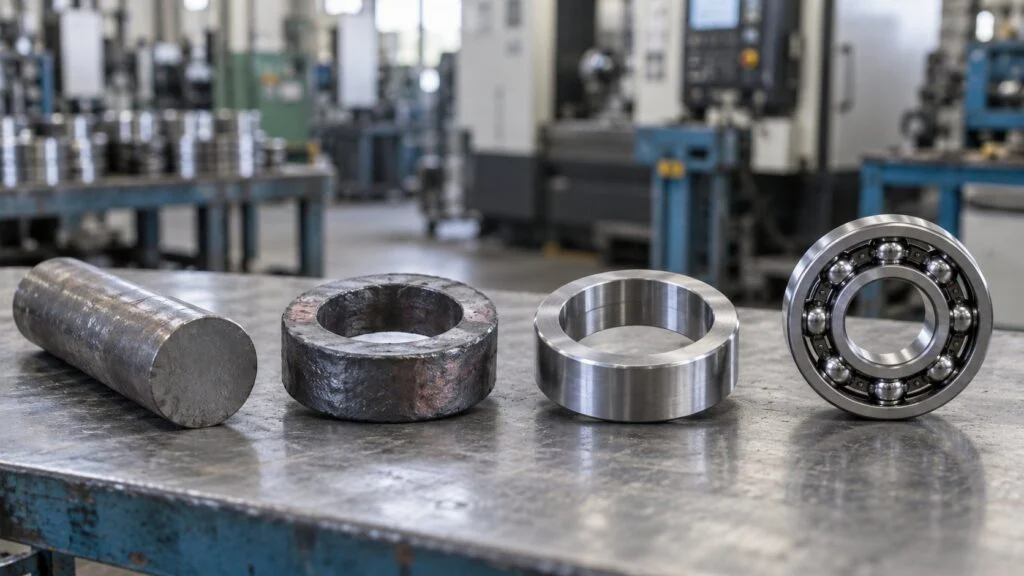
A bearing fails on a machine that a Japanese company built for your plant in Thailand, Ohio, or Pune. The spare parts list gives an NSK bearing number, an SMC cylinder, a THK linear guide, and a dozen MISUMI part numbers for shafts and brackets. Local prices look high, an online marketplace offers the same bearing for half the price, and someone suggests ordering from MonotaRO in Japan. Which route is safe, and which one will still support you if the part fails early?
The answer depends on how Japan's mechanical components industry is organized. Mechanical components, called kikai yoso buhin (機械要素部品, machine elements) in Japan, are the parts that almost every machine shares: bearings, screws and bolts, springs, gears, seals, linear guides, ball screws, and pneumatic cylinders and valves. This guide explains who makes them, how they reach the user, why distributors and catalog e-commerce companies matter so much, and where a buyer outside Japan should go for each type of purchase. It ends with a buying checklist and a sample inquiry email.
Contents
The Supply Chain at a Glance
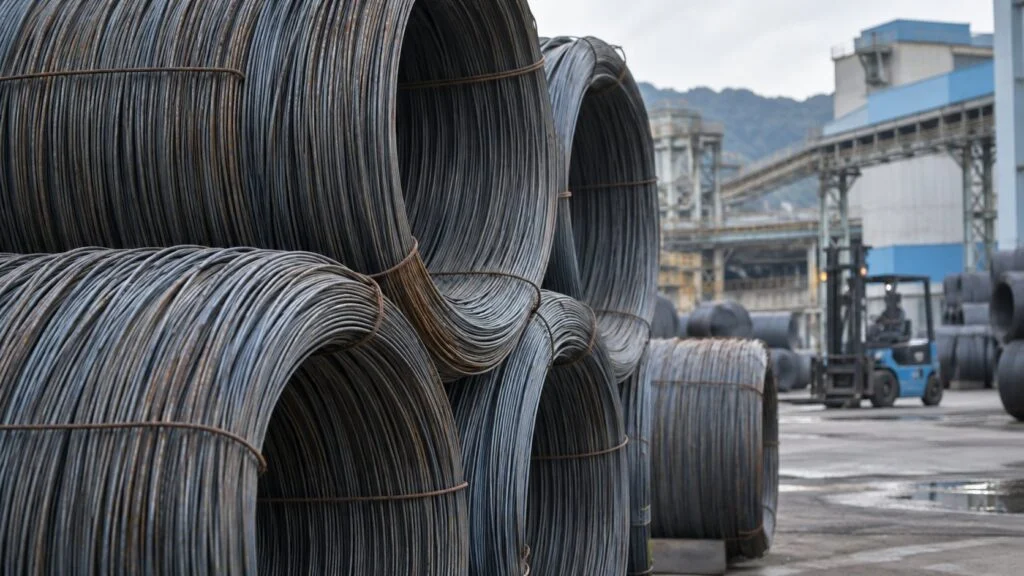
Mechanical components start as steel, rubber, or resin, go through machining, heat treatment, and assembly, and end up inside a customer's machine. Demand does not stop there. Once the machine is running, worn parts have to be replaced for as long as it operates.
That gives the industry two flows: parts for new machines (the OEM flow) and replacement parts for machines already in use (the maintenance, repair, and operations, or MRO, flow). As a maintenance or purchasing engineer outside Japan, you are almost always in the second flow, even though the parts on your machine were chosen in the first.
Many companies connect raw material to the running factory and its spare parts.
Note: The levels overlap. Some component makers also build units.
Component makers look like the center of the chain, but their customers, the machine makers, set the workload for the whole industry. The replacement flow works differently. Its main buyers are plant maintenance departments and machine service companies, and it continues even when new machine production slows, because running machines still wear out parts.
Who Makes and Sells What
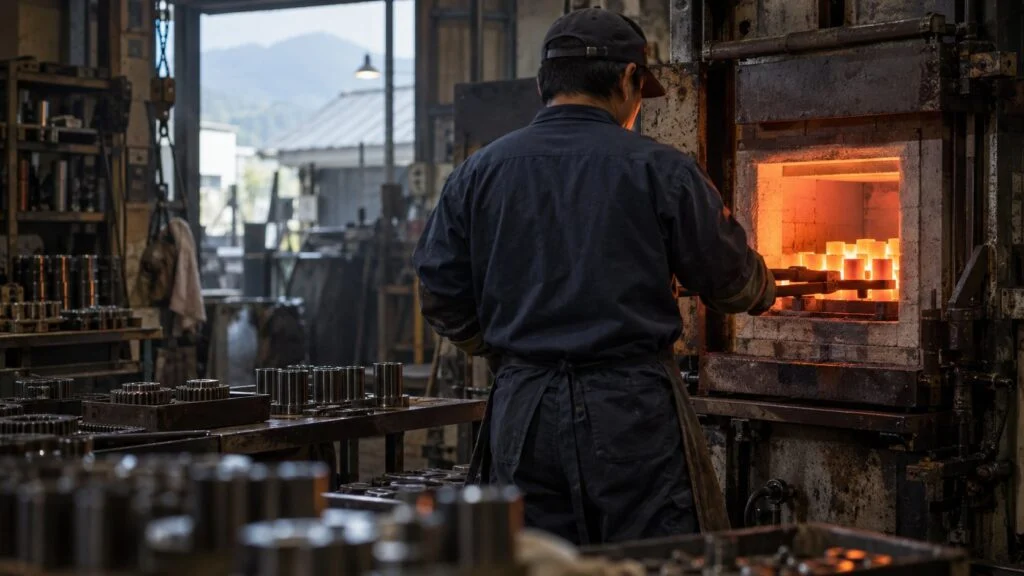
Company size, customers, and the kind of work differ a lot by level. Before looking at each one, here is the basic split between large component makers and the small and mid-sized companies that supply them.
In the same industry, company size changes who you deal with and how.
Note: A rough guide only. Every company is different.
Material Makers
Steelmakers and specialty steel makers supply bearing steel, spring steel, and wire rod for screws. Because material quality has a large effect on part life, material makers sometimes develop new grades together with component makers. Mechanical components are only one of many customer industries for these steelmakers, but bearing steel, which has to be very clean (low in non-metallic inclusions), is a technically demanding product. For how steel price moves pass down this chain, see Japan Steel Price Increase 2026.
Machining and Heat-Treatment Subcontractors
These companies specialize in cutting, grinding, heat treatment, or plating. Most are small, local businesses that receive drawings and material from a component maker and handle a fixed set of processes. A shop that is strong in one process can win work from several component makers, but the ordering side often has the stronger hand on price and delivery terms. Shops with processes that need special equipment and experience, such as surface treatment or specialized heat treatment, are hard to replace and can deal on more equal terms. You will rarely buy from them directly, but they are one reason a Japanese supplier's lead time can depend on outside processes. For the terms involved, see Heat Treatment Terms on Japanese Drawings.
Component Makers
These companies mass-produce bearings, springs, seals, and similar parts. The large ones have plants and sales networks around the world, typically developing products in Japan and producing and selling them globally. Many keep heat treatment and precision grinding, the processes that decide part life and accuracy, in-house as a core strength. For you, that means the big bearing brands usually have a sales subsidiary in your region and a network of authorized distributors under it. Their product numbers follow each maker's own system; for bearings, see NSK, NTN, Koyo Bearing Numbers.
Unit and Equipment Makers
These companies combine parts into equipment such as speed reducers, linear motion units, and pneumatic devices. Examples include SMC and CKD in pneumatics and Nabtesco in precision speed reducers. Because their products sit closer to the customer's machine design, technical proposals matter more than for single parts. They also offer a huge number of model numbers, so selection tools and support are part of what they sell. Model numbers often encode options such as bore, stroke, and port thread, which matters when you look for a local equivalent. For one example, see Pneumatic Speed Controllers: Meter-Out vs. Meter-In.
Distributors and Catalog E-Commerce
Distributors (in Japan, trading companies called shosha, 商社) buy from makers, hold stock, and deliver to customers in their region, often with technical advice. Alongside them, catalog companies such as MISUMI deliver small quantities of parts quickly through printed catalogs and websites.
Catalog e-commerce is a large business in this industry. In the fiscal year ended March 2026, MISUMI Group reported sales of JPY 441.4 billion. Its VONA business, which sells other makers' products as well as MISUMI's own, accounted for JPY 192.5 billion, up 7.1% from the previous year. In other words, some distributors are now as large as the makers whose parts they sell.
How Orders and Money Flow
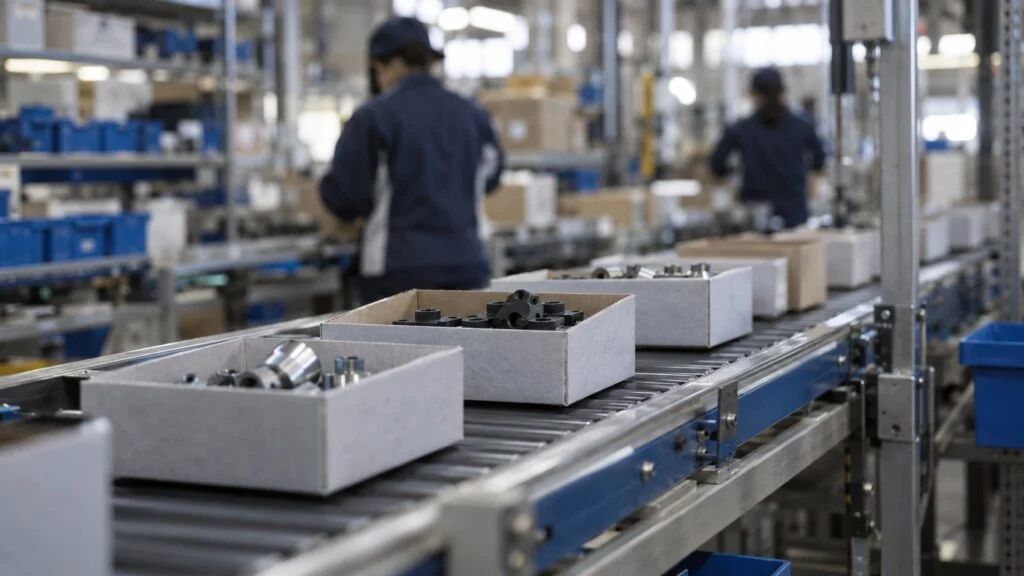
A component deal does not end at delivery. After the customer selects, orders, and receives the part, the relationship continues through replacements and reorders. Japanese buyers call this commercial flow shoryu (商流). The typical sequence looks like this.
Three stages: before design-in, volume supply, and after use.
Note: Standard parts tend to go through distributors or catalog companies; custom parts and large volumes tend to go direct.
For a formal request to a Japanese supplier (step 01–02), see RFQ to a Japanese Manufacturer.
Direct Accounts vs. Distributors
Component makers usually deal directly with large customers such as carmakers and major machine builders. Smaller customers spread across the country are served through distributors and catalog companies.
Statistics from the Japan Bearing Industry Association (JBIA) show the balance for bearings. In 2025, Japanese bearing makers received orders worth JPY 760.1 billion. Of that, JPY 528.9 billion came from domestic demand and JPY 231.1 billion from overseas demand. Orders placed through distributors (listed as agents) were JPY 30.3 billion. The distributor share in these order figures is small, but distributors support the many smaller customers with stock and technical advice.
Design-In and Long Relationships
Once a part is on a customer's drawing, the same model number stays in use for as long as that machine is built. So the basic pattern is a long proposal and evaluation period before design-in, then a long relationship after it. Some component makers have close ties to particular carmakers, but because most mechanical components are standard products sold to many customers, these ties are weaker than in auto parts. For how the automotive version works, see Japanese Automotive Supply Chain Tiers and Keiretsu.
For you, design-in has a practical consequence: the brand on a Japanese-built machine was usually chosen by the machine designer in Japan years ago. Switching to another brand is possible for many standard parts, but the person who approves the change is often on the Japanese side.
How Prices Are Set
Prices for high-volume parts are negotiated with each customer. Large customers ask for price cuts almost every year, and when steel and other material costs rise, a maker's profit depends on whether it can pass those costs on. For how Japanese suppliers handle that conversation, see Price Increase Requests in Japan.
Catalog parts sell from a list price, with terms that depend on volume. Short lead times and small-lot service are part of what the customer pays for. A distributor earns the difference between its purchase price and its selling price, so stock on the shelf and technical advice are how it avoids competing on price alone.
Margins also differ by flow. Replacement parts are needed for as long as machines run, and customers value fast delivery. Schaeffler, the German bearing and automotive supplier, reported a 2025 EBIT margin (before special items) of 14.8% in Vehicle Lifetime Solutions, its automotive aftermarket division, above the 10.5% in its Powertrain & Chassis division, which supplies new vehicles. In general, high-volume OEM supply is where price pressure is strongest, while standard catalog products and the aftermarket tend to hold margins better.
Where to Buy Japanese Mechanical Components Outside Japan
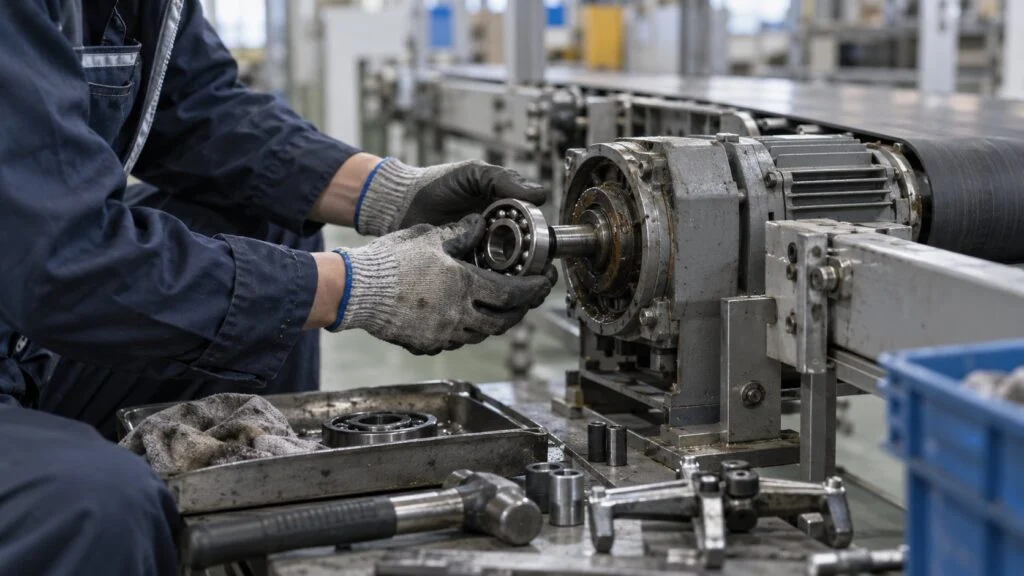
Outside Japan, the same chain exists, but the doors you knock on are different. Most large Japanese component and equipment makers sell through a local subsidiary and its authorized distributors. Catalog companies run regional websites. Some Japanese distributors have overseas branches that mainly serve the plants of their Japanese customers. Use the table below as a starting point.
| What you need | Where to start | Watch out for |
|---|---|---|
| A bearing from a Japanese brand (NSK, NTN, JTEKT/Koyo, and others) | The maker's local subsidiary or an authorized distributor on its list | Counterfeits sold online; suffix codes that change clearance, seals, or grease |
| Pneumatic cylinders, valves, or fittings (for example SMC or CKD) | The maker's local subsidiary or its distributor | Japan-only models; port threads (Rc vs. NPT) and voltage of solenoid coils |
| Linear guides, ball screws, or speed reducers | The maker's local subsidiary or authorized distributor | Preload and accuracy grades in the suffix; mixing rails and blocks from different sources |
| MISUMI part numbers from a Japanese drawing or parts list | MISUMI's regional website for your country (for example the US, India, Thailand, or Vietnam site) | Whether the part number and options are sold in your region, and local lead time |
| A part from MonotaRO's Japanese catalog | A local source for the same maker part number; in India, Indonesia, and Korea, check the group's local stores | The Japanese site serves customers in Japan; local stores have their own catalogs |
| Machined parts or custom components made to the builder's drawing | The machine builder that designed the machine | Drawings may belong to the builder; check the contract and revision |
| Many brands in one order for a Japanese-owned plant | The distributor your Japanese parent already uses, if it has a local branch | Prices include its service margin; confirm warranty handling |
The same logic applies to PLCs, servos, and sensors on the same machine. For those, see Japanese Factory Automation: Makers, Distributors, SIers.
Bearings: Authorized Channels and Counterfeits
Counterfeit bearings are a known problem, and they are hard to spot by eye. NSK tells customers to buy only from authorized channels, says an authorized NSK distributor will never supply fake NSK products, and notes that technical and engineering support is available only through authorized distributors. If you doubt a bearing, NSK asks you to contact its local staff for verification. The World Bearing Association (WBA), together with major makers including JTEKT (Koyo), NACHI, NTN, and NSK, runs the "Stop Fake Bearings" campaign and offers an app that checks the code on the packaging. Some makers also offer their own verification apps.
A low price from an unknown seller is not proof of a fake, but it is a reason to ask where the stock came from and to check the seller against the maker's distributor list for your country.
MISUMI Part Numbers on Japanese Drawings
Japanese machine builders often specify MISUMI parts directly on drawings and parts lists. A MISUMI part number usually describes a configurable part: the base type plus dimensions and options chosen by the designer, such as length, diameter, or surface treatment. MISUMI runs regional e-commerce sites (for example, MISUMI USA states that it offers more than 20 million products), but the range and lead time differ by region. Enter the full part number on your regional site, and if it is not available, ask MISUMI's local office for the closest configurable equivalent before you redesign anything.
Also note the split inside MISUMI's business. MISUMI-brand parts (its FA and die components businesses) are its own products, while its VONA business resells other makers' products. When a MISUMI site lists another maker's bearing or cylinder, the warranty and technical support for that item may run through the original maker.
MonotaRO and Other Japanese Online Stores
MonotaRO is a large Japanese online store for MRO supplies, aimed at small and mid-sized factories in Japan. Its main site is in Japanese and built for delivery within Japan. Outside Japan, the MonotaRO group runs separate online MRO stores: NAVIMRO in South Korea, monotaro.id in Indonesia, and IndustryBuying in India (through IB MONOTARO). These stores have their own local catalogs, so do not expect the same item list or prices as the Japanese site.
If a part number on your machine comes from a Japanese online store, treat it as a reference. Find the maker and maker part number behind it, then buy that part through a channel in your country that the maker supports.
How the Industry Is Changing
In the past few years, Japanese component makers have been reshaping their businesses in three ways. Each one can change the brand name, contact, or product line you deal with.
Consolidation Within the Same Field
Tsubakimoto Chain and Daido Kogyo, a large maker of motorcycle chains, signed integration and share exchange agreements in May 2025, and Daido Kogyo became a wholly owned subsidiary of Tsubakimoto Chain on January 1, 2026. In October 2025, MinebeaMitsumi completed its acquisition of Tsubaki Nakashima's ball screw business, which now operates as Minebea Linear Motion. As the domestic market matures and competition from overseas makers grows, companies in the same field are combining to gain scale.
Focusing on Core Businesses
In February 2026, THK agreed to transfer its transportation equipment (automotive parts) business to a company funded by investment funds serviced by Advantage Partners, and the transfer was completed on June 1, 2026. THK cited capital efficiency and will focus on its industrial equipment business. When a business changes owner, part numbers and sales contacts can change too, so check who supports a product line after a deal.
Digital Ordering
More and more parts are selected and ordered online, as the growth of MISUMI's VONA business shows. Distributors' role is widening from stock and delivery to proposals based on data. When customers choose model numbers on the web themselves, makers have to provide CAD data and selection tools. The ability to make parts easy to choose is becoming a point of competition alongside the parts themselves. For you, it is worth checking the maker's English or regional site for CAD files and configurators before asking for drawings.
Checklist: Before You Order a Replacement Part
Use these questions when you buy Japanese mechanical components for a machine outside Japan. Ask the maker's local office, the distributor, or the Japanese machine builder, depending on the item.
- Do we have the full model number from the nameplate or parts list, including every suffix code?
- Is this exact model sold and supported in our country, or is it a Japan-only model? If so, what is the local equivalent?
- Is the seller on the maker's authorized distributor list for our location?
- For bearings: can the seller confirm the source of the stock, and can we verify the packaging code?
- For pneumatic parts: do port threads, coil voltage, and certifications match our site?
- For MISUMI parts: is the full configured part number available on our regional site, and at what lead time?
- For parts made to the machine builder's drawing: who owns the drawing, and is our copy the latest revision?
- Does the Japanese parent or the machine builder need to approve a change of brand or model?
- Is the model current, or has the maker announced a discontinuation or a change of owner?
- Who handles warranty claims locally: the maker, the distributor, or the machine builder?
Sample Inquiry Email to a Maker's Local Office
The example below is fictional. Replace the bracketed items.
Subject: Replacement part for [model number], [plant name], [country]
Hello,
Our plant in [city, country] operates a machine built in Japan by [machine builder]. The machine's parts list specifies the following item from your company:
Model: [full model number, including suffix codes]
Quantity installed: [number]
Position on the machine: [for example, main spindle drive, conveyor axis 2]Could you tell us:
1. whether this exact model is sold and supported in [country], or what the local equivalent is;
2. which authorized distributor we should order from;
3. the current lead time, and whether the model is scheduled for discontinuation;
4. how we can confirm that parts we receive are genuine.We can send nameplate photos and the relevant page of the parts list if needed.
Best regards,
[Name, title, company, phone]
Limits of This Guide
- This describes typical patterns in Japan. Routes vary by company and product, and large users often buy direct from makers.
- Sales channels, catalogs, and warranty terms outside Japan differ by maker and country. Check the maker's local website for its current authorized distributors.
- Store names and coverage for MISUMI and MonotaRO were checked in October 2026 and can change.
- This guide does not rank makers or compare market shares or profitability.
FAQ
Can I buy Japanese bearings directly from the maker?
Usually not for small quantities. Large Japanese bearing makers deal directly with big OEM accounts and serve other customers through their local subsidiaries and authorized distributors. Start with the distributor list on the maker's website for your country.
Does MonotaRO ship outside Japan?
MonotaRO's main site is a Japanese-language store built for customers in Japan. In South Korea, Indonesia, and India, the group runs separate local stores (NAVIMRO, monotaro.id, and IndustryBuying) with their own catalogs. Elsewhere, buy the same maker part number through a local channel.
Can I order MISUMI parts from outside Japan?
Yes, through MISUMI's regional websites and local offices in many countries. Check that the full configured part number is available on your regional site, because ranges and lead times differ from Japan.
How can I tell if a Japanese-brand bearing is genuine?
Buy from an authorized distributor, and if in doubt, contact the maker's local office. The World Bearing Association's app and some makers' own apps can check the code on the packaging, but they do not replace buying through authorized channels.
Sources
- Bearing orders by demand sector, 2025: Japan Bearing Industry Association, bearing orders statistics (Japanese)
- MISUMI Group sales and VONA business: MISUMI Group, consolidated financial results for the fiscal year ended March 2026 (Japanese)
- MISUMI USA product range: MISUMI USA website
- MonotaRO group companies: MonotaRO, Company Profile
- Buying genuine bearings: NSK Americas, Brand Protection and World Bearing Association, Stop Fake Bearings
- Schaeffler division margins: Schaeffler AG, "Schaeffler reports solid results for 2025"
- Tsubakimoto Chain and Daido Kogyo: Tsubakimoto Chain, press release, January 1, 2026
- MinebeaMitsumi and Minebea Linear Motion: MinebeaMitsumi, news releases 2025
- THK transportation equipment business: THK, notice of February 2, 2026 and THK, investor information FY2026 2Q
Original article in JapaneseThis guide is adapted from a MONOSCOPE article written for readers in Japan: 機械要素部品業界の構造をわかりやすく解説|サプライチェーン・商流・利益構造
About the editor
 MONOSCOPE EditorFOUNDER & EDITOR
Spent about ten years at a plant equipment maker and a plant engineering company, proposing, designing, and commissioning equipment, then moved into web marketing. Now a web consultant for B2B manufacturers, helping them explain their products and technology. Licensed in Japan as an Energy Manager and a Third-Class Chief Electrical Engineer.
Has run an engineering blog since 2017 (500+ articles) and a Japanese YouTube channel with about 20,000 subscribers. Each English guide is written from the Japanese shop-floor point of view and checked against the cited standards.